

Learn how we are working to transform how we use and produce energy.
Why we share this work for free
RMI is an independent nonprofit working to accelerate the clean energy transition. We publish research like this to inform decision-makers and drive real-world impact.
Our work is supported by philanthropy as well as partnerships, including fee-for-service engagements. This support makes it possible for us to share our independent insights for free.
If you find this work valuable, you can support it anytime.
Get more insights like this
Stay up to date with the latest research, analysis, and tools from RMI by opting in to receive occasional emails below. You’ll get new reports, event invitations, and practical insights to help us all accelerate the clean energy transition.
Loading form...
Your download should start automatically. If it doesn’t, click the download button below.
This work is made possible by philanthropy
RMI is a nonprofit supported by donors and partners. Philanthropy enables us to produce independent research and make resources like this freely available.
If you find this report valuable, please consider supporting our work. You can also explore how we partner with organizations to drive impact.
Jump to Section
Amid the combined challenges of load growth and a changing generation mix, the US transmission grid is in urgent need of expansion and upgrading.
However, while spending by US utilities on transmission has quadrupled over the past two decades, spending has moved in the opposite direction of what we need — from high-voltage regional lines to lower-voltage local projects. This is an inefficient way to expand the grid. In addition, the lack of robust review of local projects means they may be costlier and have greater land use and environmental impacts than larger, well-planned regional projects.
In this report, we show how a regulatory gap is enabling billions of dollars in local transmission spending annually to escape scrutiny by federal and state regulators. This gap is a crucial contributor to the recent shift in spending by utilities to lower-voltage local projects. The exhibits below illustrate some of the causes of the regulatory gap and how the lack of a robust review process for local projects compares to the robust process for regional projects.
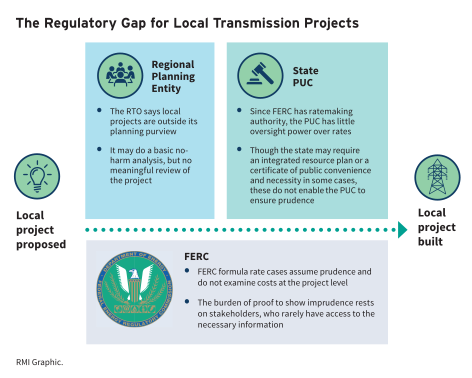
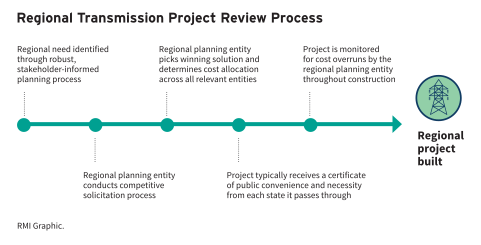
Correcting the regulatory gap will be critical to ensure that ratepayer money is well-spent on efficient high-voltage grid expansion projects to meet the future needs of the US grid. The regulatory gap as it exists today runs the risk of causing upgrades to the US grid to be made in a more costly and inefficient manner. Absent state and federal action, we miss a key opportunity to proactively design the grid of the future rather than simply rebuild the grid of the past.
Relying heavily on local projects rather than coordinating their development with regional planning needs is an inefficient way to meet overall grid needs.
The report lays out 11 recommended reforms at the state, regional, and federal levels to help to close the regulatory gap. Because the reforms are synergistic, parallel reforms at all three levels will be most effective.



Related Insights

For Clean Energy Projects, How Community Benefits Are Delivered Matters
Tracking WestTEC: Where 100+ Transmission Projects Stand and What Comes Next

Help build the clean energy future. Donate today.
Independent research. Real-world solutions. Supported by donors.
RMI can pursue the highest-impact climate and energy solutions because we’re supported by people who believe change is possible. Every gift helps advance the work needed to make clean energy the default choice worldwide.
For other ways to give to RMI, including checks or gifts of stock, please visit Other Ways to Give.
