

Learn how we are working to transform how we use and produce energy.
Fighting for a Just Transition for Coal Communities
Jeremy Richardson’s heart lies with the coal communities where he was raised. As a manager at RMI, he’s working hard to ensure they benefit from the energy transition.
Why we share this work for free
RMI is an independent nonprofit working to accelerate the clean energy transition. We publish research like this to inform decision-makers and drive real-world impact.
Our work is supported by philanthropy as well as partnerships, including fee-for-service engagements. This support makes it possible for us to share our independent insights for free.
If you find this work valuable, you can support it anytime.
Get more insights like this
Stay up to date with the latest research, analysis, and tools from RMI by opting in to receive occasional emails below. You’ll get new reports, event invitations, and practical insights to help us all accelerate the clean energy transition.
Loading form...
Your download should start automatically. If it doesn’t, click the download button below.
This work is made possible by philanthropy
RMI is a nonprofit supported by donors and partners. Philanthropy enables us to produce independent research and make resources like this freely available.
If you find this report valuable, please consider supporting our work. You can also explore how we partner with organizations to drive impact.
Jump to Section
RMI Manager Jeremy Richardson is passionate about ensuring a just transition for coal communities. Richardson grew up in West Virginia in a third-generation coal mining family. His grandfather died of black lung disease, caused by inhaling coal dust. His father is a retired mine maintenance foreman. And his brother still works in the mines today. “Coal communities have always been the lens through which I’ve seen the climate crisis,” he says.
Richardson has since moved to sunny San Diego, where solar dominates the energy landscape. But his heart still lies with the coal communities that dot Appalachia and elsewhere. He joined RMI in January of 2022, after almost a decade at the Union of Concerned Scientists. “I started out 10 years ago with a passion for ensuring that coal communities benefit from the energy transition,” he says. He came to RMI to not only lead that work, but also to think more broadly of what a just and equitable transition means.
“When coal mines and plants close, workers and communities feel the hit right away,” he says. “Not only with job loss, which is huge, but also with the loss of local tax revenue. Especially in more isolated rural areas, taxes from the local coal plant might account for upward of 50 percent of a county’s or school district’s budget.”
Shuttered coal plants and mines leave behind degraded lands or brownfields that can continue to pollute waterways and drinking water. Without proper and comprehensive cleanup, these sites can’t be put to better use. And communities must grapple with how to create new forms of economic activity and diversify the local economy. Fortunately, there are policy interventions that can ensure that the energy transition uplifts — rather than abandons — coal workers and communities, which Richardson and his co-authors describe in RMI’s Ensuring an Inclusive Energy Transition report, published in May 2022.
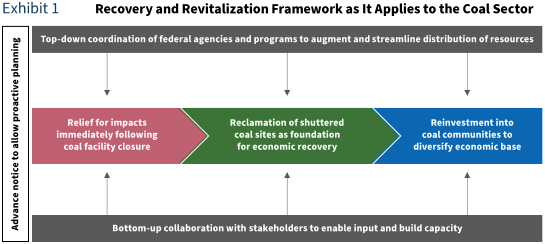
The report lays out RMI’s recovery and revitalization framework, based on interviews with stakeholders, which consists of three steps:
- Relief for coal workers and communities to alleviate losses of local revenue and jobs that occur immediately following coal closure
- Reclamation of remaining coal sites to prevent prolonged pollution risks and promote short- and medium-term job creation and local economic activity
- Reinvestment in coal communities to promote long-term economic resilience and diversification
Looking to the transition challenge ahead, Richardson is excited about the Energy Infrastructure Reinvestment program (EIR), a little-known provision in the Inflation Reduction Act (IRA). The EIR is a new loan program that can drive economic development in energy communities by investing in valuable infrastructure.
With other RMI colleagues, Richardson recently wrote about how the EIR offers a powerful way to invest in energy communities directly. It will support the low-carbon transition of any type of energy infrastructure, including electricity generation and transmission, as well as production, processing, and delivery of fossil fuels.
The EIR is one important piece of some of the incredible opportunities we have at hand with new federal funding to invest in coal communities. “Right now, with the Inflation Reduction Act, the Infrastructure Investment and Jobs Act, the CHIPS Act, and the American Rescue Plan, we have a once-in-a-generation opportunity to drive real success stories,” Richardson explains. “There are resources and policy mechanisms in these laws that taken together can really advance the transition in a way that ensures energy communities thrive.”
Richardson feels that we are at a pivotal moment. “This is the first time I’ve felt that transformative change is a real possibility. But it will require a lot of work from a lot of people to get there,” he says. “And RMI is well positioned to play a strong role in really driving the transformation we want to see.”
Authors

Laurie Stone
Managing EditorRelated Insights



Help build the clean energy future. Donate today.
Independent research. Real-world solutions. Supported by donors.
RMI can pursue the highest-impact climate and energy solutions because we’re supported by people who believe change is possible. Every gift helps advance the work needed to make clean energy the default choice worldwide.
For other ways to give to RMI, including checks or gifts of stock, please visit Other Ways to Give.
