

Learn how we are working to transform how we use and produce energy.
Digging for Carbon Cuts: How the Mining Industry Can Win with Renewables
Why we share this work for free
RMI is an independent nonprofit working to accelerate the clean energy transition. We publish research like this to inform decision-makers and drive real-world impact.
Our work is supported by philanthropy as well as partnerships, including fee-for-service engagements. This support makes it possible for us to share our independent insights for free.
If you find this work valuable, you can support it anytime.
Get more insights like this
Stay up to date with the latest research, analysis, and tools from RMI by opting in to receive occasional emails below. You’ll get new reports, event invitations, and practical insights to help us all accelerate the clean energy transition.
Loading form...
Your download should start automatically. If it doesn’t, click the download button below.
This work is made possible by philanthropy
RMI is a nonprofit supported by donors and partners. Philanthropy enables us to produce independent research and make resources like this freely available.
If you find this report valuable, please consider supporting our work. You can also explore how we partner with organizations to drive impact.
Jump to Section
An unprecedented drop in renewable energy prices, the high energy intensity of mining, and the volatility of fossil fuel pricing have combined to create a groundbreaking opportunity for decarbonizing the mining industry—no pun intended! Seriously, the sustainability opportunity in front of mining companies across the world is no joking matter, and with potential to cut a gigaton of carbon, it’s time to take a hard look toward sustainable mining.
To continue economic and demographic growth as a modern society, extraction of the commodities we depend on is essential. However, while the extractive industry has radically progressed in productivity and energy efficiency, it still remains an exceedingly energy- and carbon-intensive operation. The amount of renewables in the mining sector’s electricity mix is only 2.5 percent of the renewable energy used globally. Yet renewable resources have the potential to provide a large portion of the electricity consumed by the mining sector at or below the cost of traditional diesel generators or grid power. Therefore, it is crucial to accept the existing realities of the mining industry to adopt a practical path to decarbonization.
By analyzing the mining industry, Sunshine for Mines, a Rocky Mountain Institute-Carbon War Room program, has uncovered advantages in energy economics, operational efficiency, and community relations.
In RMI’s Toward Sustainable Mining Insight Brief, we find five themes that contextualize the status of the mining industry, and provide a practical path toward a less carbon-intensive, more profitable mining operation.
- Tackling Negative Externalities in the Extractive Industry
Carbon intensity is an often-unrecognized externality of the mining industry, and is simply a consequence of the composition of the current energy mix, the off-grid nature of most mines, and the inherent energy intensity of this process. Many mining sites in remote locations use the most readily available form of electricity generation, diesel generators, which are highly polluting and expensive. Grid-connected mines do not escape carbon intensity either, as the electricity mix on the grid is dominated by fossil fuels.
- Energy Intensity Need Not Imply Carbon Intensity
In the cases of both off-grid and grid-connected mines, the energy load poses a significant burden on the generation and delivery infrastructure. Some of the larger mines can reach a peak load of 250 MW. A large portion of the energy consumed at a mine site is used for material movement by diesel-operated mobile equipment. However, conveyor belts, powered by electricity, present a possibility for efficiency and sustainability improvements. Continuing to analyze energy use on mine sites reveals immediate sustainability and efficiency improvements.
- How Energy Economics Makes This Possible
The lifetime cost of energy generated by today’s solar PV is now far lower than the cost of diesel generation, meaning an off-grid facility can operate at lower cost with solar than diesel generation. Even assuming nighttime use of fossil fuels, there will still be an overall reduction in carbon intensity and costs. Mining operators can lock in prices at cost-competitive rates via on-site generation or long-term power purchase agreements (PPAs) for as long as 25 years.
Lazard compared the levelized cost of electricity (LCOE) for solar, gas peaking, and diesel generation found at remote, off-grid mining sites, and exposed significant advantages for renewable generation: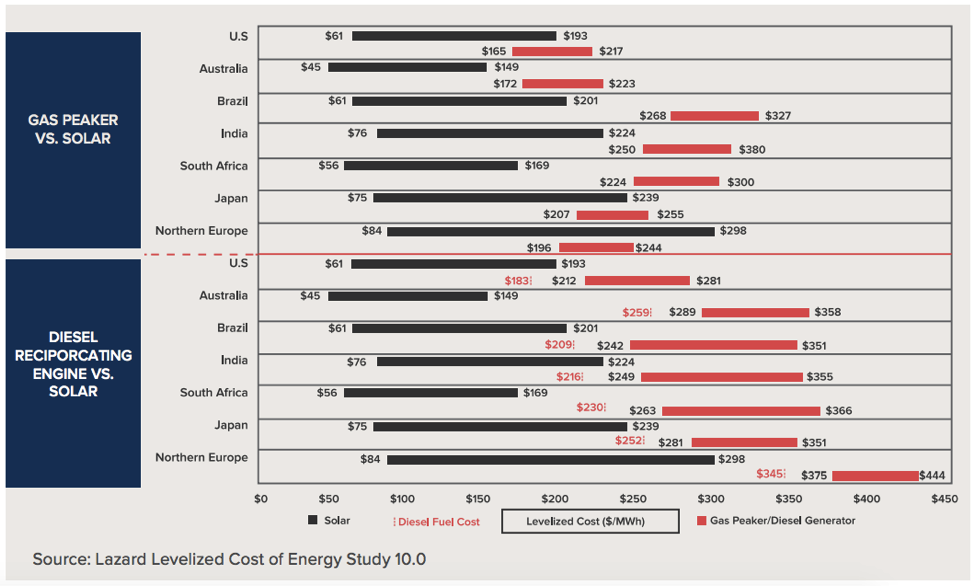
- Driving Systemic Change
Volatility in fossil fuel prices directly impacts both grid-connected and off-grid mines, the latter relying solely on diesel generators to meet their electricity needs. An on-site renewable energy and storage system creates supply stability and insulation from fossil fuel price spikes that plague grid-connected and off-grid mines. Also, the large amount of available space on mining sites creates an additional opportunity for a grid-connected mine site to have an oversized system to cover its own energy production with the added benefit of selling electricity back into the grid.
- Accounting for Less Tangible Benefits
Additional benefits to the local and international communities create support for a mine’s social license to operate.
Creating Shared Value: Publicly investing in sustainability creates additional jobs for local communities in addition to creating value for the mining company. Having 20–40 percent of a mine’s energy demand met with renewables would yield significant benefits for the local community.
Improving Community Relations: The initial investment in renewable energy has a public relations value while also creating the possibility of community integration of renewables and other technologies. The microgrid and community solar markets are rapidly growing, allowing local citizens to buy into sustainability efforts. Aligning business efforts with community interests helps build community support for the mine.
Mitigating Climate Risks: Investments in renewable energy benefit national governments with international commitments to sustainability, allowing mining-heavy nations to lead the decarbonization efforts. A transition to a renewables-fueled mining industry would be significant both nationally and globally.
Creating Value Out of Closed Mines: Mines don’t need to be operating for value generation via energy production. Renewable energy and storage systems can help legacy or inactive mine sites generate revenue, reduce greenhouse gas emissions, and offer a sustainable energy solution for neighboring communities.
The Sunshine for Mines program facilitates adoption of renewables for mines and hopes to reach a total of 8 GW of renewable capacity in the ground by 2025. By consulting with existing mines through feasibility and procurement stages and repurposing legacy mines into renewable energy generating facilities, we are certain we will reach our goal.
Image courtesy of iStock.
Authors

Paolo Natali
Tegan Campia
Related Insights

Advance Market Commitments Today Can Build a Low-Carbon Tomorrow
Help build the clean energy future. Donate today.
Independent research. Real-world solutions. Supported by donors.
RMI can pursue the highest-impact climate and energy solutions because we’re supported by people who believe change is possible. Every gift helps advance the work needed to make clean energy the default choice worldwide.
For other ways to give to RMI, including checks or gifts of stock, please visit Other Ways to Give.
