

Learn how we are working to transform how we use and produce energy.
Capturing the Benefits of Industrial Decarbonization for Houston and Beyond
Why we share this work for free
RMI is an independent nonprofit working to accelerate the clean energy transition. We publish research like this to inform decision-makers and drive real-world impact.
Our work is supported by philanthropy as well as partnerships, including fee-for-service engagements. This support makes it possible for us to share our independent insights for free.
If you find this work valuable, you can support it anytime.
Get more insights like this
Stay up to date with the latest research, analysis, and tools from RMI by opting in to receive occasional emails below. You’ll get new reports, event invitations, and practical insights to help us all accelerate the clean energy transition.
Loading form...
Your download should start automatically. If it doesn’t, click the download button below.
This work is made possible by philanthropy
RMI is a nonprofit supported by donors and partners. Philanthropy enables us to produce independent research and make resources like this freely available.
If you find this report valuable, please consider supporting our work. You can also explore how we partner with organizations to drive impact.
Jump to Section
The energy transition is well underway and represents an enormous opportunity for economic growth and emissions reductions worldwide. This report identifies the double benefits the Houston region could experience through a concerted effort to decarbonize existing industrial activity and presents an outline for other jurisdictions to follow.
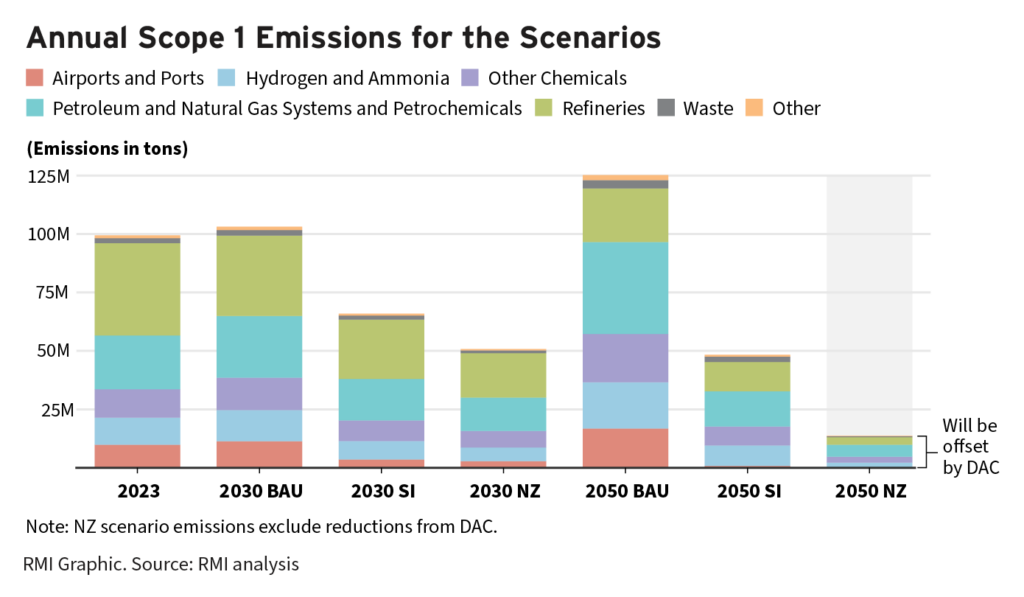
This paper identifies four primary pathways for achieving emissions reduction in the Houston region — electrification, energy efficiency measures, hydrogen utilization, and carbon capture and storage (CCS) — between 2025 and 2050. Three scenarios — a business-as-usual case, a selective investment scenario reflecting economic limitations on the cost of carbon abatement measures, and a net-zero scenario — compare the potential impacts of emissions reductions and job creation potential with a focus on 2030 and 2050 forecasts.
In the best-case scenario, Houston and the surrounding regions could see more than 21,000 jobs created annually up to 2050 while achieving net zero carbon emissions from industry.
Acknowledgments: This work is generously supported by the Mission Possible Partnership (MPP), an alliance that supports public and private sector partners working on the industry transition towards net-zero greenhouse gas emissions by 2050, and RMI, an independent, nonpartisan nonprofit founded in 1982 that transforms global energy systems through market-driven solutions, with a grant provided by the Bezos Earth Fund
Authors

Megan Gross-Wilkinson
Senior Associate
Pablo Muñoz
Senior Associate
Ruosida (Star) Lin
Senior Associate
Nabil Bennouna
PrincipalRelated Insights

The Opportunity for Heat Pumps to Put Downward Pressure on Electricity Rates
Gas Utility Depreciation: Recommendations for an Uncertain Future

Help build the clean energy future. Donate today.
Independent research. Real-world solutions. Supported by donors.
RMI can pursue the highest-impact climate and energy solutions because we’re supported by people who believe change is possible. Every gift helps advance the work needed to make clean energy the default choice worldwide.
For other ways to give to RMI, including checks or gifts of stock, please visit Other Ways to Give.
