
How Manufacturers in India Can Leverage Environmental Product Declarations
Helping India’s building product manufacturers prepare for a low-carbon future.
In India, manufacturers of high-emissions construction materials — such as cement and concrete, steel, aluminum, blockwork, and tile — will play a pivotal role in shaping a low-carbon future. To facilitate this shift, Environmental Product Declarations (EPDs) offer a valuable tool to measure and disclose the emissions associated with building products while strengthening competitiveness in both Indian and international markets. An EPD is a standardized, third-party verified report that communicates the environmental performance of a product across its life cycle. For building materials, EPDs are becoming the global norm for transparency and carbon accounting. They are essential tools for manufacturers to meet the expectations of regulators, developers, and construction markets.
EPDs offer substantial competitive advantages to manufacturers who pursue them, including access to sustainability-oriented building markets, enhanced reputation, and valuable insights into opportunities for improved efficiency and profitability of manufacturing operations.
This article provides step-by-step guidance to help both large and small manufacturers obtain EPDs and leverage them as strategic business investments.
“EPDs make the environmental impact of materials visible and comparable — much like a nutrition label does for food. When done well, they provide the last-mile clarity designers need to make informed choices in addition to cost and function. They also increase awareness of embodied carbon and enable benchmarking and target-setting, helping projects move toward genuinely low-carbon, high-performance outcomes.”
Exhibit 1: Anatomy of an EPD

The core of an Environmental Product Declaration (EPD) is a life cycle assessment (LCA) — an analysis of the environmental impacts of a product over some or all of its life cycle. In addition to the LCA results, EPDs must report supplementary information about the product, manufacturer, and the LCA methodology applied.[1]
Product category rules (PCRs),[2] developed and updated by EPD program operators (see stakeholder list in Exhibit 3), define what information must be reported, and which methodology should be used to calculate impacts. These impact indicators are the “key performance indicators” (KPIs) of an EPD, quantifying the environmental impacts of greatest concern to regulators and buyers.[3]
Exhibit 2: Information provided in an EPD
EPDs in India: the new standard for market access by 2030
By 2030, EPDs are likely to become a widespread requirement for building product manufacturers in India. Globally, regions such as the European Union and several US states already mandate EPDs through green public procurement policies and “Buy Clean” initiatives. For instance, the EU’s Carbon Border Adjustment Mechanism (CBAM) has required importers of carbon-intensive goods — such as steel and cement — to report embodied emissions since 2023, with carbon pricing starting in 2026. While CBAM does not mandate EPDs specifically, verified LCA-based data from EPDs can support compliance and reduce reliance on unfavorable default emissions factors.
India’s emerging Green Steel Policy and taxonomy framework already signal a shift toward product-level emissions disclosure. EPDs can provide a standardized, internationally recognized method for reporting these emissions, ensuring interoperability across market instruments such as CBAM, carbon trading systems (CCTS), and future domestic carbon accounting schemes.
Indian developers are also beginning to make embodied carbon commitments and seek suppliers with transparent, verifiable data. At the national level, India’s Net Zero by 2070 commitment is underpinned by sector-specific climate targets. Because what isn’t measured cannot be managed, Environmental Product Declarations are emerging as a baseline tool for disclosure and market access. Publishing an EPD today positions manufacturers to meet domestic and international expectations, comply with emerging supply chain norms, and prepare for future public procurement alignment.
As a sign of global momentum, the EC3 database — a free platform for comparing building material EPDs — has grown rapidly since its launch in 2019 and now hosts over 90,000 EPDs, demonstrating widespread global industry adoption.
EPD stakeholder landscape in India
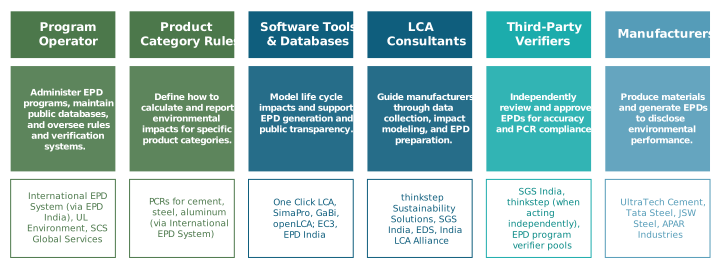
For Indian manufacturers beginning to engage with Environmental Product Declarations, it is important to understand the key stakeholders involved and their respective responsibilities. The table below provides an overview of these roles, along with examples specific to the Indian context.
Exhibit 3: Key stakeholders in India’s EPD ecosystem
The process for getting an EPD can take between 10 and 30 weeks, depending on data readiness, material complexity, and verification process. The general steps to produce an EPD are outlined below.
Exhibit 4: EPD process overview

- Engage an LCA Consultant or Select a Software Tool (~1–4 weeks)
Manufacturers can hire a life-cycle assessment (LCA) consultant with experience in EPD development, or use a software tool such as One Click LCA to complete the analysis internally. - Choose a Program Operator and Applicable PCR (~1 week)
Manufacturers should select a recognized EPD program operator. Manufacturers must identify and use the correct product category rules (PCR) relevant to their product type, which define how the LCA should be conducted. - Collect Facility-Level Data (~2–6 weeks)
Manufacturers need to gather detailed operational data from their facilities, including inputs (raw materials, water, energy), outputs (emissions, waste), and transportation information. Accuracy and completeness are critical. - Conduct the Life Cycle Assessment (LCA) (~2–6 weeks)
The LCA can be performed using the selected software or by the consultant. This involves modeling the environmental impacts of the product throughout its life cycle, typically from raw material extraction to manufacturing (cradle-to-gate). - Draft the EPD Document (~1–3 weeks)
The LCA results and supporting information must be formatted into an EPD that meets the requirements of the PCR. Software tools often help automate formatting and ensure alignment with the program operator’s templates. - Submit for Third-Party Verification (~2–6 weeks)
The draft EPD should be submitted to an independent verifier approved by the program operator. Feedback should be addressed and the document revised as needed. Complex products may require multiple rounds of review. - Register and Publish the EPD (~1–4 weeks)
Once verified, the EPD can be published through the program operator. It will receive a registration number and be listed in the program’s public database. Manufacturers are encouraged to share the EPD through their website and marketing channels, and submit it to additional databases as needed.
From insight to impact: how EPDs promote business efficiency
The process of creating an EPD also serves as a practical “efficiency audit” for manufacturers. It provides a snapshot of operational performance that can evolve into an ongoing dashboard for tracking efficiency and decarbonization. Obtaining a first EPD offers a valuable opportunity to build this internal system. Once this tracking system is established, manufacturers can update their EPDs regularly — as frequently as every year — with minimal additional cost. Over time, this approach delivers ongoing operational savings and strengthens market competitiveness as India’s industrial sector moves toward a low-carbon future.
“We require EPD’s for all steel and concrete used in our projects. You can’t manage what you haven’t measured – EPD’s provide a quantitative basis for us to make product selections and benchmark our progress towards our company’s embodied carbon reduction goals.”
Business benefits of EPDs
Producing an EPD has numerous benefits to Indian manufacturing businesses:
- Gain a Competitive Advantage: Manufacturers can stand out in green building markets by providing transparent, third-party verified data. EPDs can qualify products for points in certification programs such as LEED, IGBC, and GRIHA.
- Meet Procurement and Regulatory Requirements: EPDs help manufacturers stay ahead of emerging mandates by public and private clients requiring environmental data. EPDs are increasingly required in government procurement and international tenders.
- Enhance brand trust and ESG performance: EPDs signal a strong commitment to sustainability. They contribute to robust ESG reporting and help manufacturers meet investor expectations for climate-related disclosures.
- Improve market access: Many international buyers require EPDs as part of their sourcing criteria. A verified EPD can open up export opportunities and long-term contracts.
- Support internal sustainability goals: The LCA process behind an EPD highlights inefficiencies and emissions hotspots, helping manufacturers identify and prioritize areas for operational improvement.
- Build customer loyalty and engagement: Transparency and environmental leadership are increasingly important to customers. Promoting EPDs can help manufacturers tell a compelling story to architects, developers, and end-users.
- Enable participation in decarbonization programs: Many national and international programs, including low-carbon procurement initiatives, favor products with published EPDs.
- Make smart business improvements: Most EPD-related improvements — such as energy efficiency, waste reduction, and logistics optimization — have quick paybacks and can improve margins. The added benefit of a more competitive, lower-carbon EPD strengthens this business case.
Estimated costs of developing an EPD in India
Typical costs for developing an EPD in India range from (approximately ₹983,000 – ₹ 1,519,000 IRP), depending on the product complexity, data readiness, and consultant or software fees. First-time EPDs tend to fall on the higher end of this range due to the effort required for data collection and LCA setup. Annual updates, once a manufacturer’s environmental data tracking and reporting systems are in place, are usually much less expensive.
Unlocking market access through EPDs
Environmental Product Declarations are rapidly becoming a gateway to market access, transparency, and long-term competitiveness in the building materials manufacturing sector. For Indian manufacturers, investing in an EPD is not simply a compliance exercise — it’s a strategic investment that unlocks opportunities across procurement, sustainability reporting, and international trade. With rising pressure from buyers and policy shifts on the horizon, now is the time to build internal capability, partner with experts, and lead India’s industrial transition toward low-carbon manufacturing through data-backed environmental impact disclosure.
[1] For more information on the life-cycle assessment, see Exhibit A2 in Appendix A.
[2] Product category rules can be found in Exhibit A3 in Appendix A.
[3] For more information on impact indicators, see Exhibit A2 in Appendix A.
Appendices
Appendix A: Technical Information
Exhibit A1: Life-cycle assessment phases defined in EN 15804 standard

Exhibit A2: CML Impact Indicators
Exhibit A3: Product Category Rules for India’s key building materials
Appendix B: Key Resources
LCA & EPD Tools:
Program Operators:
Consultants & Support:
thinkstep Sustainability Solutions
Environmental Design Solutions (EDS)
RMI gratefully acknowledges Harsha Pallerlamudi and Tarun Garg, of the RMI India Foundation, for their contributions to this article.
Artificial intelligence (AI) disclosure: This article was developed with assistance from OpenAI GPT‑5; all content verified by the authors.