

Learn how we are working to transform how we use and produce energy.
Deploying private capital for clean community development
Strengthened regional community financing ecosystems will serve as the foundation for scalable clean energy deployment.
The US energy transition is shaped by where projects are economically viable and deployable today. RMI has developed a market readiness map, drawing on publicly available data, to show where the opportunities and bottlenecks are for investment in residential cleantech. The beta version of this tool is available below. Test it out and work with us to continue refining and improving the tool for your use case!
Residential Clean Energy Market Readiness Map
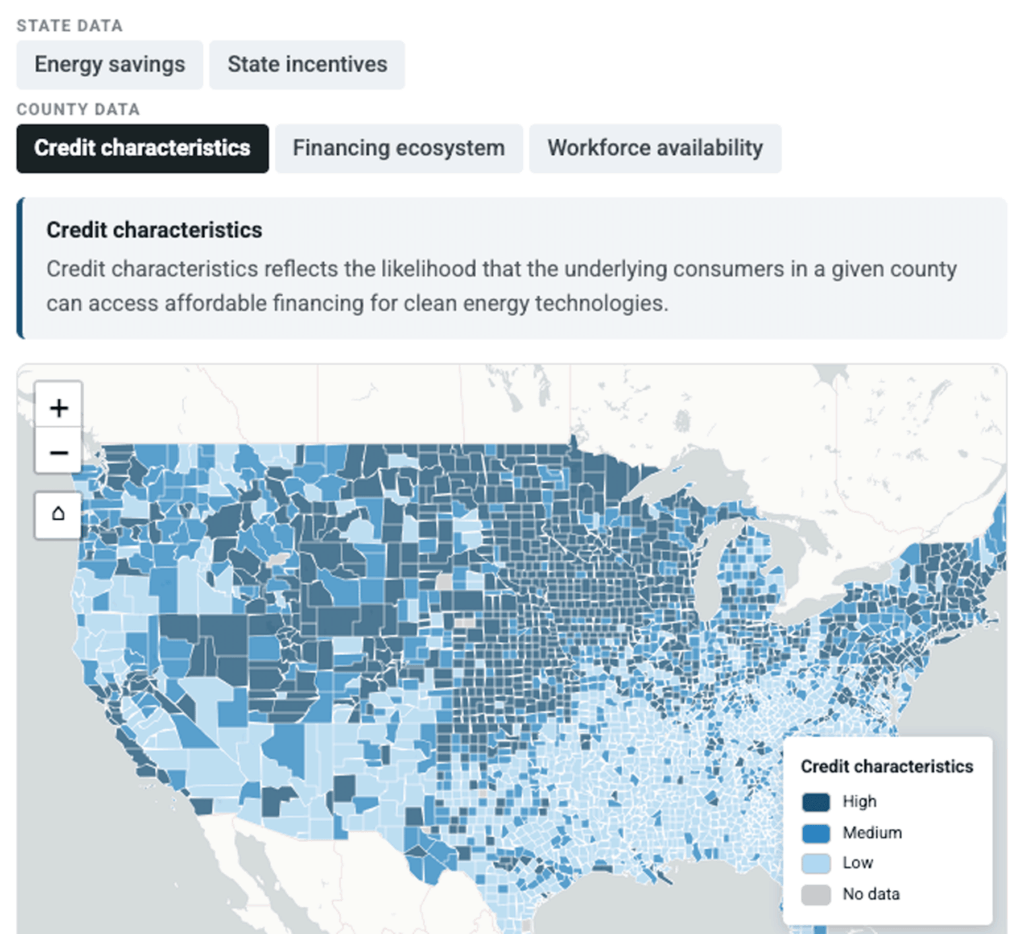
This interactive map brings together national data and regional insights to highlight where capital can be most impactful for deploying residential rooftop solar, electric vehicles, and heat pumps. Filter by technology, savings potential, credit access, workforce availability, and financing ecosystem maturity to diagnose which interventions are most needed across different states and counties. There is potential for scale and deployment everywhere, but the solutions will not all be the same. For example,
- Where cleantech drives high savings and access to credit is high, there is an opportunity for crowding in secondary capital to support deployment.
- Where access to credit is poor and the workforce is limited, there is an opportunity for job training and credit enhancement to drive community development and address affordability gaps.
- Where the financing ecosystem is immature, there is an opportunity for new market entrants and improving cooperation among the few actors who service the area.
This map is intended to streamline these diagnoses and identify the right interventions and opportunities for a given county or region. Please note that this is currently the beta version of the map, and we look forward to improving it with the incorporation of user feedback.
What Michigan’s Clean Community Financing Ecosystem can teach other US regions

Michigan offers a lens into how industrial states are navigating affordability, workforce dynamics, and infrastructure constraints in real time.
Michigan stands out as a place where the clean community financing ecosystem is leveraging local strengths and building the infrastructure needed to navigate key market conditions — including affordability, workforce, credit access, state support, and capacity — and unlock opportunity at scale. Explore insights and recommendations from Michigan, and how they may apply to market readiness in your market.
Financing Community Clean Energy Projects in 2026
2025 marked a structural shift in clean energy and community development finance. Prior to 2025, federal programs had been providing or promising flexible capital to make clean energy projects less risky for lenders and investors. Many of those programs are now gone. While that has upended workplans and made financing harder, it has neither reduced demand nor commitment for clean energy in communities.
RMI’s research and partnership with leading practitioners highlighted four priorities for 2026:
- Fix affordability gap: Strengthen concessional balance sheets for institutions that can absorb cash flow risk and provide products that improve project economics for low-income and underserved customers.
- Address risk perception gap: Map and standardize credit enhancements to build investor confidence and move from bespoke risk mitigation to scalable structures.
- Close market access gap: Identify asset classes ready for standardization and aggregation, and support warehousing to connect small or fragmented assets to secondary markets.
- Resolve ecosystem capacity constraints: Invest in subnational financing ecosystems that can turn localized solutions into investable markets by diagnosing constraints, enabling institutional specialization, and strengthening coordination across the finance stack.
Help build the clean energy future. Donate today.
Independent research. Real-world solutions. Supported by donors.
RMI can pursue the highest-impact climate and energy solutions because we’re supported by people who believe change is possible. Every gift helps advance the work needed to make clean energy the default choice worldwide.
For other ways to give to RMI, including checks or gifts of stock, please visit Other Ways to Give.
