

Learn how we are working to transform how we use and produce energy.
Actionable Insights
Contents
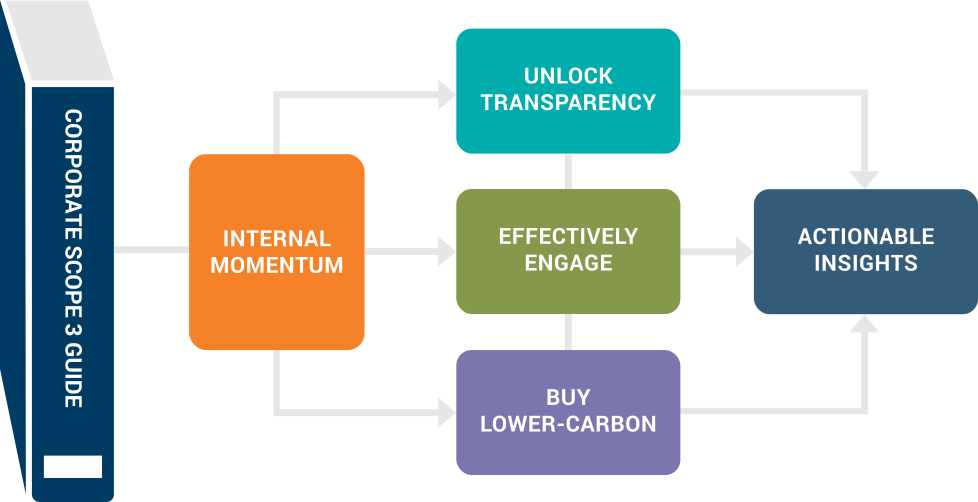
Summary of Actionable Insights
What you can do now to implement learnings from this guide
Creating internal momentum is essential for driving aligned climate actions that lead to meaningful reductions. Corporate climate teams can:
- Secure senior leadership buy-in by highlighting climate initiatives as a clear business opportunity.
- Help shape an effective internal climate governance structure, often benefiting from a decentralized and distributed approach.
- Sustain momentum by progressively embedding climate KPIs, creating internal incentives, and integrating carbon pricing into business decision-making.
When addressing Scope 3 emissions transparency, corporate climate teams can:
- Set clear reporting goals (e.g., disclosure or reduction) and develop a methodology selection decision tree (or use the proposed one) to navigate complex requirements.
- Manage GHG data uncertainties by leveraging industry-specific sources to understand typical emissions ranges. When evaluating green products, verify scope boundaries, certification schemes, recycled content, and additionality to minimize greenwashing risks.
Moving beyond transparency for effective supply chain emissions reduction, corporate and procurement teams can:
- Incorporate material-specific indicators into existing supplier segmentation frameworks to accurately identify suppliers by climate impact and maturity.
- Tailor engagement strategies for different supplier groups, focusing on achieving reduction outcomes with innovation suppliers and building capacity with intervention suppliers.
- Prioritize financial incentives for suppliers with high climate impact and maturity, while organizing abatement levers across various supplier segments.
- Track climate progress using sector-specific metrics aligned with supplier maturity to capture actual emissions from major sources.
When exploring lower-carbon procurement options to concretely support decarbonization, procurement teams can work with corporate climate teams to:
- Understand green product choices, from standard-certified products and low-carbon product brands to advanced products from new projects or net-zero technologies.
- Incorporate climate factors in procurement decisions, such as assessing product-level and industry-level emission impacts, what reduction actions will be enabled, technology costs, risks, and the knowledge requirement.
- Leverage flexible purchasing mechanisms (e.g., small-batch contracts, long-term agreements, group purchases, direct investments, or book and claim) to balance near-term cost-effectiveness with long-term decarbonization investments.
Appendix
Supplier capacity-building overview
| Type | General training | Sector-specific | Corporate programs | Public resources |
|---|---|---|---|---|
| Content | Awareness raising; carbon accounting fundamentals; implementations (how-to) | Sector-specific accounting guidance; industry-related implementation examples | Buyer-determined frameworks; targets specific corporate goals | [TODO — content for this column not fully captured in source extract; verify against live page] |
| Format | Online — self-paced (30 min – 20 hours); publicly available | For employees or suppliers of member companies; online written content; online, self-paced video trainings; publicly available or membership only (instructor-led trainings) | Online, self-paced video and content; in-person or online workshops; free for suppliers only; co-founding options | [TODO] |
| Trainer & examples | Membership organizations (e.g., WBCSD, PACT, UN Global Compact Academy); consultancy (e.g., Guidehouse, S-LOCT); standard setters, NGOs, universities (e.g., GHGp E-learning, GHG Institute) | Industry associations / multi-stakeholder organizations (e.g., ASI, IAI, TfS, AA, WorldSteel); NGOs | Buyers managing multiple suppliers across various sectors (e.g., Walmart, Unilever, Apple, Coca-Cola, Nike, Pepsi, Target, BMW) | [TODO] |
| Targeted level of suppliers | Self-motivated beginner & intermediate | Beginner & intermediate | Intermediate & advanced | Request-based: beginner, intermediate, advanced |
| Buyers' commitment | Low | Medium | Medium | High |
| Considerations | ✗ Slow in learning ✗ Hard to measure progress ✗ Materials not tailored to specific needs or audience ✓ Good for awareness raising | ✗ Often focus on implementation of general frameworks ✓ Somewhat incentivized for learning ✓ Measurable progress ✓ Flexible materials for customization | ✗ Need to map multiple resources across sectors ✗ Tailored to specific sector ✓ Ability to reach more detailed information ✓ Access to sector-specific examples ✓ Broadly applicable to the suppliers' business focus ✓ Third-party expertise | ✗ Constant need for incentives ✗ Need to create content from scratch ✗ Need to accommodate for suppliers with different levels of maturity ✓ Balance between buyers' needs and suppliers' capabilities ✓ Measurable progress and participation – enabling quantifiable comparisons ✓ Targeted data collected |
Supplier capacity-building resources
Listed by training content for general training, sector-specific initiatives, and corporate programs.
General training
Awareness-raising
- Foundations of GHG accounting for Organizations (ASU)
- UN Global Compact Academy E-learning Course on Science-based Targets
Carbon accounting fundamentals
- Greenhouse Gas Protocol: E-learning Opportunities
- GHG Management Institute: E-learning courses
Implementations (how-to)
- United Nations Global Compact Academy (Network Singapore)
- WBCSD Bespoke Learning Program & Online Academy
- ISCC Greenhouse Gas (GHG) Training
Other
- The Climate Drive Net Zero Guidebook (WBCSD)
- The Climate Drive Action Library (WBCSD)
- Ultimate Guide: Collecting Greenhouse Gas (GHG) Data from Suppliers (Ecochain)
Sector-specific
Carbon accounting and implementation – training
- Aluminum Stewardship Initiative (ASI) – ASI Standards and GHG Emissions Training
- Together for Sustainability (TfS) – Scope 3 GHG Emissions Programme
- Together for Sustainability (TfS) – TfS Academy
Other – written resources
- International Aluminum Institute (IAI) – Aluminum Industry GHG Emissions Training
- World Steel Association – Steel Industry Climate Action Training
- Aluminum Association – Sustainability and GHG Training
- TfS PCF Guideline
Corporate programs
- Together for Sustainability (TfS) – Product Carbon Footprint (PCF) Supplier Toolkit
- Walmart Sustainability Hub: Trainings and Webinars
- Unilever: Supplier Climate Training
- Apple: Clean Energy Program
- Coca-Cola: Supplier Leadership on Climate Transition
- Nike: Supplier Climate Action Plan (SCAP)
- Target: Supplier Sustainability Training
- PepsiCo: Sustainable Agriculture and GHG Training
- BMW Group: Sustainable Supplier Engagement
Help build the clean energy future. Donate today.
Independent research. Real-world solutions. Supported by donors.
RMI can pursue the highest-impact climate and energy solutions because we’re supported by people who believe change is possible. Every gift helps advance the work needed to make clean energy the default choice worldwide.
For other ways to give to RMI, including checks or gifts of stock, please visit Other Ways to Give.
