Learn how we are working to transform how we use and produce energy.
Why we share this work for free
RMI is an independent nonprofit working to accelerate the clean energy transition. We publish research like this to inform decision-makers and drive real-world impact.
Our work is supported by philanthropy as well as partnerships, including fee-for-service engagements. This support makes it possible for us to share our independent insights for free.
If you find this work valuable, you can support it anytime.
Get more insights like this
Stay up to date with the latest research, analysis, and tools from RMI by opting in to receive occasional emails below. You’ll get new reports, event invitations, and practical insights to help us all accelerate the clean energy transition.
Loading form...
Your download should start automatically. If it doesn’t, click the download button below.
This work is made possible by philanthropy
RMI is a nonprofit supported by donors and partners. Philanthropy enables us to produce independent research and make resources like this freely available.
If you find this report valuable, please consider supporting our work. You can also explore how we partner with organizations to drive impact.
Jump to Section
Turkey and Australia have uniquely been paired up as joint presidents of COP31. These nations also uniquely sit at opposite ends of the oil and gas value chain. Australia is an energy maker, ranked as a top gas producer and liquefied natural gas (LNG) exporter. Turkey, conversely, is an energy taker, producing scant volumes, importing most of the gas it consumes, and acting as a regional trade hub for pipelined gas and LNG for shipments to other countries.
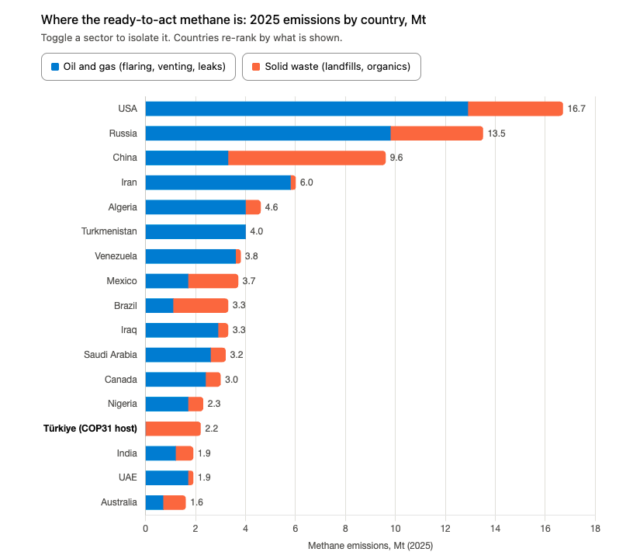
Regardless, their dual responsibilities in shaping global gas markets, preventing energy waste, and reducing methane emissions are equally vital in Turkey and Australia. Their shared ambition, along with 157 other nations, is to make progress at COP31 in meeting the Global Methane Pledge, which was launched five years ago at COP26 and aims to cut methane emissions by 30% by 2030. Where each of these countries sits along the gas value chain determines what their emissions are, what segments their emissions come from, and where they can rapidly mitigate them.
Navigating the gas value chain
The gas value chain — spanning from resource extraction through commodity end uses — is long and complex, as depicted below. Gas is produced from onshore wells and offshore fields, then processed to remove water, liquids, CO2, and hazardous impurities. For ocean export, gas is super-cooled into LNG, shipped by tanker, and turned back into gas at import terminals, while pipeline gas skips these steps. Transmission pipelines move gas long distances and storage facilities act to balance gas supply with needs within and between countries. Local networks of distribution pipelines deliver the gas to power plants, industry, and homes.
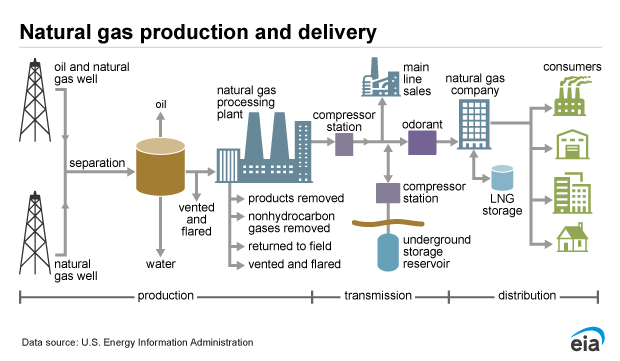
Source: US Energy Information Administration, https://www.eia.gov/energyexplained/natural-gas/delivery-and-storage.php
Emissions along this lengthy supply chain can vary widely, and where a country is positioned dictates what levers it can pull to reduce their climate impact and energy waste from oil and gas operations.
Australia’s opportunity to mitigate methane lies mostly in its production segment and export shipping terminals. Turkey’s climate opportunity rests on diversifying its domestic energy needs, importing the least emissions intensive gas assets, and minimizing leaks from its gas transmission pipelines.
Australia: The maker
Australia is the world’s fifth largest gas producer (tied with Canada and Qatar) extracting over 150 billion cubic meters (bcm) and is tied (with Qatar) as the world’s second largest LNG exporter at nearly 110 bcm. Only the United States and a handful of other countries dominate global energy markets more than Australia. The majority of Australia’s gas production is exported to Asian markets. To supply trade, the country greatly increased its domestic gas production from 2010 to 2020 and has remained steady since. Australia consumes some 50 bcm of its gas and exports about 75% of its production.
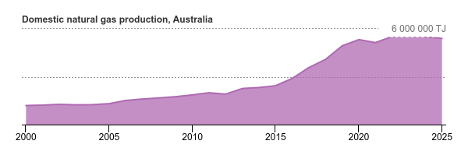
Source: International Energy Agency, https://www.iea.org/countries/australia/natural-gas
Most of Australia’s gas fields are located offshore its west coast. Smaller volumes of gas are produced from coalbed methane operations in Queensland.
For gas producers, most greenhouse gas (GHG) emissions can be attributed to methane released during extraction, processing, and gathering, boosting, shipping, and storage systems. However, Australia’s gas is also a source of CO2 emissions given its domestic stores of acid gas that contain elevated levels of CO2, a corrosive contaminant that must be removed and is often vented into the atmosphere.
Australia’s largest gas project, Chevron’s Gorgon field off Barrow Island, is high in CO2. Initially approved in 2007, the government required the reinjection of its CO2. Yet problems have persisted with Gorgon’s carbon capture and sequestration (CCS) equipment and Chevron must buy over 2 million metric tons of CO2 offsets a year (equivalent to removing half a million cars from the road) to meet its government commitments. Even more concerning, hundreds of metric tons of methane and CO2 have been detected from space being emitted by Australia’s Gorgon field, as shown below.
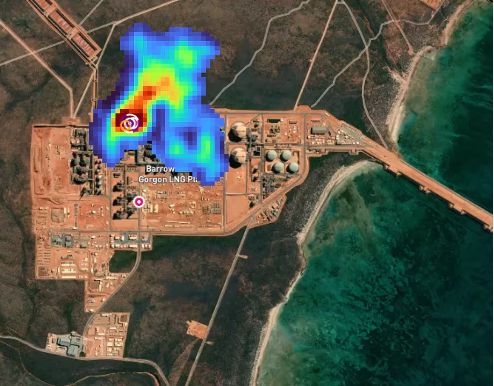
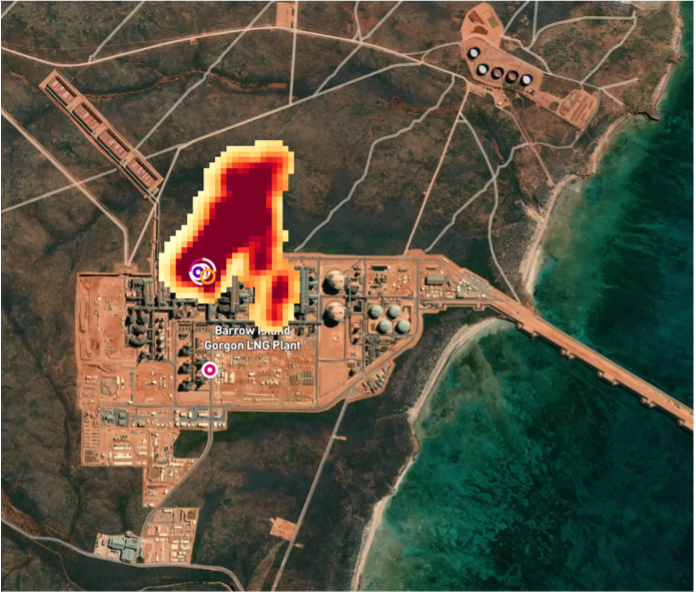
Notes: Satellite detections on August 29, 2026; Top image shows a methane plume (7.8 tons per hour) one of 7 methane detections since 2025; bottom image shows a CO2 plume (940 tons per hour) one of 13 CO2 detections since 2024.
Source: Carbon Mapper, https://data.carbonmapper.org/
Equivalent volumes of Australian gas assets have wide variances in their total GHG emissions. For example, assets like Ichthys and Prelude are estimated to have even higher GHG emissions intensities than Gorgon, as plotted below. And among Australia’s gas fields where LNG is exported, there is a two-fold difference in upstream production carbon dioxide equivalent (CO2e) emissions between the Pluto and Ichthys fields. This difference indicates what better operators are already capable of in practice. Thus, reducing high emitting assets in line with lower emitting assets by capturing vented CO2, reducing gas leaks, and running equipment more efficiently can cut GHG emissions in half.
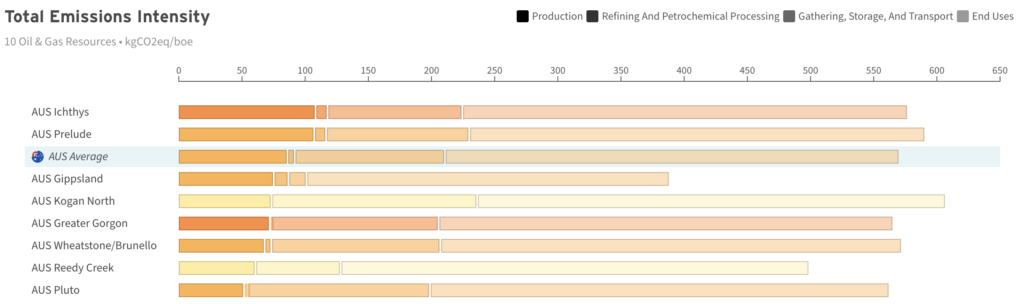
Note: CO2e emissions assume methane has a 20-year global warming potential of 82.5x CO2.
Source: RMI, OCI+, 2024 data, https://ociplus.rmi.org/
Turkey: The mover and taker
Turkey sits at the other end of the gas supply chain, annually consuming some 53 bcm (nearly the same volume as Australia), but producing only 2 bcm. Its vast imports supply both domestic use and gas export trade by Turkey. Turkey is working to increase its gas production — which increased nearly ten-fold between 2022 and 2025, as shown below — but it remains nearly wholly dependent on imports. It gets most of its supply piped in from Russia, Azerbaijan, and Iran, and receives LNG shipments from the United States and Algeria.
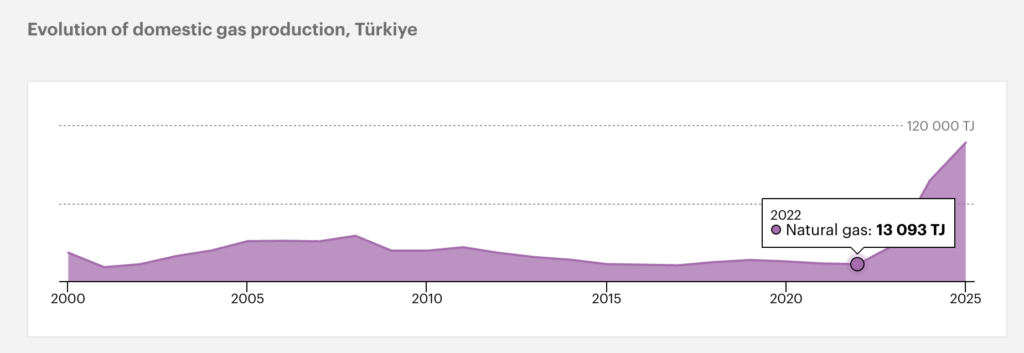
Note: 1 billion cubic meters (bcm) of natural gas is roughly equal to 37,681.2 terajoules (TJ), depending on the exact heat and energy content standards used.
Source: International Energy Agency, https://www.iea.org/countries/turkiye/natural-gas
For a natural gas importer like Turkey, most related emissions come from the equipment needed for receiving and moving the gas: LNG regasification terminals, pipeline compressors, storage, and leaky pipeline networks.
Turkey is aiming to become a gas transit and re-export hub for Europe. It has built strategic pipeline partnerships, begun expanding its LNG infrastructure, signed long-term LNG contracts, and encouraged domestic production. As a hub, it plans to blend gas from multiple sources and re-export the surplus to the rest of Europe. As such, Turkey is well-positioned to be a responsible conveyor of gas: managing demand, writing standards into its purchases, and powering new infrastructure with renewable energy.
Such climate action dovetails with Turkey’s goal to reach net-zero GHG emissions by 2053. Although the timeline is long, the journey starts now — and it includes gas infrastructure, trade and mitigating methane. For example, the EU Methane Regulations (EUMR) set a global standard for methane monitoring, reporting, and verification and drive harmonization and transparency across the global oil and gas market. While Turkey is not a member of the EU and therefore plays no official role in advancing the EUMR, tackling methane from its gas must still be a top priority.
What the host countries’ positions mean for COP31
While Turkey and Australia each consume essentially the same volume of gas domestically, their climate actions will differ given their maker versus taker positions. Their shared presidency at COP31 offers an unusually clear view of the entire gas value chain. One country is a maker, bringing the gas up and shipping it; the other is a taker, receiving it and siphoning a bit off before passing it on. Neither can fix the chain alone, and each holds levers the other lacks.
Methane is the clearest place to start. Oil and gas are extracted together and that gas is made up mostly of methane. As such, methane is both a commodity and a pollutant, making its emissions the easiest and cheapest to cut.
The International Energy Agency (IEA) estimates that over one-half of the methane emissions from the global oil and gas sector can be abated with existing technology, and more than 35 million tons could be avoided at no net cost, because selling the gas recoups more than the cost of the fix. There is an energy security opportunity too: over 200 bcm of gas (more than the combined production of Australia and Turkey) is currently vented and flared worldwide each year.
Methane from the waste sector is on the COP31 agenda, along with electrification, industrialization, buildings, and more. The opportunity at Antalya is to add the gas value chain onto the agenda. The hosts can start by asking for three things:
- Verification of reported methane emissions along the gas value chain, from the wells to end uses, using the best measurements available
- Methane-intensity data written into gas contracts and trade deals, so buyers can reward the lower energy-waste suppliers.
- A first commitment from the COP31 hosts themselves: each country closing the gap between its own best and worst operations, starting with Australia’s call by the COP President to improve emissions measurement.
A maker and a taker that agree on this could turn a divided supply chain into a shared standard for the rest of the world.


Related Insights
Help build the clean energy future. Donate today.
Independent research. Real-world solutions. Supported by donors.
RMI can pursue the highest-impact climate and energy solutions because we’re supported by people who believe change is possible. Every gift helps advance the work needed to make clean energy the default choice worldwide.
And right now, your impact goes twice as far. Thanks to generous donors and our special match, every $1 you give becomes $2, up to $150,000, through December 31, 2026.