

Learn how we are working to transform how we use and produce energy.
Why we share this work for free
RMI is an independent nonprofit working to accelerate the clean energy transition. We publish research like this to inform decision-makers and drive real-world impact.
Our work is supported by philanthropy as well as partnerships, including fee-for-service engagements. This support makes it possible for us to share our independent insights for free.
If you find this work valuable, you can support it anytime.
Get more insights like this
Stay up to date with the latest research, analysis, and tools from RMI by opting in to receive occasional emails below. You’ll get new reports, event invitations, and practical insights to help us all accelerate the clean energy transition.
Loading form...
Your download should start automatically. If it doesn’t, click the download button below.
This work is made possible by philanthropy
RMI is a nonprofit supported by donors and partners. Philanthropy enables us to produce independent research and make resources like this freely available.
If you find this report valuable, please consider supporting our work. You can also explore how we partner with organizations to drive impact.
Jump to Section
Hydrogen Sulfide (H2S) is present at dangerous concentrations across a substantial share of global oil and gas operations and processes. This colorless, flammable, highly toxic inorganic gas naturally occurs. But it is highly corrosive to equipment, and acutely toxic to humans and animals, and environmentally damaging to air, water, and soil. Its presence influences reservoir development, facility design, worker safety, gas processing, sulfur recovery, and environmental management throughout the oil and gas supply chain.
H2S Impacts
Not only is H2S dangerous to people and animals, but it is also deadly at high levels. For workers without proper training and equipment, the gas can rapidly become fatal. In a 2004 study, 21% of worker fatalities were found to have come from “good Samaritans,” i.e., coworkers trying to help a fallen colleague only to succumb to the gas themselves.
H2S emitted into the air reacts in the atmosphere to form sulfur dioxide and cause acid rain. High H2S levels in soil harm plant life and reduce crop yields. When dissolved in water, H2S contaminates rivers, lakes, and groundwater, tainting drinking water and creating a toxic environment for aquatic life.

The acid formed when H2S readily dissolves in water is corrosive to industrial equipment that the industry relies on to prevent damaging leaks and dangerous fugitive emissions. An estimated 40% of all corrosion in the oil and gas industry is due to H2S. This corrosion leads to worker and environmental risk. Not only do the resulting leaks pose imminent risk to human health, the methane released as a result of equipment corrosion exacerbates climate change and leads to energy loss.
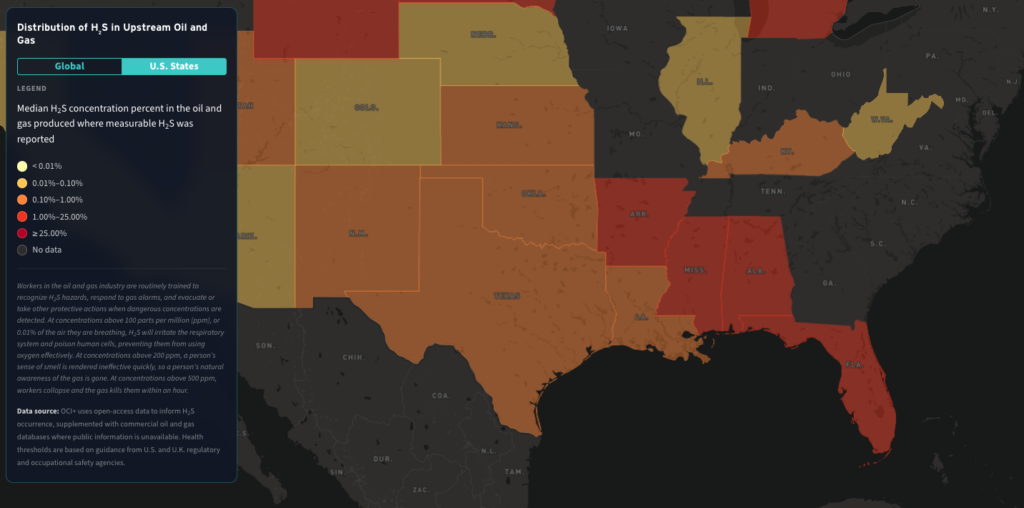
Workers in the oil and gas industry are routinely trained to recognize H2S hazards, respond to gas alarms, and evacuate or take other protective actions when dangerous concentrations are detected. At concentrations above 100 parts per million (ppm), or 0.01% of the air they are breathing, H2S will irritate the respiratory system and poison human cells, preventing them from using oxygen effectively. At concentrations above 200 ppm, a person’s sense of smell is rendered ineffective quickly, so a person’s natural awareness of the gas is gone. At concentrations above 500 ppm, workers collapse and the gas kills them within an hour.
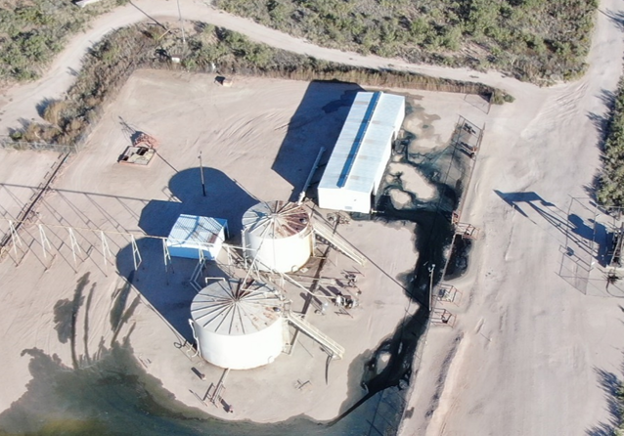
The site of a Hydrogen Sulfide incident that led to two deaths. Below is a video summary by CSB, the independent agency that investigated the incident.
Fate of H2S in the Oil and Gas Supply Chain
H2S may be present as a gas or be dissolved in the produced oil, condensate, and water at the wellsite. H2S can be generated or introduced into petroleum reservoirs when heat, bacteria, and pressure decompose sulfur-rich organic matter to form H2S over time. The introduction of bacteria during oil and gas production via water injection or in fields with declining pressures can also release H2S after production starts and as fields age.
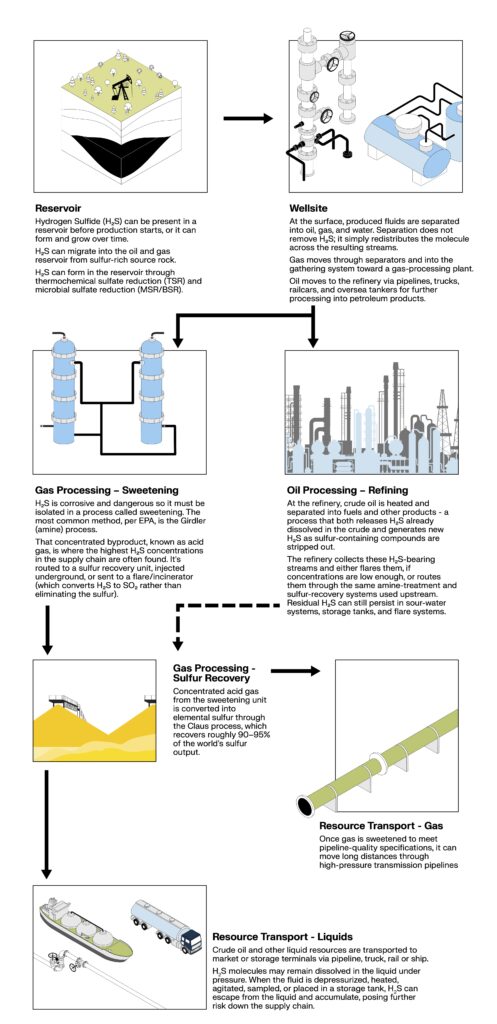
H2S must be removed from the oil and gas supply chain both during gas processing before oil and gas are transported and during refining when petroleum products are manufactured.
At the gas-processing plant, sour gas undergoes sweetening, meaning H2S and often carbon dioxide is removed from the natural gas. Sweetening takes concentrated H2S and converts it into elemental sulfur at a sulfur recovery plant. Alternatively, a unit at the gas processing plant injects H2S underground or sends it to be flared or incinerated. Flaring or incineration, however, does not eliminate the sulfur; combustion converts most of the H2S into sulfur dioxide (SO2), another harmful air pollutant. By the time natural gas enters a pipeline, most H2S must be removed at a gas-processing plant so the gas meets the receiving pipeline’s quality requirements to prevent corrosion. Oil refineries also remove embedded H2S from the petroleum products—using sulfur recovery plants or incineration at the refinery.
Tracking H2S Concentrations
Dangerous H2S concentrations can occur through the oil and gas supply chain at key process stages. While concentrations can vary widely by oil and gas reservoir, chemical process, and operating conditions, they generally increase as H2S becomes more concentrated as it moves through processing stages before being minimized in pipelines that ship finished petroleum products to customers.
Analyzing H2S Data
RMI’s Oil Climate Index plus Gas (OCI+) is an open-source analytic tool that estimates and compares the life-cycle greenhouse gas emissions from equivalent barrels of oil and gas. Over 70% of global supply is modeled, from extraction through consumption. RMI inputs concentrations of H2S as one of the many variables to model overall oil and gas emission intensities.
In addition to reporting emissions intensities, RMI maps our results on the OCI+ web tool. A new H2S risk map has been developed to indicate how this dangerous molecule plays a role in our energy future. This map is only as good as the data underlying it, however. H2S data is frequently missing or unreported, leaving the public in the dark about major risks in their own backyards.
H2S Incident Trends
RMI analyzed five decades of workplace incident records from the US Occupational Safety and Health Administration (OSHA) to understand where H2S-related incidents occur across the oil and gas industry supply chain, from production, gas processing, and refining, and transport.
The analysis revealed a persistent pattern: wellsite production operations and oil refineries consistently experience higher H2S incident risk than gas processing and transmission operations. These findings show that H2S remains a persistent safety challenge despite decades of industry experience and the widespread adoption of H2S detection, monitoring, and training programs.
Why this matters to protect people and property
RMI analysis reveals that dangerous concentrations of H2S are present across a substantial share of oil and gas operations. The findings highlight the persistent challenge of managing H2S hazards over the past five decades despite the widespread adoption of safety protocols.
Given these known, persistent risks, the oil and gas industry has been tasked with safely managing H2S for decades. Technologies have been developed to handle high-H2S oil and gas responsibly with low leakage. Extending these best practices across all oil and gas operations can safeguard both human health and the climate.
The next step in the path towards a cleaner energy future resides in greater transparency in H2S occurrence, varying concentrations, and field souring. Local communities and oil and gas workers have the right to understand the risks they face, and decision makers need the data to make informed and intelligent decisions to protect people and the environment.



Related Insights




Help build the clean energy future. Donate today.
Independent research. Real-world solutions. Supported by donors.
RMI can pursue the highest-impact climate and energy solutions because we’re supported by people who believe change is possible. Every gift helps advance the work needed to make clean energy the default choice worldwide.
For other ways to give to RMI, including checks or gifts of stock, please visit Other Ways to Give.
