

Learn how we are working to transform how we use and produce energy.
Tracking WestTEC: Where 100+ Transmission Projects Stand and What Comes Next
A coalition of utilities and stakeholders laid out a transmission roadmap for the Western United States. Now states can help move projects from planning to construction.
Why we share this work for free
RMI is an independent nonprofit working to accelerate the clean energy transition. We publish research like this to inform decision-makers and drive real-world impact.
Our work is supported by philanthropy as well as partnerships, including fee-for-service engagements. This support makes it possible for us to share our independent insights for free.
If you find this work valuable, you can support it anytime.
Get more insights like this
Stay up to date with the latest research, analysis, and tools from RMI by opting in to receive occasional emails below. You’ll get new reports, event invitations, and practical insights to help us all accelerate the clean energy transition.
Loading form...
Your download should start automatically. If it doesn’t, click the download button below.
This work is made possible by philanthropy
RMI is a nonprofit supported by donors and partners. Philanthropy enables us to produce independent research and make resources like this freely available.
If you find this report valuable, please consider supporting our work. You can also explore how we partner with organizations to drive impact.
Jump to Section
Three years ago, more than 70 utilities and stakeholders came together to chart a new path for transmission planning in the Western United States. In February 2026, the Western Transmission Expansion Coalition (WestTEC) identified a 10-year portfolio of 105 actionable transmission projects, representing an estimated $58 billion in investment, that reliably and economically meet the region’s forecasted needs through 2035.
While building 105 transmission projects may seem daunting, 77% of the total investment associated with projects is already incorporated in utility planning processes and expected to be completed by 2035. These projects are at varying stages of planning, permitting, and development. In this article, we take a closer look at their development progress and offer recommendations for Western state decision makers to help accelerate these projects and ensure they are completed on time.
Tracking WestTEC projects from planning to completion
Transmission projects undergo rigorous planning, permitting, and construction processes involving oversight from multiple local, state, and federal agencies. The timeline from initial concept to steel in the ground varies widely by project and jurisdiction but often exceeds a decade. For example, new 200+ KV transmission projects in California took an average of 12 years to develop. Larger regional and interstate projects, such as those identified through WestTEC, may take longer, with some projects taking over 20 years.
WestTEC’s 10-year portfolio includes projects in various stages of development. Tracking each project through the development process is critical to identifying potential barriers and the actions decision makers can take to accelerate progress and keep projects on schedule. To better understand the status of the identified projects, we mapped them onto seven development stages: newly proposed, conceptual planning, advanced planning, permitting, under construction, in-service, and canceled. Exhibit 1 illustrates the criteria for each project stage.
Exhibit 1
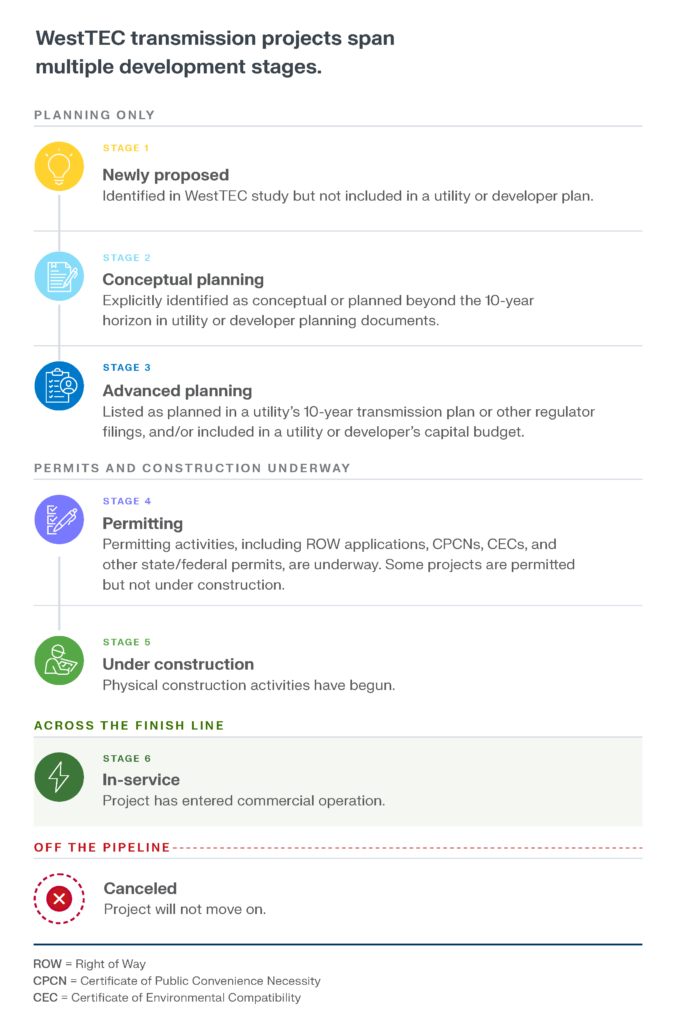
Of the total investment identified by WestTEC, 77% is associated with projects already incorporated into utility plans and expected to be completed by 2035, with projects ranging from advanced planning to in service (Exhibit 2). In fact, 29% of WestTEC’s identified investment is already under construction or in service, providing strong confidence that these projects will be completed by 2035. Another 48% is in advanced planning or permitting, indicating meaningful progress but also substantial work ahead. Only 21% of the investment consists of projects that are conceptual, fall beyond the 10-year horizon, or are newly proposed and still require sponsorship from utilities, independent developers, or public power entities. All projects require coordinated action, at times across state borders, to meet the West’s grid needs by 2035.
Exhibit 2
Realizing WestTEC benefits across Western states
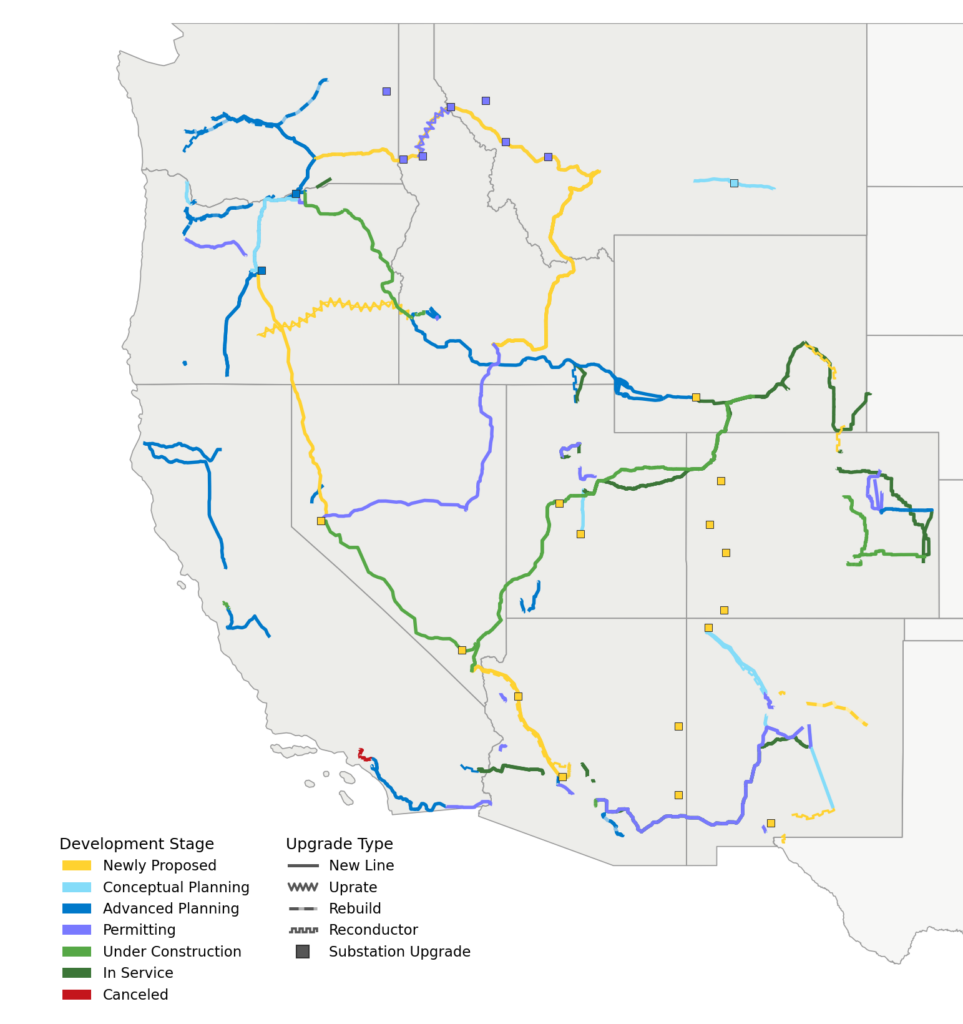
WestTEC’s 10-year portfolio is specifically regional in scope, focusing on high-voltage transmission lines (200 kV and above) that connect eleven Western states (Exhibit 3).
These projects are critical because the West’s electricity system does not operate state by state. Every state both relies on and supports a shared regional grid, and investments that strengthen connections across the region can deliver reliable and affordable electricity to millions of homes and businesses across the West.
Collectively, WestTEC’s 10-year portfolio will add 10 gigawatts (GW) of transfer capability across key interregional interfaces, enable 229 GW of new generation capacity, reduce the risk of power shortages, and improve regional reliability. The value of this additional transfer capability is substantial. During the January 2024 winter weather event, when the Pacific Northwest (Montana, Washington, Oregon, and Idaho) faced grid emergencies and high wholesale electricity prices, Powerex found that just 2 GW of additional Western transmission — only 20% of WestTEC’s proposed transfer additions — could have saved $140 million over five days while reducing the risk of power shortages. The January 2024 winter weather event was not a one-off: extreme heat, drought, and wildfires increasingly stress the Western grid during summer as well, underscoring the value of greater transfer capacity to move power between regions during periods of system stress.
At the same time, these projects can advance individual state policy goals and support economic development. WestTEC’s state-by-state infographics provide a closer look at each state’s project benefits and development progress. Strong support from governors, state decision makers, and other stakeholders will be critical to moving projects from planning to operating.
Exhibit 3
WestTEC transmission projects connect 11 states in the Western Interconnection.
Recommendations to move WestTEC projects across the finish line
Given the long timelines for transmission planning, permitting, and construction, it is critical to move WestTEC projects forward now. State decision makers can help advance these projects by accelerating permitting, advancing regional cost allocation, supporting continued regional planning, and building state transmission expertise. In particular, we recommend that state decision makers take the following four actions:
1. Accelerate permitting through multi-agency coordination.
Transmission projects often require approvals from multiple federal, state, local, and Tribal authorities, making coordination across agencies critical to timely permitting. States can help reduce delays by improving coordination and creating clearer, more predictable review processes at the federal, regional, and state levels by:
- Improving federal coordination by signing a memorandum of understanding (MOU) with the Federal Permitting Council. Earlier this year, the Federal Permitting Council signed MOUs with Idaho, Utah, and Nevada to identify priority infrastructure projects, align and coordinate permitting reviews across agencies, and improve transparency through the FAST-41 process. While these agreements cover multiple types of large-scale infrastructure, transmission is particularly well positioned to benefit from improved state–federal coordination because projects frequently cross federal lands and trigger federal permitting requirements. Other Western states should pursue similar agreements to strengthen state-federal coordination and accelerate permitting for WestTEC transmission projects.
- Improving regional coordination by operationalizing the Transmission Permitting Alignment and Coordination Task Force (PACT). Over the summer, governors from 12 Western states (including North Dakota) signed a Joint Statement of Agreement endorsing the WestTEC results and establishing the PACT as a state-driven platform where state leaders can access targeted support to coordinate permitting on transmission lines critical to their priorities. State leaders should now turn this commitment into action by providing the institutional support needed to implement PACT and the letter’s recommendations.
- Improving state permitting processes through greater clarity and coordination. State regulators and energy office staff should identify opportunities to coordinate state, county, and local permitting through targeted policy and administrative reforms. This could include establishing an in-state permitting council or lead agency to coordinate permitting reviews, clarifying permitting requirements and agency responsibilities, setting predictable review timelines, and identifying opportunities for concurrent rather than sequential reviews. These changes can reduce uncertainty for project developers while preserving the substantive environmental and community protections embedded in existing permitting processes.
2. Advance regional cost allocation solutions.
Transmission projects often provide benefits across a wide geographic area, making it challenging to allocate costs fairly among states, utilities, and customers. To address this, transmission owners and developers can:
- Use CREPC’s State Exploration of Western Transmission Cost Allocation Frameworks as a starting point for negotiating cost allocation for multi-state transmission projects. In 2025, the Committee on Regional Power Cooperation Transmission Collaborative (CREPC TC) developed a cost allocation framework that Western states broadly agree improves on the status quo. The work subsequently informed a related state-led effort through the CREPC Order 1920 Ad Hoc Committee, which developed specific cost allocation proposals for NorthernGrid and WestConnect that were submitted for FERC consideration as part of the regions’ Order 1920 compliance processes. While FERC reviews these proposals, transmission owners and developers should not wait; they should build on the CREPC TC principles as a common starting point for project-specific cost allocation negotiations. Doing so could help resolve disagreements earlier and ensure costs reflect three core principles: cost causation and beneficiary pays, opportunities for choice, and flexibility.
3. Continue West-wide transmission planning.
WestTEC represents a major step forward for regional transmission planning in the West. To maintain this momentum on planning and development, states can:
- Incorporate WestTEC projects in utility and state plans. State regulators and energy office staff can require or encourage utilities to evaluate relevant WestTEC projects and transmission needs in their integrated resource plans (IRPs), local transmission plans, and other long-term planning processes. States should similarly incorporate WestTEC results into state-led efforts, including transmission studies developed by state energy offices and transmission authorities.
- Act on WestTEC’s 20-Year Horizon Study. Expected later in 2026, WestTEC’s 20-Year Horizon Study will build on the 10-year study by identifying additional transmission needs through 2045. The study will evaluate three scenarios representing a range of load growth, policy, and technology futures and quantify the cost savings delivered by the resulting transmission portfolio. States should use the results to inform long-term transmission priorities.
- Support future iterations of WestTEC. WestTEC has established a coalition and planning approach that can serve as a repeatable model for West-wide planning as electricity demand grows and new resources come online. With efforts already underway to formalize the next round of WestTEC planning, states should support regular iterations of the process to meet the region’s evolving electricity needs.
4. Build state capacity to advance WestTEC projects.
While WestTEC provides a regional roadmap, developers make many of the decisions that determine whether individual projects advance at the state level. To support this process, states can:
- Build state transmission expertise and capacity. Establish transmission-focused positions within public utility commissions, state energy offices, and electric transmission authorities to build institutional expertise on proposed WestTEC projects, regional planning processes, and transmission development.
- Advance and evaluate WestTEC projects. Transmission-focused staff can monitor and advance WestTEC projects while they move through planning, permitting, paying, and development. RMI developed a workbook to support this process, with detailed information on each project’s voltage, length, cost, location, development status, and links to additional resources. States can use this resource to anticipate upcoming development milestones, inform their evaluation of projects, and identify opportunities to address barriers or support projects as they move forward.
Timely completion of the projects identified in WestTEC’s 10-year study — and those that emerge from the 20-year study — will be essential to a reliable and affordable energy future in the West. Developing WestTEC’s portfolio over the next decade is ambitious but achievable, given the advanced development status of many projects and growing commitment to multi-state coordination. By accelerating permitting, advancing regional cost allocation, continuing West-wide planning, and building state capacity, Western state decision makers can help move WestTEC transmission projects from paper plans to steel in the ground.





Help build the clean energy future. Donate today.
Independent research. Real-world solutions. Supported by donors.
RMI can pursue the highest-impact climate and energy solutions because we’re supported by people who believe change is possible. Every gift helps advance the work needed to make clean energy the default choice worldwide.
For other ways to give to RMI, including checks or gifts of stock, please visit Other Ways to Give.
