

Learn how we are working to transform how we use and produce energy.
Emissions Accounting Framework
Attributional Accounting Guidance for Lower-Emissions Oil and Gas Supply
Why we share this work for free
RMI is an independent nonprofit working to accelerate the clean energy transition. We publish research like this to inform decision-makers and drive real-world impact.
Our work is supported by philanthropy as well as partnerships, including fee-for-service engagements. This support makes it possible for us to share our independent insights for free.
If you find this work valuable, you can support it anytime.
Get more insights like this
Stay up to date with the latest research, analysis, and tools from RMI by opting in to receive occasional emails below. You’ll get new reports, event invitations, and practical insights to help us all accelerate the clean energy transition.
Loading form...
Your download should start automatically. If it doesn’t, click the download button below.
This work is made possible by philanthropy
RMI is a nonprofit supported by donors and partners. Philanthropy enables us to produce independent research and make resources like this freely available.
If you find this report valuable, please consider supporting our work. You can also explore how we partner with organizations to drive impact.
Jump to Section
RMI, along with consultancies WSP, Relae (formerly Carbon Direct), and Green Strategies, has released a first-of-its-kind suite of emissions accounting guidance for methane emissions from the oil and gas sector.
The guidance is intended to apply to a wide range of stakeholders, with a specific focus on corporate greenhouse gas accounting and reporting teams. The authors are seeking feedback from a wide range of stakeholders to ensure it is credible, aligned with existing standards, emerging standards, best practices, and market needs. (Instructions for how to give feedback are below.)
Entities with suppliers linked to the oil and gas value chain are increasingly seeking to reduce the “upstream” (early in the value chain) GHG emissions associated with their products as buyers increasingly demand products with verifiably lower emissions profiles. To date, however, no clear, consistent framework for incorporating lower emissions oil and gas purchases into attributional inventories exists.
Once complete, the Attributional Accounting Guidance for Lower-Emissions Oil and Gas Supply will enable corporates to understand and incorporate the actual emissions profile of their oil and gas use with far greater granularity than traditional GHG accounting, which typically rely on highly simplistic average emissions figures. For example, methane — the main component of natural gas and a potent greenhouse gas that traps more than 80 times more heat in the atmosphere than carbon dioxide over a 20-year period — leaks from oil and gas operations at all points along the supply chain. Even though the ‘methane intensity’ (the amount of methane emitted per unit of energy sold) of any given unit of gas can vary by an order of magnitude across different lcoations, most typical inventory accounting calculations assume all oil and gas are associated with an equal amount of methane emissions. With clarity from this new guidance, corporates can understand the true emissions impact of their oil and gas usage and act, including by leveraging their purchasing power, to reduce this important source of GHG emissions in their value chain.
The authors of the Framework emphasize that it is not intended to justify expanded use of oil and gas or replace efforts to transition to non-fossil, cleaner alternatives, and that lower-emissions oil and gas should only be used when no feasible alternative exists.
The draft guidance released by RMI focuses on the accounting methods that apply to varying upstream oil and gas emissions intensities in the context of a corporate GHG emissions inventory. Instead of one single accounting pathway, RMI’s guidance establishes multiple tracking and accounting pathways that can be applied across a range of contexts and is designed to be both sufficiently precise that it can be applied as-is, while remaining flexible enough to accommodate future technology, systems, and infrastructure improvements.
Concurrent with RMI’s release of its guidance, Relae (formerly Carbon Direct) and Green Strategies also released “A Methodology for Buyers to Apply Impact Accounting for Actions that Reduce GHG Emission in the Natural Gas Supply Chain,” and “Producing Lower-Emissions Natural Gas Using Impact-Based Instruments: Principles and Criteria,” respectively, which focus on impact-based applications of lower emissions oil and gas.
More information on the feedback sought is below. Please submit written feedback on the draft materials using the Lower Emissions Oil and Gas Accounting Framework Response Form and email your completed submission to mpeltier@rmi.org.
Written comments will be accepted through October 31, 2026. We will incorporate feedback and the final version of the Framework will be released by first half of 2027.
Collectively, RMI and its partners seek feedback from:
- Current buyers of oil and gas products, both directly and indirectly, and prospective purchasers of lower emissions oil and gas products,
- Supply chain actors with exposure to oil and gas supply chains, particularly those who have, or intend to offer, products that incorporate differentiated oil and gas,
- Technical experts, industry associations, and standards bodies,
- Relevant NGOs, coalitions, and civil society, and
- Digital solution providers exploring chain of custody product provisions.
Acknowledgements
We would like to thank the following organizations and technical experts for their collaboration and consultation in developing this framework. The individuals and organizations participating in working group discussions and peer review are not responsible for the opinions or conclusions expressed in this document. All errors and omissions remain the sole responsibility of RMI. Participation in the working group or peer review process does not constitute endorsement of the Emissions Accounting Framework: Attributional accounting guidance for lower-emissions oil and gas supply.
Organizations
Beyond Alliance
Relae (formerly Carbon Direct)
Green Strategies, Inc.
RMI
WSP
Technical Experts
Roger Ballentine
Patrick Falwell
Wenjuan Liu
Jamila Yamani
Lei Zhu




Related Insights


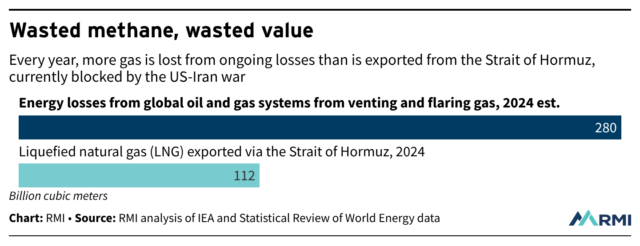
The World Wastes More Gas Each Year than the Strait of Hormuz Supplies
Help build the clean energy future. Donate today.
Independent research. Real-world solutions. Supported by donors.
RMI can pursue the highest-impact climate and energy solutions because we’re supported by people who believe change is possible. Every gift helps advance the work needed to make clean energy the default choice worldwide.
For other ways to give to RMI, including checks or gifts of stock, please visit Other Ways to Give.