

Learn how we are working to transform how we use and produce energy.
Decarbonizing Concrete Infrastructure Projects
How state departments of transportation can leverage the federal government’s $1.2 billion Low Carbon Transportation Materials (LCTM) program.
Why we share this work for free
RMI is an independent nonprofit working to accelerate the clean energy transition. We publish research like this to inform decision-makers and drive real-world impact.
Our work is supported by philanthropy as well as partnerships, including fee-for-service engagements. This support makes it possible for us to share our independent insights for free.
If you find this work valuable, you can support it anytime.
Get more insights like this
Stay up to date with the latest research, analysis, and tools from RMI by opting in to receive occasional emails below. You’ll get new reports, event invitations, and practical insights to help us all accelerate the clean energy transition.
Loading form...
Your download should start automatically. If it doesn’t, click the download button below.
This work is made possible by philanthropy
RMI is a nonprofit supported by donors and partners. Philanthropy enables us to produce independent research and make resources like this freely available.
If you find this report valuable, please consider supporting our work. You can also explore how we partner with organizations to drive impact.
Jump to Section
The US federal government is making historic investments in addressing the embodied emissions of construction materials. The Federal Buy Clean Initiative aims to turbocharge markets for low-carbon concrete, steel, and other building materials by leveraging the purchasing power of the government.
A key piece of this strategy is a $2 billion grant program funded by the Inflation Reduction Act (IRA) and administered the Federal Highway Administration (FHWA) that will reimburse or provide incentives to infrastructure building agencies for the use of low-embodied carbon construction materials and products in projects. This is a critical demand-side investment in transportation infrastructure decarbonization — particularly for the concrete and cement sector.
Regional concrete markets are driven by large infrastructure building agencies, such as state departments of transportation (DOTs). Funding for low-carbon concrete innovation can catalyze transformational change across the cement and concrete value chain — from designers and specifiers to ready-mix suppliers and contractors.
FHWA’s Low-Carbon Transportation Materials (LCTM) Grants Program Is LIVE
In March 2024, FHWA announced that applications are open for $1.2 billion in grant funding through the LCTM Program. RMI has developed an easily deployable toolkit of project ideas that state DOTs can use to inform their applications to the FHWA LCTM program, specifically related to procurement of low-carbon concrete materials. Our recommendations build off efforts currently underway at many state DOTs. Our hope is to make it easy for DOTs to develop a cohesive approach to improving the durability and reducing the environmental impact of concrete. Note that the LCTM Program is designed to cover a broader set of building materials, and state DOTs should pursue projects to address these materials as well.
We encourage agency staff to use program approaches and ideas from this document. The Reduced-Carbon Concrete Consortium (RC3) is another resource that can support qualifying entities in developing their applications.
Four Priority Low-Carbon Concrete Initiatives
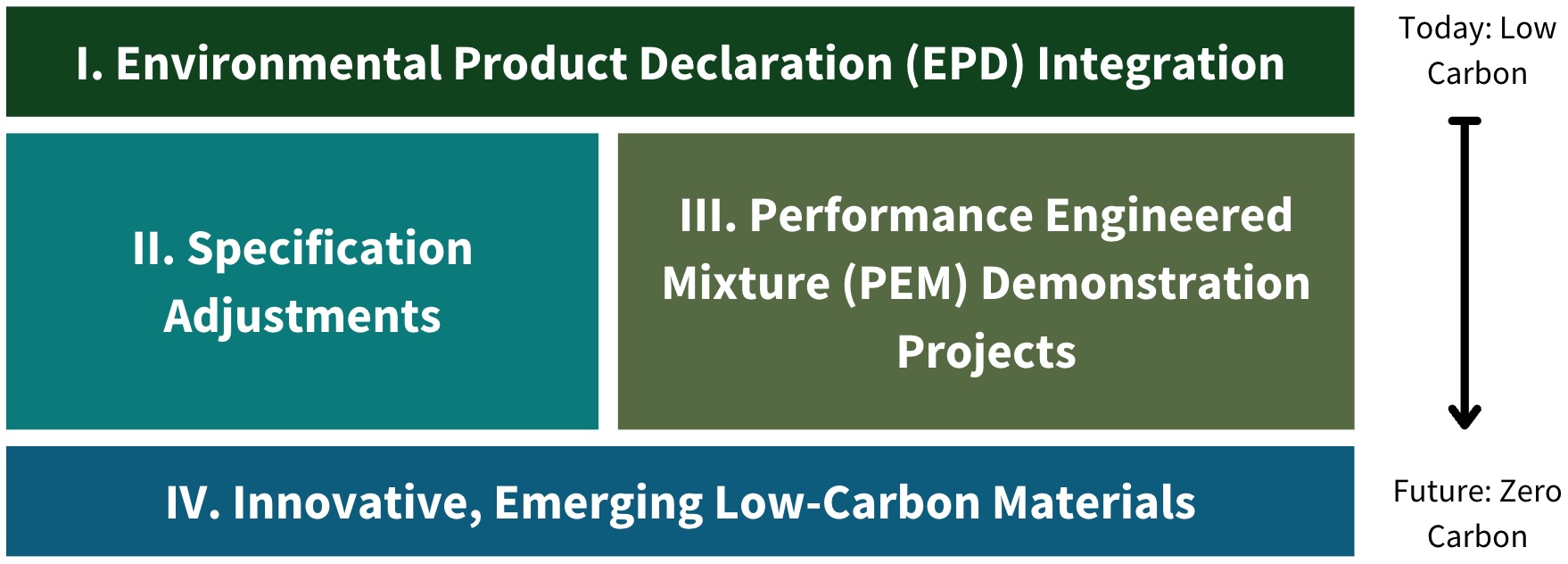
We’ve provided a list of recommended initiatives and project ideas that will unlock state DOTs’ abilities to procure low-carbon concrete materials. The recommendations are organized into four initiatives that build up to a well-rounded low-carbon concrete program for a state DOT. Deployed together, these initiatives will facilitate widespread use of today’s best, market-ready, low-carbon concrete mixes, while getting DOTs started with unlocking deeper reductions through innovative, high-performance mixes.
These initiatives cover both eligible “process development” items — activities that setup DOTs to procure materials with substantially lower embodied carbon — as well as initiatives to deploy eligible materials on construction projects. Download the document below for the full set of recommendations. The four priority initiatives are summarized in the graphic below:
Download our list of recommended initiatives and project ideas


Related Insights

Help build the clean energy future. Donate today.
Independent research. Real-world solutions. Supported by donors.
RMI can pursue the highest-impact climate and energy solutions because we’re supported by people who believe change is possible. Every gift helps advance the work needed to make clean energy the default choice worldwide.
For other ways to give to RMI, including checks or gifts of stock, please visit Other Ways to Give.
