

Learn how we are working to transform how we use and produce energy.
Building Smarter, More Efficient Air Conditioners for Real World Conditions
A workshop convened by RMI and CEPT University explored how smarter controls can deliver more comfortable, efficient cooling
Why we share this work for free
RMI is an independent nonprofit working to accelerate the clean energy transition. We publish research like this to inform decision-makers and drive real-world impact.
Our work is supported by philanthropy as well as partnerships, including fee-for-service engagements. This support makes it possible for us to share our independent insights for free.
If you find this work valuable, you can support it anytime.
Get more insights like this
Stay up to date with the latest research, analysis, and tools from RMI by opting in to receive occasional emails below. You’ll get new reports, event invitations, and practical insights to help us all accelerate the clean energy transition.
Loading form...
Your download should start automatically. If it doesn’t, click the download button below.
This work is made possible by philanthropy
RMI is a nonprofit supported by donors and partners. Philanthropy enables us to produce independent research and make resources like this freely available.
If you find this report valuable, please consider supporting our work. You can also explore how we partner with organizations to drive impact.
Jump to Section
India’s summers are testing the limits of what its people and power grid can absorb. And with each passing summer, more homes are turning to air conditioners (ACs) for respite as the need for cooling grows. Domestic AC production from about 6 million units in 2021, is expected to nearly quadruple and reach 24 million units by 2030. The challenge is increasingly becoming how to deliver comfort to people without locking in avoidable energy use and stretching power grids to their limit.
Delivering comfort is no longer limited to keeping cooler temperatures. ACs also need to remove moisture from the air, particularly as many cities are experiencing more humid conditions than in the past. Yet the way ACs are developed, tested, and rated has not fully caught up with this changing reality. ACs based on vapor compression technology address the sensible cooling load (lowering the air temperature), while dehumidification is achieved as a by-product. As a result, during an AC energy performance test, a unit can perform well against today’s energy performance standards but struggle to deliver comfort in hot, humid conditions, straining the grid with additional power requirements.
This shift from just cooling to delivering thermal comfort requires a better understanding of how an AC responds to the conditions it encounters in the real world. This is the challenge RMI and CEPT University have been exploring with India’s AC industry through a series of capacity-building workshops. The first workshop, held in March 2026, focused on Foundations & Practical Orientation for AC Design and highlighted how modeling and simulation tools can support faster prototype development. It explored using these tools to model and simulate performance of heat exchangers, which can improve system efficiency.
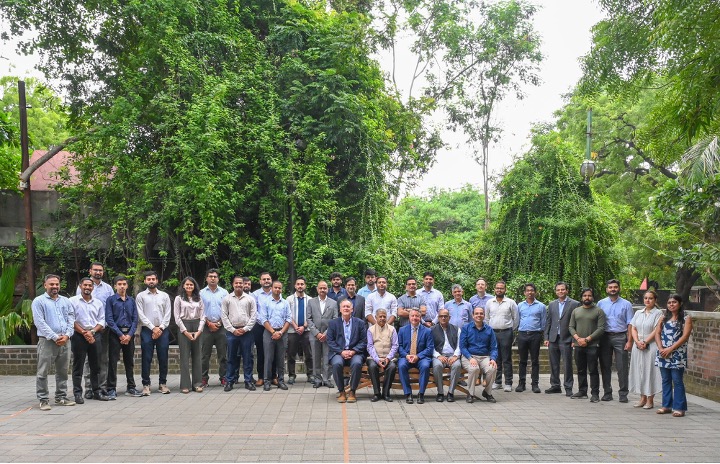
Workshop participants at CEPT University, Ahmedabad
The second workshop in the series, “Controls Optimization for Better Real-World Performance of Room AC,” was held in August 2026 at the CEPT University in Ahmedabad, Gujarat, India. It went a layer deeper by focusing on the control logic that decides what a given set of components can actually deliver in terms of AC performance and comfort to the end-user.
Identical ACs, different real-world outcomes
Two ACs having an identical refrigerant circuit, compressor, coil, and expansion valve can deliver very different real-world cooling capacity, humidity control, and energy use, depending on how its controls sequence compressor speed, expansion valve position, indoor airflow, and outdoor fan speed. Controls are a primary design lever for making better use of hardware already in the product. This matters because comfort is about achieving the desired levels of temperature and humidity in a space to make occupants feel comfortable.
In humid conditions, conventional ACs overcool the space to remove moisture and humidity, using 25%–35% more energy in the process. The opportunity is to redesign ACs with improved controls strategies that allow for better management of comfort, rather than treating humidity as an afterthought.
A recurring finding across the workshop was that dehumidification has no single lever. Evaporator airflow, coil temperature, compressor speed, and superheat each affect cooling capacity, moisture removal, and efficiency in different ways, and the optimal combination changes with operating conditions. A dehumidification mode tuned for one set of conditions may not work at another set of conditions.
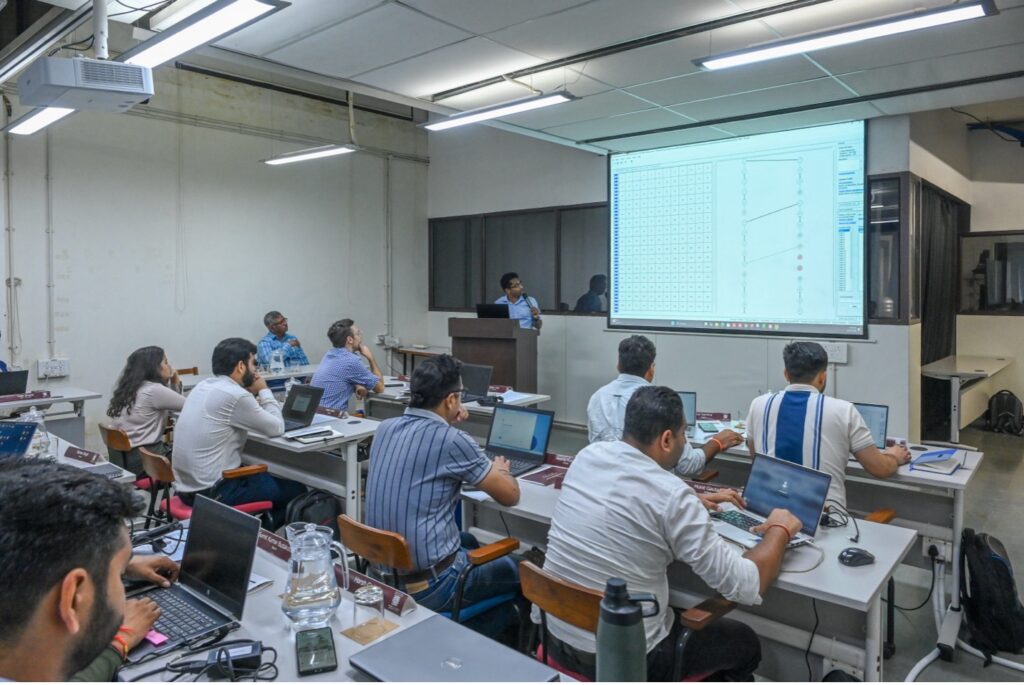
Hands-on modeling and simulation tools exercise
The reason for these differences is that outdoor temperature alone is a poor proxy for what a unit actually has to do. CEPT University’s field and laboratory measurements show that on two days with similar temperatures, the amount of moisture in the air can be very different. This becomes particularly important at night, when temperatures may fall but cooling needs can remain high due to humidity. An AC with a suboptimal dehumidification mode may slow down the compressor speed just when moisture removal is needed the most, leaving people uncomfortable and ultimately prompting them to lower the thermostat and spend more energy.
Addressing this challenge, however, does not always require new hardware. Simulation results showed that coordinating compressor speed, indoor airflow, the expansion valve, and condenser fan speed along with a low cost readily available humidity sensor can improve comfort and efficiency of the system by around 20 – 25 % in one annual evaluation period, while using the same components but with improved control logic.
India’s Opportunity to leapfrog to better ACs
As demand for AC explodes worldwide due to rising heat and humidity levels, India can become a global leader in AC manufacturing. India’s Bureau of Energy Efficiency has driven important progress by steadily raising the Minimum Energy Performance Standards (MEPS) and star rating requirements for room ACs over the past decade. However, as manufacturers optimize products to meet increasingly stringent star ratings, a gap can emerge between rated efficiency and real-world performance, particularly around efficient humidity removal. The opportunity is to evolve testing and rating systems to recognize both temperature and humidity control and better reward efficient comfort delivery under real-world conditions.
The emerging testing standard by the International Organization for Standardization (ISO), ISO 21280 under development by ISO/TC 86/SC 6, provides an important global signal. India can build on its progress on efficiency and act early on this shift, spurring development of ACs designed for real-world performance and positioning Indian manufacturers at the forefront of the next generation of efficient, comfort-optimized cooling.
Looking ahead
The opportunity now is to move beyond prototypes and lab experiments toward products that manufacturers can bring to market. Continued collaboration among manufacturers, component suppliers, testing laboratories, academia, and civil society is needed to help build the data, evidence, testing capabilities, and market confidence that give industry the signals they need to make humidity-optimized commercially viable products.
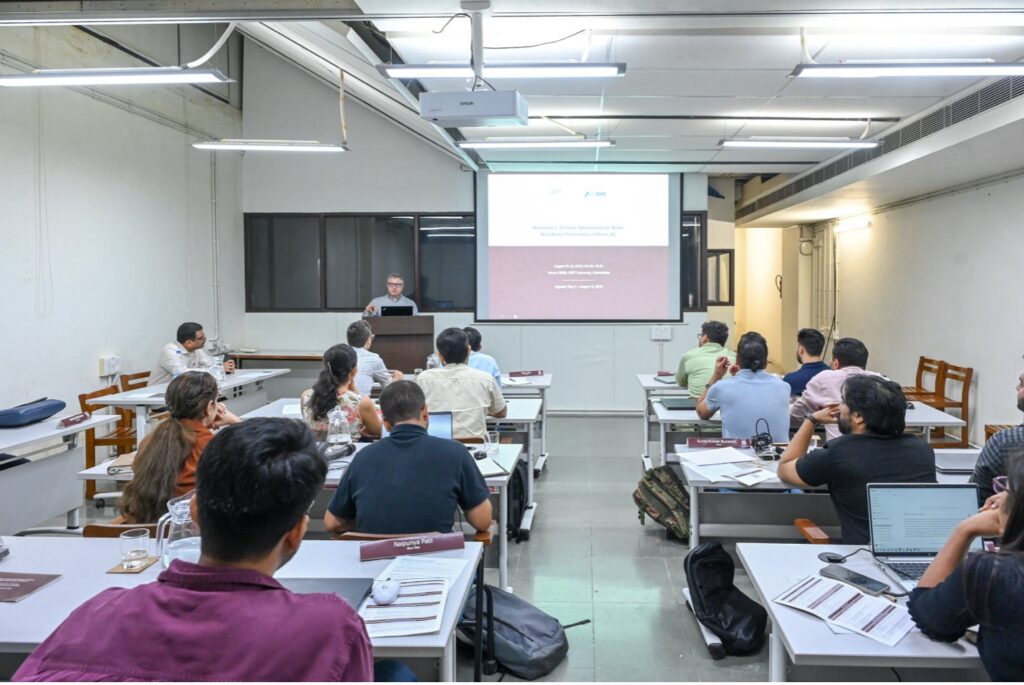
ASHRAE Presidential Member Bill McQuade provides closing remarks
For India, where cooling demand is growing rapidly and the AC R&D industry has a significant opportunity to shape what comes next, now is the time to invest in the foundations of a strong cooling ecosystem. The lessons are relevant well beyond India, as many other markets face a similar challenge of meeting growing cooling needs under increasingly demanding conditions. RMI and our partners at CEPT University remain committed to building the capacity needed across this ecosystem — so that every new AC is better prepared for the real-world conditions it will serve without compromising comfort or efficiency.
The authors would like to thank Akhil Singhal from RMI India Foundation for his contributions to the article. The authors also thank OTS R&D, a US-based engineering group with deep experience in translating academic research into practical HVAC product design, for delivering the technical sessions during the workshop.
Authors

Yash Shukla (CEPT University)
Ian McGavisk
Bill McQuade
Related Insights

How Heat Pumps Reduce Energy Bills and Air Pollution in the San Francisco Bay Area
Delivered Fuel Customers in Maryland See Strong Energy Bill Savings in a Switch to Heat Pumps

Gas Utility Depreciation: Recommendations for an Uncertain Future
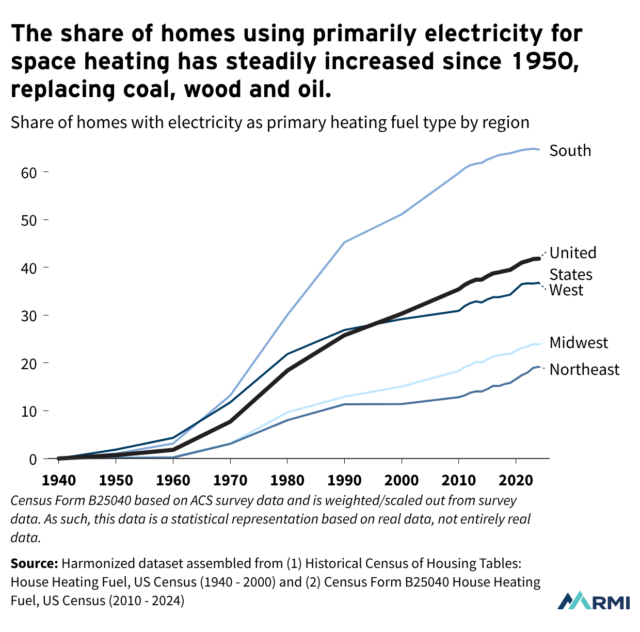
More Americans Are Heating Their Homes with Electricity than Ever Before
Help build the clean energy future. Donate today.
Independent research. Real-world solutions. Supported by donors.
RMI can pursue the highest-impact climate and energy solutions because we’re supported by people who believe change is possible. Every gift helps advance the work needed to make clean energy the default choice worldwide.
For other ways to give to RMI, including checks or gifts of stock, please visit Other Ways to Give.
