

Learn how we are working to transform how we use and produce energy.
California Ballot Measure Could Transform EV Charging and Access
California is dedicating the largest pool of funds to date to help improve EV adoption and charging in low- to moderate-income communities.
Why we share this work for free
RMI is an independent nonprofit working to accelerate the clean energy transition. We publish research like this to inform decision-makers and drive real-world impact.
Our work is supported by philanthropy as well as partnerships, including fee-for-service engagements. This support makes it possible for us to share our independent insights for free.
If you find this work valuable, you can support it anytime.
Get more insights like this
Stay up to date with the latest research, analysis, and tools from RMI by opting in to receive occasional emails below. You’ll get new reports, event invitations, and practical insights to help us all accelerate the clean energy transition.
Loading form...
Your download should start automatically. If it doesn’t, click the download button below.
This work is made possible by philanthropy
RMI is a nonprofit supported by donors and partners. Philanthropy enables us to produce independent research and make resources like this freely available.
If you find this report valuable, please consider supporting our work. You can also explore how we partner with organizations to drive impact.
Jump to Section
There’s an electric vehicle revolution coming in the United States. In the first quarter of 2022, EV registrations rose 60 percent even as overall new car registrations dropped 18 percent. As this demand spurs continued investment and competition, it becomes even more likely that EVs will reach upfront purchase price parity with gas-powered vehicles by 2030 (and lower total cost of ownership). In August, Congress unleashed a new wave of incentives in the Inflation Reduction Act, which offers up to $7,500 toward the purchase of an electric vehicle through 2032. States are increasingly focused on an electrified future; California alone accounted for 28 percent of the country’s overall electric vehicle registrations in 2021.
However, despite these encouraging trends, the United States simply isn’t prepared to accommodate full EV adoption, much less ensure the associated benefits are enjoyed by and accessible to as many people as possible. RMI’s recent report Increasing Equitable EV Access and Charging proposes approaches that state governments can take to help low-income drivers access EVs. We highlight California’s proposed Proposition 30, which would dedicate the country’s largest pool of funds to date to help improve EV adoption and charging in low- to moderate-income communities.
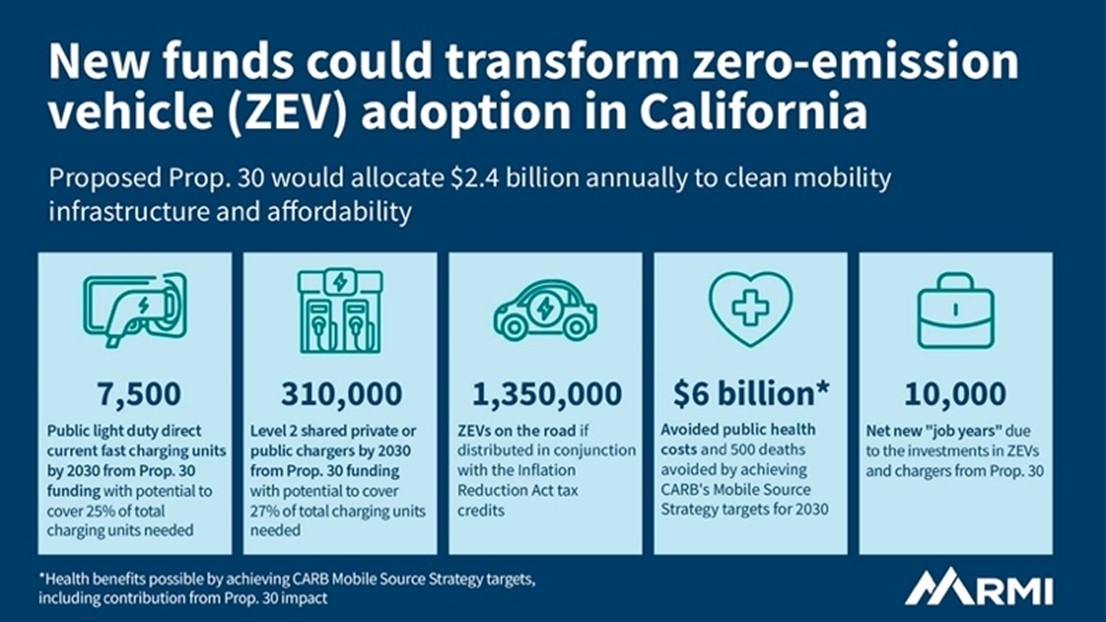
Over 40 percent of Americans in the top 100 metropolitan areas live in multiunit dwellings (MUDs) and have limited access to on-site chargers. Today, most apartment or condo buildings do not include EV charging infrastructure, making home charging impossible for residents. In California, RMI calculates that 330,000 MUD chargers will be necessary to meet the state’s EV targets. For comparison, California today has fewer than 72,000 total MUD, workplace, and public level 2 chargers combined. This lack of charger access makes it particularly difficult for drivers in low- to moderate-income communities to choose electric.
If passed, Proposition 30 would allocate $2.4 billion per year to EV access and infrastructure, along with other clean mobility solutions. RMI analyzed the potential impacts of the proposed funding and found that it could have a significant impact on EV adoption, health, and other critical outcomes.
As RMI’s new report explains, the charging barrier is not unique to California. Every US state needs to be taking steps now to ensure it is laying the groundwork for a transition to carbon-free transportation that benefits all residents. States that want to prioritize widespread adoption of EVs can:
- Reduce up-front EV costs through incentives
- Educate residents about EVs to relieve range anxiety
- Offer sufficient public charging that is affordable to different income levels
- Focus on charging infrastructure at home and work, especially at MUDs
Additional features that can support state design of comprehensive and equitable policies include creating non-invasive ways to manage charging so EVs charge primarily when power costs are low, setting enforceable zero-emissions vehicles sales targets, engaging community stakeholders for procedural equity, and coordinating policies across states for a more consistent driving and charging experience.
Policies like California’s Proposition 30 open the door to allowing people of all income levels benefit from the EV revolution. Other states must step up as well, to increase the number of EVs on state highways and within residential neighborhoods equitably across the United States.
Authors

Kiley Kroh
Alessandra R. Carreon
Related Insights
Gas Utility Depreciation: Recommendations for an Uncertain Future
Building Charging Networks That Meet Drivers’ Needs Without Breaking the Bank

Help build the clean energy future. Donate today.
Independent research. Real-world solutions. Supported by donors.
RMI can pursue the highest-impact climate and energy solutions because we’re supported by people who believe change is possible. Every gift helps advance the work needed to make clean energy the default choice worldwide.
For other ways to give to RMI, including checks or gifts of stock, please visit Other Ways to Give.
