

Learn how we are working to transform how we use and produce energy.
Leveraging Transition Pathways
How financial institutions can use pathways to inform transition intelligence
Why we share this work for free
RMI is an independent nonprofit working to accelerate the clean energy transition. We publish research like this to inform decision-makers and drive real-world impact.
Our work is supported by philanthropy as well as partnerships, including fee-for-service engagements. This support makes it possible for us to share our independent insights for free.
If you find this work valuable, you can support it anytime.
Get more insights like this
Stay up to date with the latest research, analysis, and tools from RMI by opting in to receive occasional emails below. You’ll get new reports, event invitations, and practical insights to help us all accelerate the clean energy transition.
Loading form...
Your download should start automatically. If it doesn’t, click the download button below.
This work is made possible by philanthropy
RMI is a nonprofit supported by donors and partners. Philanthropy enables us to produce independent research and make resources like this freely available.
If you find this report valuable, please consider supporting our work. You can also explore how we partner with organizations to drive impact.
Jump to Section
Transition pathways are an essential tool for financial institutions conducting corporate transition assessments. Such pathways can contextualize the ambition and feasibility of corporate plans, identify key technologies, and more. No single pathway can answer every question a financial institution has about a client or investee. Ultimately, approaches that deploy a diverse range of complementary pathways will provide the most granular and actionable results for a corporate assessment.
Despite their value, pathways remain underutilized, due to both the complexity of selecting one from the wide range available and the resource demands of working with existing options. This paper offers a structured approach for selecting and interpreting transition pathways, recognizing that no pathway is best for every application. The approach involves five core steps:
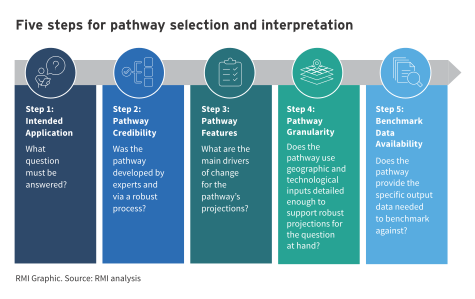
Although this process is intended to simplify the identification of suitable pathways, it may still prove to be resource-intensive when evaluating a large number of pathways in a sector and/or region that is new to the financial institution. However, this is largely a one-time investment, and it builds a deep understanding of a specific sector and/or region that can be applied to many assessments. Additionally, RMI is developing a transition pathway repository that will further streamline steps 2–5, allowing users to simply look up what pathways and benchmarks are available for a given application in a sector and/or region. This will further reduce the resource intensity and lower barriers to expanded adoption of pathways in transition assessments.
Acknowledgements
We would like to thank our colleagues at RMI who have contributed to this work. In particular, Hannah Barton, Elizabeth Harnett, Matthias Kensbock, Antoine Lalechere, Mitchell Luti, Estefania Marchan, and Christina Pastoria each played a vital role in shaping the research and ideas presented in this report.
We also thank our strategic partners and other financial institutions and experts for their ongoing support and thoughtful review. Their guidance and engagement throughout the development of this work have been invaluable, ensuring its relevance and impact.
Authors

Nicholas Halterman
Manager
Jacob Kastl
Software Developer
Aubrey McKinnon
Associate
Tom White
ManagerRelated Insights

The Opportunity for Heat Pumps to Put Downward Pressure on Electricity Rates
Gas Utility Depreciation: Recommendations for an Uncertain Future


Help build the clean energy future. Donate today.
Independent research. Real-world solutions. Supported by donors.
RMI can pursue the highest-impact climate and energy solutions because we’re supported by people who believe change is possible. Every gift helps advance the work needed to make clean energy the default choice worldwide.
For other ways to give to RMI, including checks or gifts of stock, please visit Other Ways to Give.
