

Learn how we are working to transform how we use and produce energy.
High Voltage, High Reward Transmission
Evidence from operational transmission projects that deliver cost savings to American consumers
Why we share this work for free
RMI is an independent nonprofit working to accelerate the clean energy transition. We publish research like this to inform decision-makers and drive real-world impact.
Our work is supported by philanthropy as well as partnerships, including fee-for-service engagements. This support makes it possible for us to share our independent insights for free.
If you find this work valuable, you can support it anytime.
Get more insights like this
Stay up to date with the latest research, analysis, and tools from RMI by opting in to receive occasional emails below. You’ll get new reports, event invitations, and practical insights to help us all accelerate the clean energy transition.
Loading form...
Your download should start automatically. If it doesn’t, click the download button below.
This work is made possible by philanthropy
RMI is a nonprofit supported by donors and partners. Philanthropy enables us to produce independent research and make resources like this freely available.
If you find this report valuable, please consider supporting our work. You can also explore how we partner with organizations to drive impact.
Jump to Section
Rising electricity demand, the need for a reliable grid, and new federal regulations are driving renewed interest in large-scale transmission projects. But as transmission investment grows, so do concerns about rising costs. Do these investments truly pay off for ratepayers?
This report provides a clear answer: yes — large-scale transmission projects deliver significant savings for American consumers and businesses.
Ratepayer Savings Exceed Costs
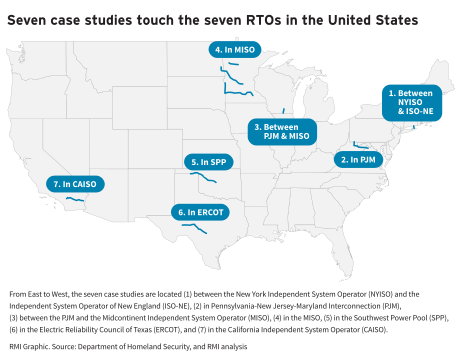
We analyzed seven regional and inter-regional transmission projects operating across the country — from California to Oklahoma — and found that each one delivered benefits exceeding their costs. These findings demonstrate that transmission investments pay for themselves over time, lowering electricity costs while strengthening grid reliability.
Transmission’s Unexpected Benefits
While transmission projects are typically designed to meet specific needs, their realized benefits extend well beyond their original purpose.
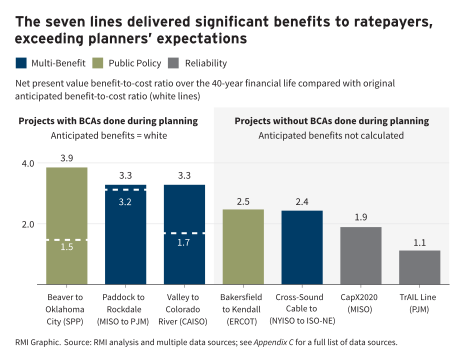
Projects designed for economic benefits outperformed planners’ expectations (green and blue projects in Exhibit ES2), expanding access to low-cost generation, improving resilience to extreme events, and helping states to meet public policy goals. Every studied non-reliability project significantly surpassed the Federal Energy Regulatory Commission’s (FERC’s) 1.25 benefit-to-cost ratio standard. Additionally, the three projects with pre-existing benefit-cost analyses (BCAs) exceeded the anticipated benefit-to-cost ratios (white dash) in their original plans.
Meanwhile, large-scale reliability-driven projects delivered unintended economic benefits beyond keeping the lights on (gray projects in Exhibit ES2). Though not required to meet FERC’s 1.25 benefit-to-cost standard, the studied reliability projects still approached or exceeded the threshold, proving their financial value while maintaining grid safety and functionality.
Smart Investments for the Future
Our findings confirm that large-scale transmission projects are cost-effective long-term investments that will continue to deliver savings for decades to come. Regulators and planners can move forward with confidence, knowing that transmission not only meets today’s energy challenges but also provides lasting value for American consumers and businesses — all while strengthening the grid.
Authors

Tyler Farrell
Manager
Celia Tandon
Senior Associate
Beverly Bendix
Manager
Chaz Teplin
PrincipalRelated Insights
Rural Electric Co-ops and the Future of American Energy
Gas Utility Depreciation: Recommendations for an Uncertain Future
Help build the clean energy future. Donate today.
Independent research. Real-world solutions. Supported by donors.
RMI can pursue the highest-impact climate and energy solutions because we’re supported by people who believe change is possible. Every gift helps advance the work needed to make clean energy the default choice worldwide.
For other ways to give to RMI, including checks or gifts of stock, please visit Other Ways to Give.
