

Learn how we are working to transform how we use and produce energy.
Why we share this work for free
RMI is an independent nonprofit working to accelerate the clean energy transition. We publish research like this to inform decision-makers and drive real-world impact.
Our work is supported by philanthropy as well as partnerships, including fee-for-service engagements. This support makes it possible for us to share our independent insights for free.
If you find this work valuable, you can support it anytime.
Get more insights like this
Stay up to date with the latest research, analysis, and tools from RMI by opting in to receive occasional emails below. You’ll get new reports, event invitations, and practical insights to help us all accelerate the clean energy transition.
Loading form...
Your download should start automatically. If it doesn’t, click the download button below.
This work is made possible by philanthropy
RMI is a nonprofit supported by donors and partners. Philanthropy enables us to produce independent research and make resources like this freely available.
If you find this report valuable, please consider supporting our work. You can also explore how we partner with organizations to drive impact.
Jump to Section
The latest installment of The Peaking Series shows demand for fossil fuels has peaked in the electricity sector. It will plateau for a few years and be in clear decline by the second half of the decade.
The key driver of change is the rapid growth of solar and wind electricity generation on typical S-curves, driven by low costs, a shift of global capital, and the rising ceiling of what is possible.
In 2022, solar and wind will produce 600–700 TWh of new electricity. Added to the 100–200 TWh from other clean sources makes it enough to meet projected global electricity demand growth of around 700 TWh.
The story just gets better and better as solar and wind advance further up the S-curve. Solar and wind generation will increase at least threefold by the end of the decade, pushing fossil fuel electricity into terminal decline.
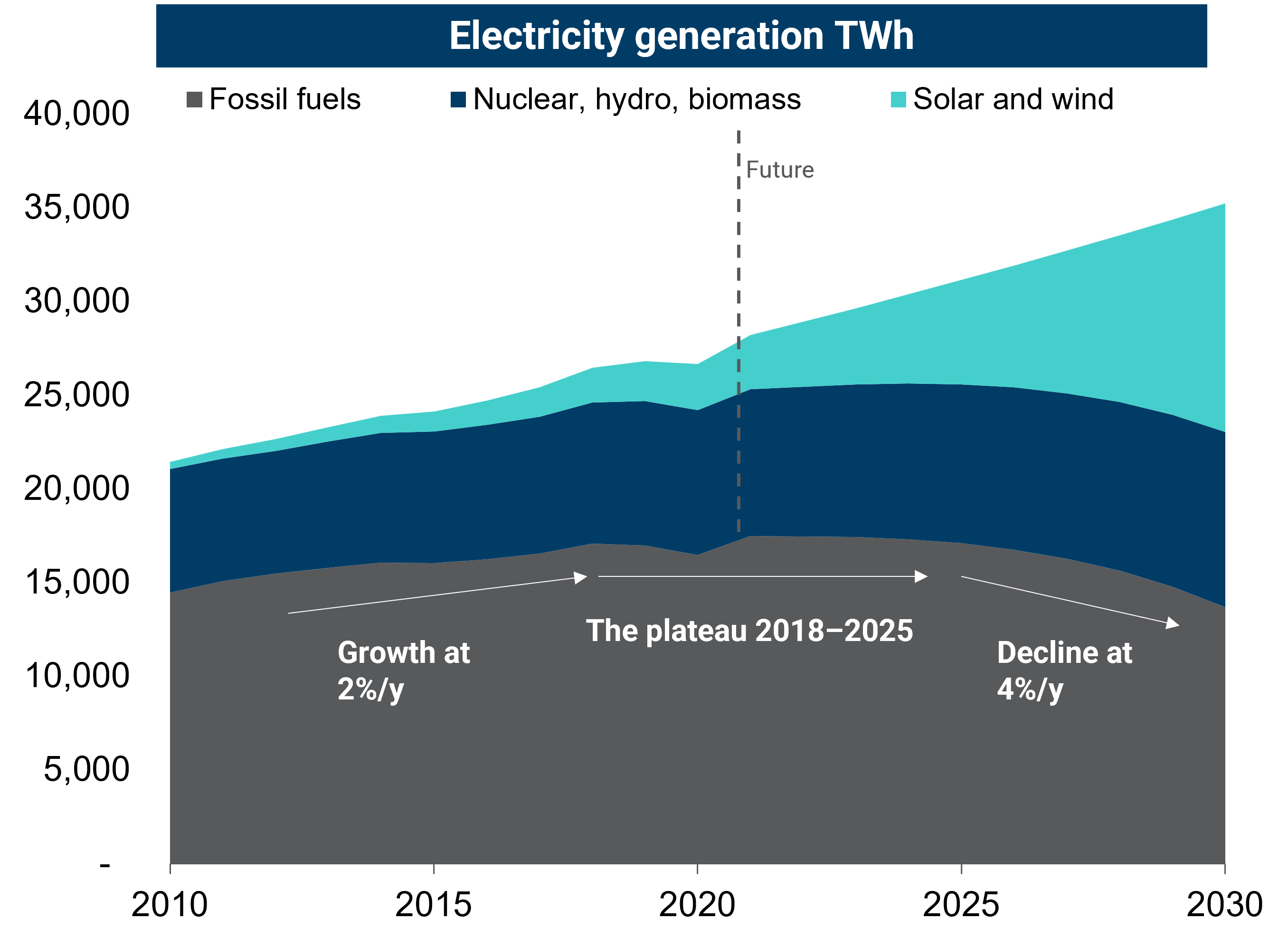
This is a global phenomenon. Fossil fuel demand for electricity has peaked in 95 percent of the OECD countries and 31 percent of the non-OECD countries excluding China. Chinese demand is about to peak as the 2030 renewable deployment goals are hit before 2025. India is choosing its own path to development, based on growth from renewables. And renewables offer new solutions for Africa.
There are plenty of barriers to change, but none of them are insoluble, immediate, and universal so cannot maintain the status quo. The ceiling of change is far above our heads and disruption of the incumbent fossil fuel system is thus inevitable.


Related Insights

Reality Check: For Power Plants, Changing the Fuel Doesn’t Fix the Economics

Beyond the First Frontier: What Comes Next for Carbon Removal
Help build the clean energy future. Donate today.
Independent research. Real-world solutions. Supported by donors.
RMI can pursue the highest-impact climate and energy solutions because we’re supported by people who believe change is possible. Every gift helps advance the work needed to make clean energy the default choice worldwide.
For other ways to give to RMI, including checks or gifts of stock, please visit Other Ways to Give.
