

Learn how we are working to transform how we use and produce energy.
Fueling the Transition: Accelerating Cost-Competitive Green Hydrogen
An achievable zero-carbon solution for decarbonizing industry
Why we share this work for free
RMI is an independent nonprofit working to accelerate the clean energy transition. We publish research like this to inform decision-makers and drive real-world impact.
Our work is supported by philanthropy as well as partnerships, including fee-for-service engagements. This support makes it possible for us to share our independent insights for free.
If you find this work valuable, you can support it anytime.
Get more insights like this
Stay up to date with the latest research, analysis, and tools from RMI by opting in to receive occasional emails below. You’ll get new reports, event invitations, and practical insights to help us all accelerate the clean energy transition.
Loading form...
Your download should start automatically. If it doesn’t, click the download button below.
This work is made possible by philanthropy
RMI is a nonprofit supported by donors and partners. Philanthropy enables us to produce independent research and make resources like this freely available.
If you find this report valuable, please consider supporting our work. You can also explore how we partner with organizations to drive impact.
Jump to Section
Green hydrogen production costs could fall below $2 per kilogram in many locations in the next five years. This zero-carbon fuel will be critical to decarbonizing some of the hardest-to-abate sectors, such as shipping and steelmaking. Achieving the crucial $2/kg target for cost-competitiveness will enable decarbonization of multiple sectors and play an important role in aligning the globe to a pathway that limits warming to 1.5°C.
RMI’s report, Fueling the Transition: Accelerating Cost-Competitive Green Hydrogen, analyzes the cost reduction opportunity and the critical enabling tools required to bring cost-competitive green hydrogen to market this decade. This report is intended for industry executives, regulators, and policymakers.
Exhibit 6
Reduced electrolyzer capex is the largest driver to realize near-term cost reduction. This makes sub-$2/kg production costs achievable in locations previously not cost-competitive producers of green hydrogen.
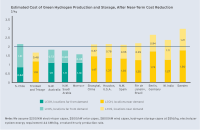 Note: We assume $200/kW electrolyzer capex, $500/kW solar capex, $800/kW wind capex, hydrogen storage capex at $516/kg, electrolyzer system energy requirement 44 kWh/kg, constant hourly production rate.
Reduced electrolyzer capital expenditure is the largest driver to realize near-term cost reduction. From today’s price range, a 50%–70% cost reduction is achievable in 2026–2030 via a combination of economies of scale, system design improvements, manufacturing optimization, and power system optimization. This makes sub-$2/kg production costs achievable in locations that were previously not cost-competitive producers of green hydrogen.
Among the report’s main conclusions:
- Low-cost green hydrogen production can be achieved faster with lower volumes of deployment than currently expected.
- Policy support will be needed for development of projects, realization of market off-take, infrastructure development, and further de-risking. While there is significant policy momentum, current policy support in most locations falls short of supporting announced targets.
- There are multiple paths to scale, from large off-take in hard-to-abate sectors, partial off-take from existing demand sectors, or a combination of these. Several sectors, such as refining and ammonia, can start scaling ahead of policy implementation, with the support of first movers.
This report presents analysis developed by RMI as a part of the Green Hydrogen Catapult (GHC). Visit the GHC website for more information on the coalition.
Authors

Thomas Koch Blank
Managing Director
Cato Koole
Manager
Patrick Molloy

Tessa Weiss
Manager
Stephen Doig
Emily Beagle
Chathurika Gamage
Related Insights
Gas Utility Depreciation: Recommendations for an Uncertain Future

Help build the clean energy future. Donate today.
Independent research. Real-world solutions. Supported by donors.
RMI can pursue the highest-impact climate and energy solutions because we’re supported by people who believe change is possible. Every gift helps advance the work needed to make clean energy the default choice worldwide.
For other ways to give to RMI, including checks or gifts of stock, please visit Other Ways to Give.
