

Learn how we are working to transform how we use and produce energy.
A Local Government’s Guide to Off-Site Renewable PPA Risk Mitigation
Why we share this work for free
RMI is an independent nonprofit working to accelerate the clean energy transition. We publish research like this to inform decision-makers and drive real-world impact.
Our work is supported by philanthropy as well as partnerships, including fee-for-service engagements. This support makes it possible for us to share our independent insights for free.
If you find this work valuable, you can support it anytime.
Get more insights like this
Stay up to date with the latest research, analysis, and tools from RMI by opting in to receive occasional emails below. You’ll get new reports, event invitations, and practical insights to help us all accelerate the clean energy transition.
Loading form...
Your download should start automatically. If it doesn’t, click the download button below.
This work is made possible by philanthropy
RMI is a nonprofit supported by donors and partners. Philanthropy enables us to produce independent research and make resources like this freely available.
If you find this report valuable, please consider supporting our work. You can also explore how we partner with organizations to drive impact.
Jump to Section
Local governments have become instrumental leaders in the clean energy transition. Nearly 200 US cities and counties and eight states have committed to 100% clean energy to date, covering approximately one in three Americans. Large-scale off-site renewable power purchase agreements (PPAs) have been the primary procurement method used to make progress on these goals, and they will likely continue to be a key strategy given their scope, flexibility, and ability to act as a financial hedge.
As with any energy procurement, off-site PPAs also come with risks. The wholesale market nature of off-site PPAs produces intricacies and financial risks that are not present in other renewable energy procurement strategies. For local governments without prior experience operating in wholesale markets, these may be new and unfamiliar.
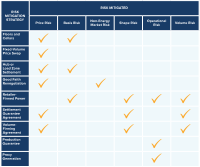
This report helps local governments understand and mitigate key risks by explaining what they are and the strategies to mitigate them. We describe six specific risks: price, basis, non-energy market, shape, operational, and volume. The report then summarizes nine mitigation strategies for the two primary types of PPAs, virtual PPAs and physical PPAs.


Related Insights

The Opportunity for Heat Pumps to Put Downward Pressure on Electricity Rates

Gas Utility Depreciation: Recommendations for an Uncertain Future


Help build the clean energy future. Donate today.
Independent research. Real-world solutions. Supported by donors.
RMI can pursue the highest-impact climate and energy solutions because we’re supported by people who believe change is possible. Every gift helps advance the work needed to make clean energy the default choice worldwide.
For other ways to give to RMI, including checks or gifts of stock, please visit Other Ways to Give.
