

Learn how we are working to transform how we use and produce energy.
Why High-Efficiency Cooling Is a Climate Priority
Why we share this work for free
RMI is an independent nonprofit working to accelerate the clean energy transition. We publish research like this to inform decision-makers and drive real-world impact.
Our work is supported by philanthropy as well as partnerships, including fee-for-service engagements. This support makes it possible for us to share our independent insights for free.
If you find this work valuable, you can support it anytime.
Get more insights like this
Stay up to date with the latest research, analysis, and tools from RMI by opting in to receive occasional emails below. You’ll get new reports, event invitations, and practical insights to help us all accelerate the clean energy transition.
Loading form...
Your download should start automatically. If it doesn’t, click the download button below.
This work is made possible by philanthropy
RMI is a nonprofit supported by donors and partners. Philanthropy enables us to produce independent research and make resources like this freely available.
If you find this report valuable, please consider supporting our work. You can also explore how we partner with organizations to drive impact.
Jump to Section
The world leaders of the Group of Seven, better known as G7, released a long communique following their recent meeting in Cornwall, detailing their plans to address the COVID-19 pandemic and “build back better.” In a departure from the previous G7 meeting in 2019, which ended with a briefer list of agreements, this year’s G7 summit yielded more alignment, particularly in the areas of climate change and the energy transition.
Although the final list did not include all the measures needed to keep global temperature rise to 1.5°C, the environmental and climate agreements did include some overlooked and significant measures to prioritize efficiency. These include doubling the efficiency of cooling systems sold worldwide by 2030.
The Cold Crunch
Developing much more efficient cooling technologies will be critical to keeping 1.5°C within reach. Appliances for space cooling already account for about 10 percent of global electricity use, according to the International Energy Agency (IEA). And without efficiency improvements, the energy consumed for cooling could more than triple by 2050. Inefficient cooling systems also contribute to large peaks in electricity demand, which can overwhelm electric grids during hot spells.
The challenge of increasing the average efficiency of cooling systems is at least twofold, driven by both technological and policy changes. But the recent Global Cooling Prize has demonstrated that superefficient ACs are technologically feasible, and policy changes can now catalyze the commercialization and adoption of more efficient units.
Between now and 2050, an estimated 3.3 billion room air-conditioning units will be installed globally as heat waves become more common, populations grow, and urbanization increases. As of 2016, the IEA estimated, more than half of all air conditioners in service were in China and the United States. But over the coming decades, air conditioning use is expected to increase rapidly countries such as India and Indonesia, where residential AC is relatively rare today.
Cooling is not just a matter of comfort and convenience. More than a billion people today are at high risk to their health and safety due to lack of access to cooling, according to a report from Sustainable Energy for All. And those risks will increase as climate change drives greater temperature extremes.
Building Better ACs
RMI launched the Global Cooling Prize in 2018 with Mission Innovation and the Department of Science and Technology of the Government of India. The $1 million Prize set out an ambitious challenge for innovators to develop affordable cooling solutions with at least 80 percent lower climate impacts than a baseline unit.
In April 2021, the Prize was awarded to two teams—both representing large industry players—that successfully developed and tested prototype units that met the Prize criteria. Both winning teams met the threshold of 80 percent lower climate impact by reducing electricity demands and using refrigerants with lower global warming potential (GWP) than traditional refrigerant gases.
The Global Cooling Prize team estimated that, if the winning technologies could be scaled, they would mitigate more than 0.5°C of warming by the end of the century.
Accelerating Progress
The Global Cooling Prize proved that superefficient ACs running on low-GWP refrigerants are technologically feasible today. But policy changes would help accelerate the commercialization and adoption of efficient cooling units. As noted in a previous blog post, policymakers have two main levers to drive AC efficiency advancements: improving performance-rating systems for cooling products and creating testing standards that are technology-agnostic.
First, performance standards should recognize what is already possible and encourage manufacturers to continually push for more efficient products that consume less energy and cost less to operate. Today’s performance standards tend to focus on minimum acceptable efficiency levels. These ratings systems gradually raise the floor of efficiency to improve the performance of the laggards but do little to recognize or encourage the adoption of the best performers, which often surpass the highest defined efficiency level altogether. Japan, in contrast, has done just the opposite—identifying the best-performing products and setting the efficiency baseline based on those performance levels.
Second, the winners and finalists in the Global Cooling Prize showed that a variety of technologies can be incorporated into efficient cooling solutions. Some of the finalist prototypes incorporated solar photovoltaics, evaporative cooling, enhanced dehumidification capabilities, and other approaches. However, testing standards that assess an air conditioner’s capacity and efficiency are generally not designed with this variety of solutions in mind. Technology-agnostic testing standards would allow manufacturers to innovate more freely and combine multiple technologies to provide efficient and affordable cooling.
Looking Ahead
With the G7 summit concluded and the 26th UN Climate Change Conference of the Parties (COP26) coming up in the fall, we look forward to additional conversations and commitments that advance the goal of sustainable cooling. Specifically, a “Race to Zero” Breakthrough challenge aims to enlist AC manufacturers representing 20 percent of the market by COP26. The goal of the challenge is for those manufacturers to bring AC units to market by 2025 that have 80 percent lower climate impact.
If manufacturers and policymakers can take these superefficient ACs from prototype to production, they can significantly limit the climate impact of cooling as billions of new air conditioners hit the market over the coming decades. For a rapidly warming world, this is a matter of survival.
Authors

John Matson
Related Insights



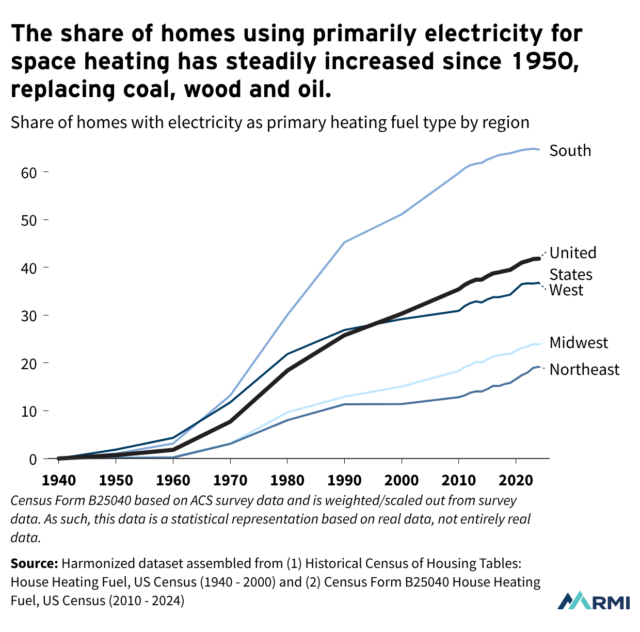
More Americans Are Heating Their Homes with Electricity than Ever Before
Help build the clean energy future. Donate today.
Independent research. Real-world solutions. Supported by donors.
RMI can pursue the highest-impact climate and energy solutions because we’re supported by people who believe change is possible. Every gift helps advance the work needed to make clean energy the default choice worldwide.
For other ways to give to RMI, including checks or gifts of stock, please visit Other Ways to Give.