

Learn how we are working to transform how we use and produce energy.
Designing Better Rates for Heat Pump Customers
Four case studies in affordability outcomes for electrification-friendly rates
Why we share this work for free
RMI is an independent nonprofit working to accelerate the clean energy transition. We publish research like this to inform decision-makers and drive real-world impact.
Our work is supported by philanthropy as well as partnerships, including fee-for-service engagements. This support makes it possible for us to share our independent insights for free.
If you find this work valuable, you can support it anytime.
Get more insights like this
Stay up to date with the latest research, analysis, and tools from RMI by opting in to receive occasional emails below. You’ll get new reports, event invitations, and practical insights to help us all accelerate the clean energy transition.
Loading form...
Your download should start automatically. If it doesn’t, click the download button below.
This work is made possible by philanthropy
RMI is a nonprofit supported by donors and partners. Philanthropy enables us to produce independent research and make resources like this freely available.
If you find this report valuable, please consider supporting our work. You can also explore how we partner with organizations to drive impact.
Jump to Section
Rising utility bills are increasing household energy costs across the United States, placing an especially heavy burden on low-income households. As electricity consumption grows, driven by users of all sizes from data centers to people using electric vehicles and appliances, policymakers are evaluating solutions to tackle the parallel challenges of rising costs and growing electricity demand. One often-overlooked tool is electric rate design, the structure of the utility tariffs that electricity providers charge customers for their services.
Electric heat pumps are a clear example of why rate design matters. While electricity demand on the grid often peaks during summer months when air conditioning use is highest, heat pumps add electric demand primarily in winter. This seasonal difference makes better usage of the grid capacity that already exists, often mitigating the need for additional system capacity upgrades. Yet many electricity rates do not recognize these system benefits. Instead, previous RMI analysis found that many electric rate structures shift costs from customers heating with fossil fuels to those heating with electricity. The result is higher-than-necessary bills for families that install heat pumps and a barrier to expanding beneficial electrification.
However, new rate designs are emerging that are more “electrification-friendly” and can lower costs for both heat pump users and electric systems at large. These rates can better reflect the true costs of electricity service, encourage adoption of technology like heat pumps and electric vehicles, and meet the needs of a grid increasingly powered by variable sources like solar and wind power.
Electric rate design approaches vary across jurisdictions, even when addressing the same goals. This is because regulators must balance a range of objectives, including revenue sufficiency, fairness, gradualism, simplicity and customer acceptance, economic efficiency, alignment with broader policy goals, and more. As a result, a variety of rate design approaches have been proposed to reduce barriers to beneficial electrification. In this piece, we examine electrification-friendly rate design in Massachusetts, Minnesota, Maine, and Maryland, highlighting the design mechanics, underlying justification, and impacts on heat pump customers for each.
Approaches
Creating a heat pump customer sub-class: Eversource Massachusetts
Goal: Advance heat pump adoption while limiting bill and revenue changes for non-participating customers.
In 2024, the Massachusetts Department of Public Utilities directed utilities to develop rates exclusively for heat pump customers using a design first proposed by Unitil. This approach matched the existing monthly fixed charge and summer per-kWh rates of the standard rate but lowered the per-kWh distribution rates in the winter by nearly 60%. This lower winter rate was calibrated to recover the same annual distribution revenue from a heat pump customer as from the average residential customer, acknowledging that heat pump customers use nearly three times as much electricity in the winter. The design reflected both climate and cost-causation considerations: a customer upgrading to a heat pump primarily adds electricity demand in the winter, with limited impact on delivery costs driven by summer demand. Eversource Massachusetts expanded on this approach, by lowering winter per-kWh rates for both distribution and transmission charges in the heat pump rate.
The new rates were designed in the context of the state’s legal mandate for the Department of Public Utilities to reduce greenhouse gas emissions. Heat pumps displace fossil fuel usage in the winter, so heat pump-friendly rates that advance heat pump adoption directly support reduced greenhouse gas emissions.
Creating an electric space heating sub-class: Xcel Minnesota
Goal: Reflect cost of service differentials between residential electric space heating and non-electric space heating customers.
Xcel Minnesota offers an electric space heating rate for residential customers who use electricity as their “primary heating system,” including heat pumps and electric resistance systems.
The rate mirrors the standard residential electric rate’s monthly service charge and per-kWh energy charge in the summer but offers a lower per-kWh energy charge in the winter. Electric space heating customers consume significantly more electricity in the winter compared to an average residential customer. Because Minnesota is a summer-peaking system, this incremental winter load typically does not drive capacity-related system upgrades in the same way summer peak demand does. In combination with higher expected winter usage, a lower winter energy charge can still allow the utility to recover needed revenue while avoiding charging electric space-heating customers for capacity-related costs they are not responsible for in the winter. Xcel Minnesota’s energy charge recovers both delivery and supply of electricity.
For a customer heating with electricity, this rate is designed to guarantee a reduced energy bill. Recognizing this, the PUC recently directed Xcel Minnesota to build default enrollment into the utility’s heat pump programs.
Reforming the standard rate: Pepco Maryland
Goal: Improve cost-reflective pricing for all residential customers by recognizing seasonal differences in system costs.
Pepco Maryland offers a standard residential rate for all customers that includes winter per-kWh delivery rates that are about half of summer per-kWh delivery rates.
While many utilities have modest differences in distribution per-kWh rates between summer and winter in their standard electric rate, some electric utilities design rates with more significant seasonal differences. This approach serves multiple goals. First, it improves alignment between customer rates and system costs (many of which are driven by summer demand). Second, it aims to reduce electric grid costs for summer-peaking systems, encouraging conservation in the summer and increased utilization in the winter when capacity is available. While this rate was not designed explicitly to support heat pump adoption, it is an example showing how improved cost-reflective pricing can also support consumer economics for heating electrification.
Expanding the menu of available rate designs for all customers: Central Maine Power
Goal: Offer optional electric rates to customers that are cost-reflective and encourage beneficial electrification.
Central Maine Power (CMP) offers an optional electric technology rate that can benefit residential customers with larger electric loads such as heat pumps and electric vehicles. Compared to the standard rate, the monthly fixed charge is increased from $30 to $40, while the per-kWh charge is lowered year-round by nearly 30%. The new rate is intended to encourage adoption of electric home equipment. The monthly fixed charge is meant to better align with the marginal costs to service a customer, as informed by CMP’s marginal cost of service study.
How do these rate solutions impact heat pump customers?
We analyzed the impact of these rate solutions on heat pump customers in three ways:
- Does the approach improve the average energy bill impacts of heating electrification?
- Does it help a greater share of customers save money when electrifying their heat?
- What portion of heat pump customers are enrolled in the rate?
First, we found that all four rates improve energy bills for residents who electrify their heating to varying degrees. The Eversource Massachusetts and Xcel Minnesota rates result in the highest average improvement for electrified heating customers, $770 and $689 per year respectively. Central Maine Power’s opt-in rate and Pepco Maryland’s seasonal distribution rate both offer a modest average improvement on the energy bills for electrified heating customers, $212 and $87 per year respectively.
Second, we looked at the percentage of customers who save when upgrading to a heat pump. The Eversource Massachusetts and Xcel Minnesota approaches result in significantly more customers saving money when electrifying their heating systems. Pepco Maryland’s seasonally differentiated rate represents a modest improvement, with nearly 60% of customers seeing savings compared with about half under the hypothetical flat rate, and fewer customers experiencing large bill increases. Central Maine Power customers mostly save regardless of what rate they are on due to the high prevalence of expensive delivered fuel heating systems.
Last but not least, we looked at the portion of customers enrolled in each rate. Pepco Maryland has the broadest reach, as it applies to all residential ratepayers and requires no additional enrollment. Eversource Massachusetts and Xcel Minnesota designed their rates to automatically opt-in customers receiving heat pump rebates. Eversource also retroactively enrolls customers who received the rebate in recent years. Central Maine Power’s opt-in rates are accessed by the minority of heat pump users within its territory. The result shows how broad enrollment strategies — such as changes to the standard rate for everyone, and automatic enrollment for qualified customers — can deliver effective rates to more customers than typical “opt-in” enrollment approaches.
Navigating the choices
Each of the above solutions benefits heat pump customers and charges them more fairly according to the costs to serve them, but to varying degrees and with distinct broader impacts and goals. Although we have selected a few case studies, the exact impacts can vary greatly even for electric rate designs with the same features, given that each utility operates under a unique set of conditions with varying demographics. There are some cases where the seasonally differentiated default rate approach, such as with Pepco Maryland, may provide even greater savings than an electric technology-specific rate — for example, in Illinois, Ameren’s seasonally-differentiated default rate provides significant savings for heat pump customers when switching from a gas furnace, on par or even exceeding savings from ComEd’s Electric Heating Rate. For more details, see our prior work, highlighting legacy electric heating rates that range from 20% annual bill savings to no savings compared to the standard rate.
Understanding the customer impacts and potential bill savings is critical when considering rate design solutions. The analysis above highlights that it is possible to evaluate these solutions in concrete terms, which provides a clearer understanding of how a new rate might compare to the default. While this article analyzed bill impacts, utilities and regulators can also consider other metrics, such as the bill impacts to non-participants or the change in the cost shift between fossil heating and heat pump customers.
When assessing the implications of proposed rate designs on heat pump customers, there are three questions to help guide evaluation:
- Is there a cost misalignment under standard rates today, and if so, how big is it? Quantifying the degree of cost shift between fossil heating and heat pump or electric heating customers is an important first step. Comparing their cost of service to what they pay under existing rates helps identify the scale of the issue, cost shifts between customer groups, and changes that may be warranted.
- How should heat pump users and other ratepayers share the benefits of beneficial electrification? Electrification can create a win-win when new electric load is served at a lower average unit cost than the existing system. Added sales can help spread fixed costs, improve utilization of existing assets, and lower average rates for all customers, including those who do not electrify, but those outcomes are not automatic. They depend on rate design and cost allocation choices that determine whether the savings created by beneficial load growth are visible to customers considering electrification.
Commissions can ensure electric rates allow heat pump customers to see enough bill savings to improve the economics of electrification while also supporting affordability for non-electrifying customers. If rates do not signal the lower cost to serve, policymakers may weaken the customer economics at the same time as ratepayers are investing significant sums to encourage building electrification.
- How many customers will be reached by the proposed solution? As jurisdictions balance tradeoffs between targeted customer benefits and broad customer reach, customer adoption is a central consideration. Opt-in rates that rely on customers taking the initiative to enroll have historically seen low enrollment, and strategies focused on increasing enrollment can expand benefits to more customers.
Customer participation strategy should be a central consideration in any opt-in rate proposal. This includes attention to simplicity, customer education, bill protection mechanisms, transparent reporting on enrollment and outcomes, or other strategies to make enrollment easy for those who could benefit. Where enrollment can be directly integrated into rebate programs, such as default rate enrollment within Mass Save or Xcel Minnesota heat pump programs, adoption can improve substantially. Finally, jurisdictions may consider a two-pronged strategy that introduces new opt-in rates and reforms to the standard rate. Reforms to standard rates may provide more modest per-customer benefits but are unparalleled in both reach and timeline to impact customers.
Conclusion
Given its central role in consumer behavior and energy bills, electric rate design will continue rising in salience in conversations on affordability, system reliability, and adoption of efficient, electric technologies. Thoughtful rate reform presents an opportunity to advance affordability and electrification, tailored to fit specific goals, needs, and customer classes of each state or utility territory.
To view the assumptions and process used to generate this analysis, download the PDF using the button below.
Thank you to our additional contributors, Angus Dillon, Mike Henchen, and Al Qarooni.


Related Insights
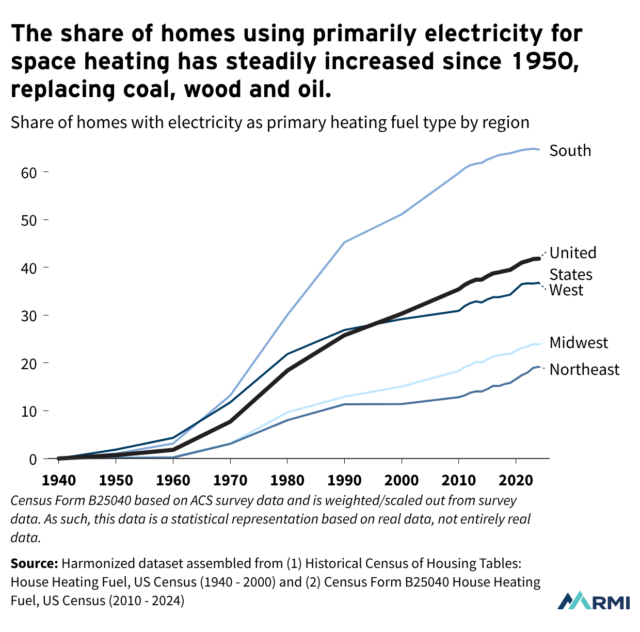
More Americans Are Heating Their Homes with Electricity than Ever Before

Appliance Efficiency Standards: A Proven Tool for Affordability and Grid Reliability
Help build the clean energy future. Donate today.
Independent research. Real-world solutions. Supported by donors.
RMI can pursue the highest-impact climate and energy solutions because we’re supported by people who believe change is possible. Every gift helps advance the work needed to make clean energy the default choice worldwide.
For other ways to give to RMI, including checks or gifts of stock, please visit Other Ways to Give.
