Learn how we are working to transform how we use and produce energy.
Transmission Affordability Resource Guide
Eight tools US regulators can use to promote affordable transmission
Why we share this work for free
RMI is an independent nonprofit working to accelerate the clean energy transition. We publish research like this to inform decision-makers and drive real-world impact.
Our work is supported by philanthropy as well as partnerships, including fee-for-service engagements. This support makes it possible for us to share our independent insights for free.
If you find this work valuable, you can support it anytime.
Get more insights like this
Stay up to date with the latest research, analysis, and tools from RMI by opting in to receive occasional emails below. You’ll get new reports, event invitations, and practical insights to help us all accelerate the clean energy transition.
Loading form...
Your download should start automatically. If it doesn’t, click the download button below.
This work is made possible by philanthropy
RMI is a nonprofit supported by donors and partners. Philanthropy enables us to produce independent research and make resources like this freely available.
If you find this report valuable, please consider supporting our work. You can also explore how we partner with organizations to drive impact.
Jump to Section
Introduction
Across the United States, transmission investment is on the rise, driven by the need to replace aging infrastructure, address accelerating load growth and extreme weather, and facilitate the construction of new power generation and storage facilities. In the past decade, annual transmission spending has risen by 75%, reaching an all-time high of $35 billion in 2025. Transmission now comprises 26% of utility assets in the United States, having steadily increased from 15% in 2005.
To keep ratepayers’ bills as affordable as possible, it will be essential to plan transmission projects wisely in a way that maximizes total system-wide savings. Well-planned regional transmission has time and again delivered substantial benefits to the grid and value to ratepayers. It is critical to continue to invest in such projects while reducing costs in complementary ways.
In this Transmission Affordability Resource Guide, we lay out eight tools that state and federal regulators can leverage today to reduce the total cost of transmission projects to ratepayers while efficiently and rapidly meeting the growing needs of the United States’ aging grid. We include several examples to illustrate how these tools have already been deployed in key geographies to the benefit of ratepayers and the grid. These eight tools can be grouped into four categories:
- Technology solutions to get more out of the existing grid
- Better planning and regulatory oversight
- Contract provisions and monitoring tools
- Financing tools
Together, these solutions are designed to (1) ensure that we get the most out of the grid we have today, (2) ensure utilities have the right incentives and oversight to develop efficient and right-sized solutions, (3) reduce capital costs for projects to free up more ratepayer dollars, and (4) protect ratepayers from cost overruns and delays.
If you are new to the transmission space, we encourage you to read this transmission primer to help familiarize yourself with what we call the transmission life cycle, which includes how transmission projects are designed, permitted, and built; how costs are allocated and rates are set; and which state and federal regulatory agencies are relevant. We are also available to provide technical assistance to states interested in implementing any of these tools.
Technology Solutions to Get More out of the Existing Grid
In this section, we discuss two technology categories that can help meet grid needs rapidly and cost-effectively: advanced transmission technologies (ATTs) and storage as a transmission asset (SATA). These technologies can help to modernize the grid at lower cost than building new transmission or rebuilding an existing line using standard (lower-capacity) conductors. Although they are not applicable in all instances due to technical limitations, where they are applicable, they create more available capacity and reduce congestion at a fraction of the cost of traditional transmission solutions.
Tool #1: Advanced transmission technologies
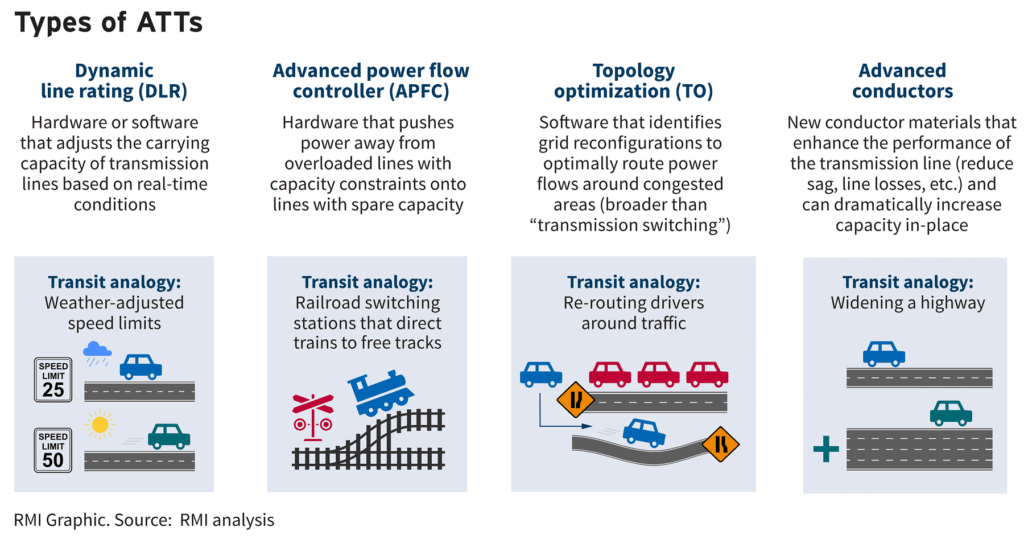
Before building new transmission, utilities and grid operators should maximize the value of the existing grid by deploying ATTs, a suite of hardware and software solutions that collectively increase the grid capacity at significantly lower cost than new build projects (see Exhibit 1). Some technologies, such as dynamic line ratings (DLR), advanced power flow controls, and topology optimization — collectively known as grid-enhancing technologies (GETs) — can be leveraged operationally to increase available transmission capacity or optimize power flows, thereby reducing grid congestion and the associated costs that are ultimately borne by ratepayers. Some GETs can also be used to measure equipment performance to most accurately identify when equipment needs to be replaced or upgraded. GETs collectively are projected to save up to 40% in total congestion costs nationwide ($5 billion each year), and many can be deployed in a matter of months.
Another ATT, advanced conductors, can be used in transmission projects to expand capacity on existing lines through a process known as reconductoring or leveraged on new-build projects to create more capacity at the outset. A 2024 study found that reconductoring could save US ratepayers $85 billion by 2035 and $180 billion by 2050 by enabling four times the amount of transmission capacity compared with relying on traditional conductors. Reconductoring projects are often easier to site and permit than new-build projects because they take place in existing rights-of-way. Moreover, they can be completed in one to three years, substantially faster than new-build transmission.
Exhibit 1. Types of advanced transmission technologies
Below are three examples of real-world ATT deployment in the United States.
- In 2025, Great River Energy in Minnesota deployed DLR sensors on 10 highly congested transmission lines, unlocking up to 63% more capacity and saving ratepayers $3.175 million in avoided congestion over the project’s life (five years).
- In 2024, AES deployed 42 DLR sensors on five lines across Indiana and Ohio. Installation took two weeks, and some lines could carry up to 60% more capacity than they had using static (default/non-DLR) ratings. AES also learned through its experience with these projects that pairing DLR with targeted reconductoring can enhance line capacity at lower cost than reconductoring the whole line.
- The Midcontinent Independent System Operator (MISO), Southwest Power Pool (SPP), and Electric Reliability Council of Texas (ERCOT) are all beginning to leverage topology optimization in their grid operations. MISO has seen $134 million in savings so far from deploying these reconfigurations in 2024 and 2025. SPP estimates that its grid could see annual congestion savings of $18 million to $44 million. This 2024 collection of 22 case studies of topology optimization deployments across the United States further illustrates the significant possible savings.
ATT deployment in general in the United States has been constrained due to inherent disincentives in utility ratemaking, a lack of familiarity with ATT capabilities, and limited use cases. First, today’s utility ratemaking structures disincentivize the use of ATTs because utility earnings are often tied to capital investment, giving utilities a stronger financial incentive to pursue more expensive traditional grid infrastructure. Changing utility incentive structures or introducing policy requirements or mandates are ways to address these financial disincentives. For instance, some states have passed legislation that requires ATTs to be considered as part of integrated resource planning (e.g., Indiana) or when utilities seek state approval for a permit for their transmission project (e.g., Massachusetts). Other states require utilities to conduct system-wide studies of ATT opportunities (e.g., California, Colorado, Minnesota). Second, many utilities are still unfamiliar with specific ATTs and their use cases. Increasing utility education on this topic and pilot programs such as the examples listed above can help accelerate deployment. Third, ATTs are not applicable in all use cases. For instance, limiting factors across the system, such as constraints at a substation or other downstream equipment, may reduce the effectiveness of an ATT. In other cases, an ATT may resolve only part of a grid violation so that additional investment in traditional grid infrastructure is needed to resolve the remainder. Thus, ATTs should not be viewed as a panacea but rather as an important tool to collectively modernize and expand the grid at least cost.
Action items
- Collectively, 18 states and counting have passed legislation encouraging, incentivizing, or requiring their utilities to deploy ATTs.1 More states should follow their lead.
- A federal shared savings incentive from Congress or the Federal Energy Regulatory Commission (FERC) could also help to accelerate ATT usage, but it should be designed to ensure that customers receive cost reductions far higher than any incentive earned by the utility. Alternatively, Congress or FERC could establish an ATT deployment requirement, although FERC has already required ATT consideration in generator interconnection, transmission planning, and large load network upgrades in Order No. 2023, Order No. 1920, and its 2026 show cause orders, respectively.
- Regional transmission organizations (RTOs), independent system operators (ISOs), and grid planners should also collectively and publicly commit to supporting ATT deployment by prioritizing ATTs as solutions during grid studies or planning exercises. States should regularly converse with RTOs/ISOs and grid planners about the extent to which they are using ATTs in their planning to ensure usage is maximized.
For more ATT resources, consult Danovo Energy Solutions’ technical planning guides and RMI’s Electricity Affordability Toolkit summary of ATTs.
Tool #2: Storage as a transmission asset
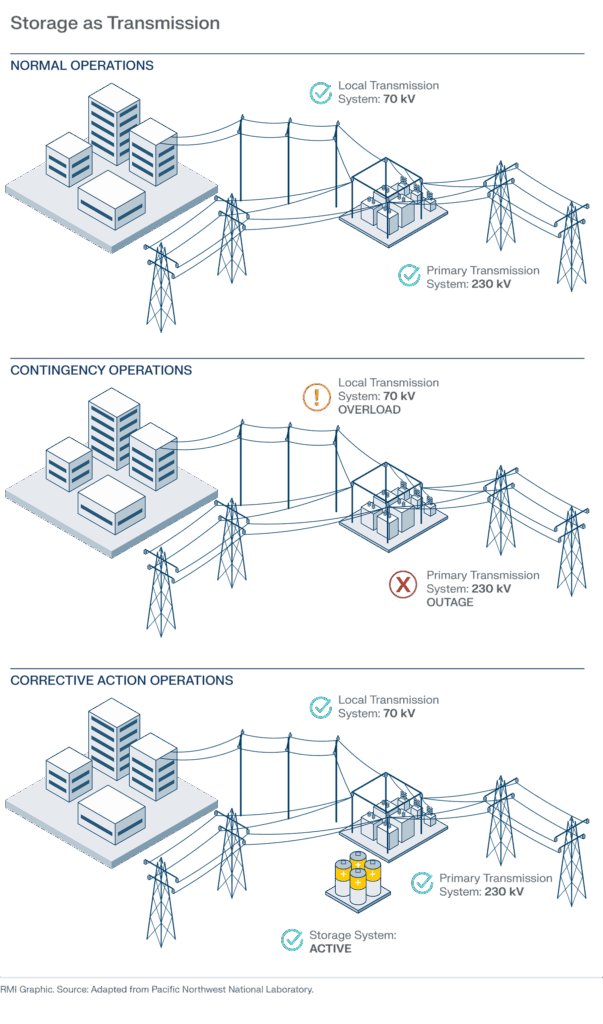
Battery storage assets can be deployed to mitigate grid constraints in a cost-effective and modular way. This is known as SATA (see Exhibit 2).2 Dual-use storage refers to SATA that also participates in wholesale markets when it is not needed to provide transmission service. It is often cheaper and faster to deploy SATA to resolve grid constraints than a traditional new-build transmission project.
SATA can also be deployed as an intermediate solution to address a grid constraint while a more permanent solution, such as a new line or ATT upgrade, is being built. After the more permanent solution is in place, the storage asset can then be used to resolve grid constraints elsewhere on the system or to provide power in energy and capacity markets.
Exhibit 2. Overview of storage as a transmission asset
Several utilities and grid planners in the United States have deployed SATA, to the benefit of ratepayers:
- In 2017, Arizona Public Service (APS) deployed a 2 megawatt (MW)/8 MW-hour battery storage system to meet modest but continuous load growth in the rural, mountainous community of Punkin Center. APS found that the battery system was 50% of the cost of a traditional wires solution.
- In 2018, California ISO (CAISO) deployed a $14 million storage asset to mitigate an outage risk on a line in the town of Dinuba, providing $2 million in savings to ratepayers by avoiding rebuilding a line that would have cost $16 million.
- In 2018, CAISO selected a $102 million proposal to deploy distributed storage assets in Oakland, California, to mitigate the retirement of a 165 MW peaker plant that would have otherwise required rebuilding and hardening the transmission network at a cost of $367 million to $574 million.
- New York state is leveraging mobile energy storage units to manage electric vehicle charging integration while waiting for grid upgrades to be completed.
- Maine deployed a 0.5 MW battery to defer the need for an $18 million transmission line upgrade that would have otherwise been needed to provide capacity and reliability to the community of Boothbay.
- National Grid deployed a 6 MW battery to avoid the need for a $200 million subsea cable from the mainland to Nantucket, Massachusetts.
- This 2024 publication from Pacific Northwest National Laboratory summarizes several SATA case studies from across the United States and the world, different SATA use cases, and current FERC/RTO policy on SATA.
SATA deployment is limited today in part because dual use is not allowed in many markets, limiting storage from maximizing its system value. This limitation is due to the valid concern that dual-use storage could lead to market manipulation. The concern is that the owner of the storage asset could operate it to artificially create transmission congestion and thus raise market prices. This possibility has led to no RTO allowing for SATA that provides transmission services to also participate in wholesale energy markets, despite FERC encouraging this dual-use framework in a policy statement in 2017 through revenue crediting.
Creative approaches can enable dual-use storage while mitigating the market distortion risk. Australia, for instance, leverages third-party ownership structures, allowing its transmission network service providers (TNSPs) to own storage assets to resolve transmission constraints and to lease spare capacity to third-party entities to earn market revenues. Australia is also exploring third-party owned storage assets that can be contracted by the TNSP to provide transmission services. Germany is also exploring dual-use storage through its GridBooster program, which has a third-party ownership model, to reduce redispatch costs by up to 60%. Market operators in the United States could consider adopting these international approaches or leveraging FERC’s 2017 recommendation to use revenue crediting, which ensures that market earnings flow to ratepayers directly rather than to the storage asset owner.
Regardless of the specific approach, enabling dual-use storage would be an essential step forward for the United States to enable more SATA deployment, helping SATA to provide their full system value and saving ratepayers money through more innovative system design.
Action items
- RTOs/ISOs should consider how to reform market rules to enable SATA market participation (i.e., dual-use storage) in a way that avoids revenue double-counting and maximizes value for ratepayers (e.g., through revenue sharing).
- FERC could build on its 2017 policy statement by issuing a rulemaking requiring RTOs/ISOs to develop dual-use storage policies.
- State regulators can also urge their RTOs/ISOs, grid planners, and utilities to leverage storage in a way that maximizes its system value. This could include conducting more comprehensive transmission, generation, and storage planning processes or scenario analyses, including through integrated resource plans in relevant states, to clarify where storage can best supplement existing and new resources.
Better Planning and Regulatory Oversight
In this section, we discuss two tools that support efficient project construction with appropriate regulatory oversight: closing the regulatory gap over local transmission spending and establishing a federal transmission consumer advocate or independent transmission monitor. These would reduce unnecessary costs and ensure that grid planners build the most beneficial projects.
Tool #3: Close the local transmission regulatory gap
As we have documented in Mind the Regulatory Gap: How to Enhance Local Transmission Oversight, transmission owners across the United States are investing more in lower-voltage local transmission projects and less in high-voltage regional transmission projects. Up to 50% of recent transmission spend can be attributed to local projects, which are not subject to the same level of rigorous planning and analysis or the same regulatory review as regional projects. This constitutes a regulatory gap that incentivizes transmission owners to build multiple, piecemeal solutions rather than more efficient larger ones, resulting in higher cost to ratepayers.
To maximize the efficacy of ratepayer dollars spent on beneficial regional transmission, state and federal regulators can take several steps to close the gap and increase oversight for local transmission projects, including:
- FERC can require planning regions (RTOs/ISOs, where applicable) to fully integrate local projects into the regional planning process through a right-sizing analysis for efficient regional-first planning.
- Individual planning regions and their transmission owners could take this action without an instigating FERC demand through proactive tariff revisions (filed at FERC under Section 205 of the Federal Power Act). States can advocate for their planning regions to file such right-sizing reforms.
- FERC can reform its formula ratemaking process to remove the presumption of prudence for local projects that have not been reviewed by a state regulatory agency (e.g., the public utilities commission [PUC]) for prudency and cost.
- FERC currently presumes all transmission projects are prudent unless proven otherwise by a third party. This makes it possible for local projects to receive approval from FERC with no substantive review. Removing the presumption of prudence for projects that were not reviewed at the state level would require utilities to submit documentation on the project’s need, cost, and other technical details akin to what they would submit to a state regulatory agency for a certificate of public convenience and necessity (CPCN). FERC should also assess opportunities to make it easier for intervenors to challenge prudence.
- FERC could lower the allowed ROE for local transmission projects to incentivize greater attention and focus on regional or interregional projects instead (which come with greater benefits).
- FERC can work with its regional planning entities and utilities to establish public, transparent information on when assets are at the end of their lives and in need of replacement. This information could be based on asset age, condition, and risk and sorted by asset type/class. Making this information public can help benchmark utilities’ decisions to replace specific aging infrastructure against industry norms and best practices. FERC can then encourage regional planning entities and utilities to extend the life of existing assets and defer upgrades as much as practically possible while maintaining grid reliability. Such deferrals can improve affordability by allowing ratepayers to receive more value from existing assets before paying for their replacement, reducing the need for premature capital investment.
- State legislatures and PUCs can make their CPCN requirements for local projects more robust, removing rebuild exemptions and establishing requirements that PUCs conduct technical modeling of projects to ensure design is adequately scoped (e.g., proper consideration of ATTs). States could also require utilities to provide evidence that the RTO/ISO was unable to find a more cost-effective or efficient regional solution to its local project when filing for a CPCN for a project.
- State legislatures and PUCs can require transmission providers to file local transmission plans regularly (e.g., annually) with a forward-looking forecast of spending (e.g., five years ahead) to provide state regulators a more complete picture of anticipated local transmission needs and prudency.
For a complete list of recommendations and more information, please see our Mind the Regulatory Gap report.
Tool #4: Establish a federal transmission consumer advocate or independent transmission monitor
At the state level, consumer advocates play an important role by advocating for lower-cost outcomes for ratepayers in proceedings, including state PUC rate cases. Yet, there is currently no federal consumer advocate. FERC trial staff play a limited consumer advocacy role in federal transmission rate proceedings,3 leaving state consumer advocates to formally challenge transmission spending in these rate proceedings. State consumer advocates, however, can lack the transmission-specific technical expertise or staff capacity to intervene in relevant rate cases. Without an established entity to fill this critical role, affordability is not necessarily always actively advocated for.
Congress could establish and fund a federal consumer advocate or a regional consumer advocate for each transmission planning region to monitor FERC transmission rate cases as state consumer advocates do in each state. This type of regional organization already exists in one grid region, the PJM Interconnection. Called the Consumer Advocates of the PJM States, it has significantly helped state consumer advocates better engage in PJM matters. Alternatively, Congress or FERC could create a federal independent transmission monitor to provide holistic technical reviews of transmission projects, enabling PUCs and state consumer advocates to intervene more effectively at FERC. Or Congress, FERC, or RTOs could establish regional independent transmission monitors in specific planning regions.
Action items
- Congress could create and authorize funding for a federal consumer advocate with the ability to intervene in FERC transmission rate cases.
- FERC or Congress could create an independent transmission monitor, housed within FERC, to equip state PUCs and consumer advocates with the technical expertise necessary to skillfully intervene in FERC rate cases.
- Alternatively, or in addition, planning regions (RTOs/ISOs, where applicable) could establish independent transmission monitors.
- ISO New England (ISO-NE), for instance, is establishing a regional reviewer for asset condition (local) projects after successful advocacy from its member states.
Contract Provisions and Monitoring Tools
In this section, we discuss two tools that can ensure projects enter service on time and on or under budget: cost containment provisions and variance analyses. These tools can reduce the total cost of transmission by rewarding transmission developers for staying within their expected costs and schedules and penalizing those that do not.
Tool #5: Cost containment provisions
Despite the availability of ATTs and SATA to get the most out of existing grid infrastructure, rapid load growth, aging infrastructure, extreme weather, and a changing resource mix still require significant new-build projects. Regulators can use cost containment provisions to ensure that new transmission projects come in on time and on or under budget. These tools typically work by limiting recovery or adjusting or denying recovery of ROE.
Cost containment provisions can be built in to a transmission project during the scoping (preapproval) phase, which is most commonly done for regional projects with competitive solicitations. Provisions include cost caps, caps with floors, schedule guarantees, or some combination thereof, among others.
Cost caps
Cost caps set the total project cost allowable for recovery at a certain amount. Exceptions can be built in for factors outside of a developer’s control, such as macroeconomic challenges (e.g., government tariffs, supply chain delays) or force majeure events that occur within a project’s forecasted build timeline. Factors within a developer’s control, such as cost escalations due to construction delays or poor estimates, would not be excepted. Regulators can also encourage projects to stay under budget by providing for a lower or no ROE on non-excepted costs that exceed the cap.
Real-world examples
In New York, several transmission projects have utilized cost caps to reduce the amount of money that the developer can recover if the project goes over budget.
- In the Propel NY project, the New York Power Authority is prohibited from recovering 20% of the project costs that exceed the estimate. The project also has an ROE incentive adder of 75 basis points, which is limited to the cost estimate and does not apply to any cost overruns.
- In the Smart Path Connect project, the Niagara Mohawk Power Corporation cannot earn an ROE on 20% of the equity associated with cost overruns. This excludes third-party costs above 2.5% (such as interconnection costs or property taxes) or other unforeseeable costs (including force majeure events, major steel price escalations, other supply chain challenges, and court/agency actions).
- In New England, ISO-NE issued the Boston 2028 Request for Proposal and, in 2020, selected the Boston Area Optimized Solution, built by Eversource and National Grid. The project developers proposed ROE reductions if they exceed the installed cost of $48.6 million (the “cost cap”), including a reduction in ROE by 25 basis points if the cost cap is exceeded by more than 5% (for that increment) and continued ROE reductions by 25 basis points for each incremental 5% overrun.
Cap-and-floor model
The cap-and-floor model allows transmission developers to recover project costs within a certain band subject to a cap (maximum) and floor (minimum). For projects whose benefits exceed costs, developers share the benefits with customers up to the cap; benefits that exceed the cap flow entirely to customers. The cap-and-floor model provides developers with both needed revenue certainty (the floor) and an incentive to build efficiently, while also ensuring that ratepayers can reap the benefits if a project experiences windfall revenues (tied to market earnings). This model is more widely used internationally, including in Australia and Europe, than in the United States. It works best in regions with competitive electricity markets that provide transmission developers with market revenues to collect.
Real-world example
Since its introduction in the United Kingdom in 2014, the cap-and-floor model has led to 5.3 gigawatts of new transmission capacity between it and other countries, returning approximately £300 million (~$400 million) in revenue to customers.
Schedule guarantees
Schedule guarantees adjust the ROE that the project developer can earn based on the project’s completion timeline. In other words, if a project comes in ahead of schedule or under budget, the project builder can be eligible for a slightly higher ROE on the total spend. This serves as an incentive for good performance. This slightly higher ROE can be set so the total cost to ratepayers is still less than the cost would have been if the project had come in on time/budget with the standard ROE.
On the other hand, if a project comes in behind schedule or over budget, the project builder can only be eligible for a reduced ROE on the portion of the project cost that occurred after the deadline or over the initial project budget (inflation adjusted). This serves as a penalty for poor performance.
Real-world example
SPP included scheduled guarantees for six regional transmission projects currently under construction, with guarantees from a 1.125- to a 2.5-basis-point penalty per month delayed (see page 560-561 of SPP Board of Directors/Members Committee meeting packet). Among the completed projects, one experienced a modest delay and the rest were finished on or ahead of schedule. The schedule guarantees for newer projects have not yet been tested.
Applying cost containment provisions together
Cost containment provisions can also be applied simultaneously. For instance, in California, LS Power developed four projects in CAISO’s 2021-22 plan that are subject to annual revenue requirement (ARR) caps over a multiyear time period and to schedule guarantees. If LS Power overspends in one year, that money is tracked and can be recovered in a future year as long as each year’s spending is below the ARR cap set for that year. The schedule guarantee reduces LS Power’s ROE by 2.5 basis points per month of delay, up to a 30-basis-point reduction in total.
To implement any of these provisions well, it is important that an independent entity, such as an RTO/ISO or an independent transmission monitor, review and approve transmission bids and final cost and build time estimates for accuracy. If cost and build times are inaccurate (e.g., inflated), then project developers may over-recover from costs subject to rate incentives.
In a competitive bidding environment, the deployment of these tools can drive further innovation among candidate project developers and create valuable transparency and cost pressures. Without competition, utilities remain largely in control of setting cost caps and other parameters, and regulators may find themselves at an information asymmetry, unable to fully assess the accuracy of utilities’ project proposals. In these noncompetitive environments, regulators can still apply cost containment tools but will need to apply more scrutiny to project details. Regulators may want to compare proposed costs and timelines with those from other regions and create opportunities for third parties to transparently review utility assumptions to create the needed record for the regulator.
In both competitive and noncompetitive environments, defining narrow exceptions to cost containment provisions will be crucial to their success. Generous exceptions can render cost containment provisions toothless.
Action items
- FERC, RTOs/ISOs, and state PUCs can expand their use of cost caps, cap-and-floor models, and schedule guarantees to protect ratepayers from rising transmission project costs and to incentivize transmission developers to build efficiently.
- RTOs/ISOs and FERC can require these provisions as part of regionally planned transmission projects, including those subject to competitive solicitation, which is most effective by putting competitive pressure on the upper limits of costs, timeliness, or returns.
- FERC can require them for local transmission projects outside of the regional planning process.
- In areas without RTOs/ISOs, state PUCs can add cost containment provisions as part of a CPCN issuance.
Tool #6: Variance analyses
Grid planners can conduct a variance analysis when a project’s cost or construction timeline exceeds a certain threshold in order to investigate the underlying causes and identify potential mitigations. In MISO, a variance analysis is triggered whenever a project cost increases by 25% or more (as well as by schedule delays, default under the selection agreement between MISO and the project developer, or other reasons leading to an inability to complete the project, such as inability to secure permits). When these problems occur, MISO can decide whether to develop a mitigation plan (such as deploying ATTs to reduce project cost or rerouting to avoid siting conflicts), reassign the project to another developer, cancel the project, or take no action. Variance analyses can provide valuable insight into why cost overruns or project delays are occurring. In Order 1920, FERC required each transmission provider to include a reanalysis component in its Long-Term Regional Transmission Planning Process, although it does not specify a cost overrun threshold.
While variance analyses can be important for identifying project cost overruns, they also can reduce certainty for developers. As a result, the scope and usage of variance analyses should be carefully defined to ensure project developers still have sufficient certainty to build and finance a project. Furthermore, using cost control provisions such as cost caps and schedule guarantees described above can be essential to insulate ratepayers from the effects of events that typically trigger variance analyses.
Action items
- Planning regions (RTOs/ISOs, where applicable) can adopt variance analysis requirements that are triggered by cost overruns or other project delays for regional and local transmission projects.
- State PUCs not in RTOs/ISOs can also employ variance analyses through oversight hearings or other investigatory dockets.
- FERC could require variance analyses nationwide for projects above a certain cost or size threshold.
Financing Tools
In this section, we discuss two financing tools that can directly reduce transmission costs to ratepayers: public financing and reform of FERC’s ROE policy. Transmission projects are typically financed using a combination of debt and equity. Public financing seeks to reduce the total cost of a project and the debt cost of a project, whereas reforming FERC’s ROE policy would reduce project equity costs. Certain public financing structures may also provide tax advantages that reduce financing costs or, in some cases, project-level tax liabilities. Exhibit 3 shows the annual cost components over the lifetime of a hypothetical project. These include fixed operation and maintenance costs, debt cost (interest paid on borrowed capital), equity return (return paid to investors for their share of capital), depreciation (recovery of the asset’s capital cost over time), corporate income tax, and local property tax.
Exhibit 3. Annual ratepayer cost of a hypothetical $100 million transmission line owned by an investor-owned utility
Tool #7: Public financing
Public financing can reduce the cost of debt (the brown wedge in Exhibit 3) for transmission projects by using government funds or credit enhancements to lower the interest rate on borrowed capital compared with private market financing. This lower cost of capital generally comes from either a direct government loan or a credit enhancement, such as a loan guarantee, which reduces lender risk and makes the debt more attractive to investors.
In some cases, public financing can also reduce the cost of debt by providing tax advantages. For example, interest on certain publicly issued bonds may be exempt from federal, state, or local income taxes. Because investors may accept a lower interest rate on tax-advantaged debt, this can reduce the project’s cost of borrowing. Separately, some public ownership or financing structures may reduce project-level income or property tax liabilities, depending on the ownership structure and applicable law. Public financing for transmission projects has typically come through federal loan programs, state banks or infrastructure funds, and state agencies issuing revenue bonds and entering public-private partnerships.
US Department of Energy funding
The US Department of Energy’s (DOE’s) Energy Dominance Financing Office, formerly the Loan Programs Office, provides direct loans and loan guarantees to transmission developers and other energy infrastructure borrowers through an application process. A direct loan provides federal financing, often through the US Treasury or Federal Financing Bank. A loan guarantee means that DOE guarantees repayment of some or all principal and interest on eligible debt, reducing lender risk and lowering borrowing costs.
Real-world examples include:
- AEP Transmission received a loan of $1.6 billion from DOE to reconductor or rebuild nearly 5,000 miles of transmission lines across five states (Indiana, Michigan, Ohio, Oklahoma, and West Virginia), saving customers an estimated $275 million in financing costs over the life of the loan.
- AEP Texas received a loan of up to $3.26 billion from DOE to help fund transmission investments, delivering an estimated $685 million in total customer savings over 30 years through lower interest rates.
- Southern Company received a loan package of $26.5 billion from DOE to help fund generation and transmission investments in Georgia and Alabama. The company expects the financing to reduce interest expenses by more than $300 million per year.
The DOE also awards grants that can lower the total cost of a project. Unlike loans or loan guarantees, grants do not need to be repaid and can directly reduce the amount of capital that must be recovered from customers or other project revenues. For transmission, DOE grant programs include the Speed to Power through Accelerated Reconductoring and other Key Advanced Transmission Technology Upgrades (SPARK) funding opportunity, funded through the Grid Resilience and Innovation Partnerships (GRIP) program.
Real-world examples include:
- Georgia Power received a GRIP award of more than $160 million to deploy GETs, including DLR and advanced reconductoring. The project is intended to expand transmission capacity and lower grid investment costs for Georgia customers.
- North Plains Connector received a conditional GRIP award of up to $700 million to support development of the interregional transmission project connecting Montana to North Dakota along with related investments. Approximately $605 million is expected to directly support the project, reducing the amount of project costs that must ultimately be recovered from participating utilities and their customers.
- The MISO-SPP Joint Targeted Interconnection Queue portfolio received $464.5 million in GRIP funding for five transmission projects. MISO and SPP are using the grant to eliminate approximately $121 million in capital costs that otherwise would have been allocated to utility customers, with the remaining costs assigned to interconnecting generators.
DOE can also support transmission projects through loans, public-private partnerships, or capacity contracts under the Transmission Facilitation Program. Under a capacity contract, DOE can serve as an anchor customer by purchasing up to 50% of a new transmission line’s planned capacity for up to 40 years. This federal commitment can provide developers with greater revenue certainty, helping projects secure more favorable financing and potentially reduce project costs. However, the Transmission Facilitation Program is relatively new. Projects supported through capacity contracts have not yet been completed, so the program has not yet demonstrated realized project or customer cost savings.
While DOE loans, grants, and programs can deliver significant savings, federal funding is limited and generally requires applicants to compete for or apply for support on a project-by-project basis. Preparing applications and completing federal review and due diligence can also require significant staff time and resources from utilities, state energy offices, and other applicants.
State-level financing
States have a more limited role in transmission financing. Public financing can lower transmission costs, but states have limited public capital and should be judicious when reasonable private financing is available. Rather, public financing can be effective when public support helps address a specific financing barrier, reduce costs, or advance projects that are particularly important to state priorities. States should therefore be deliberate about when to use these tools and establish clear processes and criteria that ensure public capital provides the greatest possible value.
Real-world examples include:
- California’s Transmission Accelerator is responsible for evaluating the results of CAISO’s transmission planning process and identifying projects that are the most promising candidates to receive public financing based on factors including financial considerations, consistency with state policy and reliability and greenhouse-gas objectives, and the potential to reduce ratepayer costs. The Transmission Accelerator is then responsible for developing a public-private partnership plan for financing these candidate projects. By linking access to public financing with the state’s existing transmission planning process and policy objectives, the Transmission Accelerator provides a mechanism for directing public support to priority projects where it can reduce costs and provide the greatest benefit to ratepayers.
State bank loans
At least 32 states have some form of state bank, infrastructure bank, or green bank. These banks offer direct loans to transmission developers at lower rates than they would receive in the private market or provide loan guarantees to transmission developers.
Real-world examples include:
- The Bank of North Dakota supported acquisition of the Nexus high-voltage direct-current line by purchasing a $150 million taxable transmission revenue bond issued by the North Dakota Transmission Authority. The authority then loaned the bond proceeds to Nexus Line LLC to help finance the acquisition of the approximately 436-mile transmission line. Without financing from the Bank of North Dakota, the transmission authority and developer would have likely struggled to secure reasonable financing in the private market, jeopardizing the broader transaction and putting the associated power plant at risk of closure.
- In 2025, California enacted SB 254, which included several measures to expand financing options for transmission infrastructure. Most notably, it created the California Transmission Accelerator Revolving Fund, administered by the California Infrastructure and Economic Development Bank, to provide a revolving source of capital for direct loans to eligible projects. It also opened pathways for transmission projects to access Proposition 4 funding and general obligation bonds, potentially allowing the full faith and credit of the State of California to support project financing.
State entity revenue bonds issuance
A handful of state entities, including transmission authorities,4 have the authority to issue revenue bonds to transmission developers (see Exhibit 4). Revenue bonds are repaid solely from the revenues generated, such as rates, lease payments, or user fees, by the specific project they finance. They do not rely on general tax revenues, require voter approval, or pledge the issuing government’s taxing authority. The state entity issues the revenue bond and typically sells it on the private market.
Exhibit 4. The process of issuing a revenue bond
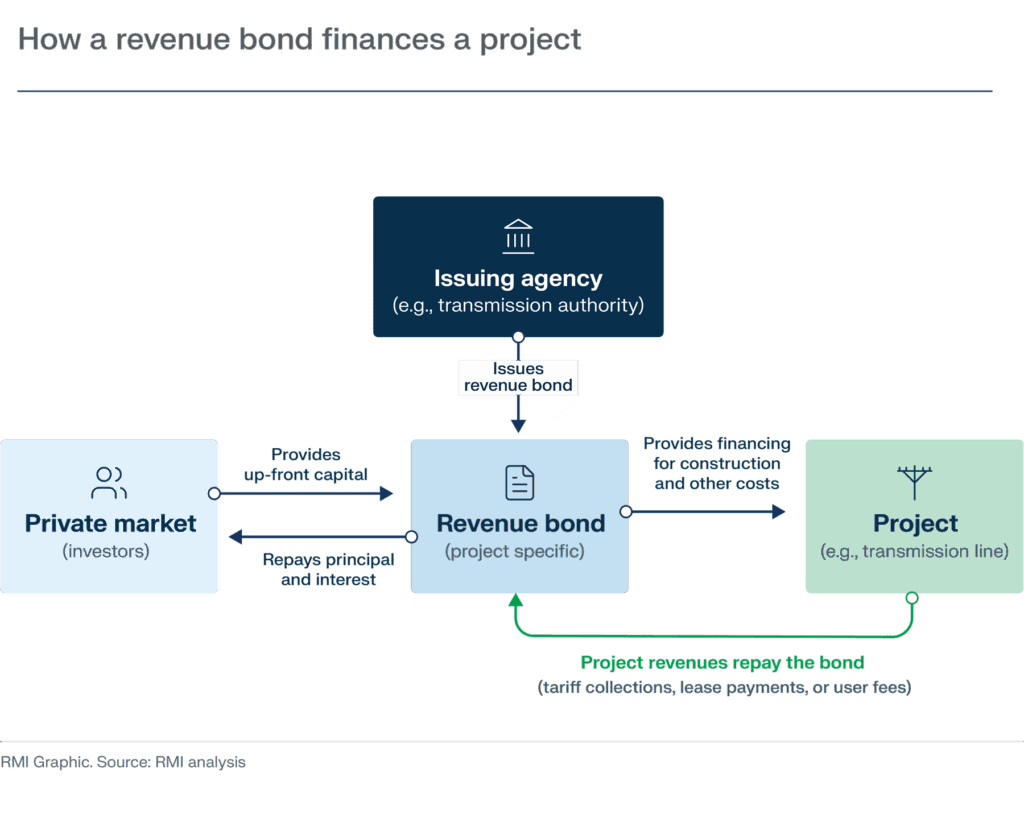
Because repayment depends on project performance, revenue bonds alone do not enhance a project’s credit. Investors assess bonds based on the predictability and stability of the underlying revenue stream. As a result, the credit quality and pricing of revenue bonds are closely tied to the market value and financial performance of the financed project.
However, revenue bonds can enhance credit and offer savings when they are used to:
- Pool bonds over multiple projects and developers to expand scale. A public entity can issue bonds on behalf of multiple transmission developers, pooling smaller projects from municipal utilities, co-ops, or other participants into a single revenue bond issuance. This structure can spread repayment risk across a diversified set of revenue streams, reduce per-project issuance costs, and create a larger, more liquid bond offering that may attract institutional investors and secure better interest rates. For example, several co-ops with $10 million to $20 million substation or line upgrades could be bundled into a $100+ million transmission revenue bond, with each utility contractually responsible for paying its project’s share.
- Promote public policy goals and environmental, social, and governance (ESG) attributes. Public entities can issue bonds to support transmission projects that advance public policy goals, such as renewable integration, decarbonization, hiring of union labor, or providing community benefits, and market those bonds as having additional ESG attributes. For example, New York Power Authority issued more than $1 billion in green transmission project revenue bonds in 2023 and 2024 to finance separately funded transmission projects, with repayment tied solely to project revenues rather than the authority’s broader finances. Such policy-aligned issuances can attract ESG-focused investors, improve marketability, and potentially lower borrowing costs while supporting public-private transmission development.
- Provide modest tax advantages. Revenue bonds issued by some state entities may be exempt from state taxes, allowing investors to accept slightly lower interest rates and reducing borrowing costs. However, this benefit is typically modest; at current interest and state income tax rates, the savings could range from roughly 0 to 80 basis points.5
Action items
- Transmission developers and utilities can work with the DOE to secure low-cost direct loans or loan guarantees, and Congress can authorize more funding and support for DOE’s public financing programs for transmission.
- States and PUCs can encourage or require utilities to seek the lowest-cost capital available and evaluate public financing options alongside private-market financing. For example, Colorado House Bill 26-1081, which became law in 2025, requires utilities to identify strategies to reduce the costs of and obtain financing for new transmission.
- State entities with revenue bonding authority, such as transmission authorities and power authorities, can partner with developers to enhance credit by pooling bonds over multiple projects and developers, enhancing bonds through public policy goals and ESG attributes, or gaining a modest tax advantage.
- State legislators can also proactively identify entities with existing bonding authorities for other types of infrastructure (such as wastewater, transportation, or other public works) and consider expanding their responsibilities to transmission if not already permitted in legislation.
- State legislatures can create state banks or infrastructure banks that issue loans or loan guarantees for transmission, though this typically requires a dedicated funding mechanism, such as natural resource royalties, public benefit charges, or carbon pricing revenues. For example, Alabama Senate Bill 304, enacted in 2025, created the Alabama Energy Infrastructure Bank, gave it revenue bonding authority, and appropriated $50 million from the Alabama 21st Century Fund to a new Strategic Energy Infrastructure Development Fund.
- States can align public financing for transmission with existing planning processes and state policy goals by establishing clear criteria for which projects are eligible for public funding.
Tool #8: Reform federal return on equity policy
FERC is responsible for setting the ROE for the vast majority of utilities’ transmission expenditures nationwide. Our research shows that utility ROEs are overestimates and, since the 1990s, “have fallen less than prevailing interest rates and costs of capital.” This increases costs borne by ratepayers. Furthermore, our research demonstrates that lowering utility ROEs does not substantially negatively affect a utility’s ability to raise capital.6
FERC utilizes two methodologies to calculate utility ROE: the discounted cash flow (DCF) analysis and the capital asset pricing model (CAPM). The DCF analysis calculates the present value of future dividends paid out to investors to calculate the utility’s cost of equity (COE), which is the return required by investors (distinct from ROE). The CAPM adjusts a company’s COE from the risk-free interest rate (i.e., return on US Treasury bonds as a proxy) based on its beta factor (i.e., a measure of the riskiness of the company’s stock) and the broader market COE. In either case, FERC then sets each utility’s ROE based on a calculated zone of reasonableness defined by calculating DCF and CAPM COEs for a spread of different US utilities. Each utility’s ROE is set within the zone of reasonableness based on that utility’s relative level of riskiness.
Both DCF and CAPM can result in higher ROEs if key inputs, including the utility’s long-term growth rate, risk-free interest rate, or COE for the broader market, are overestimated, as they frequently are by industry forecasters.7 Using noninflated and realistic assumptions to set these terms can result in more accurate and affordable outcomes. In forthcoming RMI research on ROEs, we use updated market-based assumptions to calculate a reasonable utility COE to be 7.5%. We also calculate that a utility’s ROE could be set between a floor at this 7.5% as a floor and a ceiling of the general market COE, which we find to be 9.3%. By contrast, current transmission utility ROEs at FERC can range from 8.5% to 12.5%, with a median of 10% to 11%. Using 2025 costs, our analysis finds that a 1% reduction in FERC ROEs, for instance, could reduce total transmission revenue requirements by 4.3%, or approximately $1.63 billion.
In addition to reconsidering how to calculate the base ROE, FERC can also reevaluate its usage of ROE incentive adders. In 2006, FERC created ROE adders with Order No. 679 in compliance with Section 219 of the Federal Power Act, added by Congress in the Energy Policy Act of 2005. These ROE adders are an attempt to incentivize higher-value transmission by granting utilities a slightly higher ROE for eligible projects. FERC usually sets a project-specific adder amount (normally in the range of 50 to 150 basis points, or 0.5% to 1.5%), although one adder that has been constant across all projects is the RTO membership ROE adder of 50 basis points. RMI estimates that this adder alone cost ratepayers at least $500 million in 2025. In recent years, states such as California, Connecticut, Maryland, and Ohio have begun leveraging legislative mandates for RTO membership to remove their utilities’ eligibility for the RTO membership ROE adder in an attempt to lower ratepayers’ bills.
Action items
- FERC could revisit DCF and CAPM inputs to ensure that COE more closely tracks actual observed market conditions and utility risk.
- FERC can examine if there are more cost-effective capital structures that would result in the lowest weighted average cost of capital (e.g., more debt and less equity).
- States can mandate RTO participation for their utilities and then make the case at FERC to remove the RTO membership ROE adder from their utilities’ rates (see the four state examples linked above).
- States can file complaints at FERC to lower ROEs. ISO-NE and MISO states have done this in recent years with some success.
Acknowledgements
- Commissioner Gabriel Aguilera, New Mexico Public Regulation Commission
- Mikhaila Calice, Wisconsin Public Service Commission
- Kent Chandler, Lighthouse Energy Institute
- Jeff Daniels, Electricity Customer Alliance
- Nathan Lobel, Roselle LLP
- Josh Macey, Yale Law School
- Nicole Pavia, Clean Air Task Force
- Ari Peskoe, Harvard Electricity Law Institute
- Graham Turk, Connecticut Public Utilities Regulatory Authority
Endnotes
- As of publication, these included the 16 states listed on the State Climate Policy Dashboard plus Pennsylvania and New Jersey, which had yet to be listed. ↩︎
- It is also known as storage as a transmission only asset (SATOA) in MISO, ISO-NE, and SPP. The distinction is that SATOA is not allowed to participate in regional electricity markets while SATA is. ↩︎
- FERC trial staff can take on a consumer advocate-like role in proceedings set for hearing and settlement procedures because the proceedings raise material issues of fact. FERC trial staff taking on this role does not frequently happen in formula rate revision cases because they are not particularly fact dependent and require state consumer advocates to raise factual issues with utility proposals. FERC trial staff also do not raise their own formal challenges in the formula rate annual update process, which is where factual questions about the prudence of transmission spending under formula rates must be contested. ↩︎
- Eight states today have transmission authorities: Colorado, Idaho, Kansas, New Mexico, North Dakota, South Dakota, Washington, and Wyoming. ↩︎
- This range assumes a 5.00% tax-exempt yield and state marginal income tax rates ranging from 0% to 13.3%. ↩︎
- This is based on forthcoming RMI research, to be published in early 2027. This report will be updated with that citation once it becomes available. ↩︎
- This is based on forthcoming RMI research, to be published in early 2027. This report will be updated with that citation once it becomes available. ↩︎


Related Insights

The Case for Grid-Connected Data Centers: Cleaner, More Affordable, and Fast Enough


Reality Check: For Power Plants, Changing the Fuel Doesn’t Fix the Economics

For Clean Energy Projects, How Community Benefits Are Delivered Matters
Help build the clean energy future. Donate today.
Independent research. Real-world solutions. Supported by donors.
RMI can pursue the highest-impact climate and energy solutions because we’re supported by people who believe change is possible. Every gift helps advance the work needed to make clean energy the default choice worldwide.
For other ways to give to RMI, including checks or gifts of stock, please visit Other Ways to Give.