

Learn how we are working to transform how we use and produce energy.
The Transition Finance Nexus
A primer on the connections among transition pathways, planning, assessment, and finance in the banking sector
Why we share this work for free
RMI is an independent nonprofit working to accelerate the clean energy transition. We publish research like this to inform decision-makers and drive real-world impact.
Our work is supported by philanthropy as well as partnerships, including fee-for-service engagements. This support makes it possible for us to share our independent insights for free.
If you find this work valuable, you can support it anytime.
Get more insights like this
Stay up to date with the latest research, analysis, and tools from RMI by opting in to receive occasional emails below. You’ll get new reports, event invitations, and practical insights to help us all accelerate the clean energy transition.
Loading form...
Your download should start automatically. If it doesn’t, click the download button below.
This work is made possible by philanthropy
RMI is a nonprofit supported by donors and partners. Philanthropy enables us to produce independent research and make resources like this freely available.
If you find this report valuable, please consider supporting our work. You can also explore how we partner with organizations to drive impact.
Jump to Section
Transition finance has rapidly emerged as a key concept for banks seeking to reach their net-zero targets and support real-economy decarbonization. This has relied on and contributed to a growing ecosystem of transition-related processes and approaches. In this primer, we introduce the “transition finance nexus” as a new way of conceptualizing the connections among transition pathways, transition plans and planning, transition assessment, and transition finance (see infographic below).
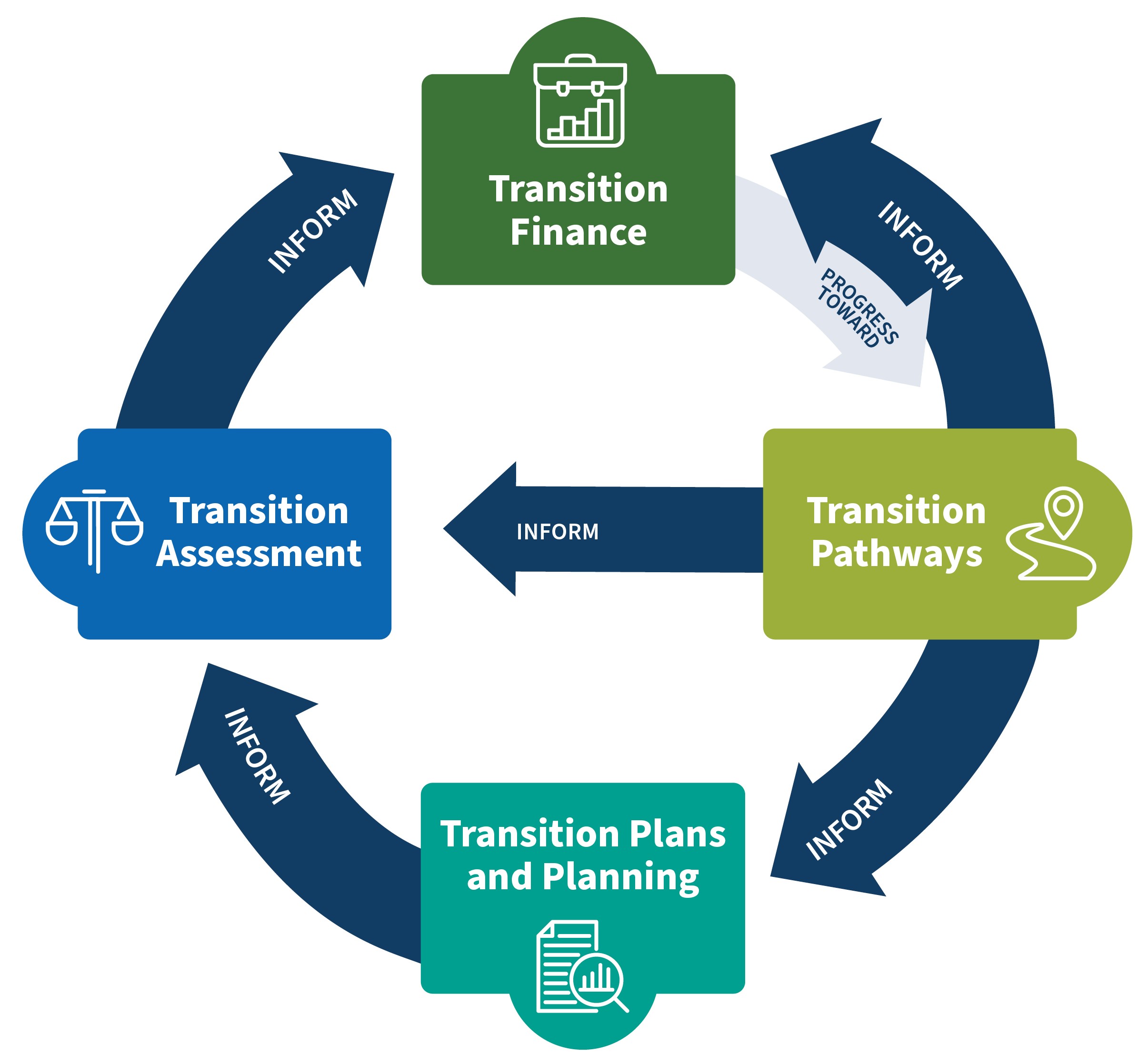
While transition finance guidance often refers to these different elements, little attention has been paid to the interconnections between them. Here we address this gap and add nuance to the transition narratives in the banking sector. This includes highlighting key dependencies involved and demonstrating that improving individual parts of the system will strengthen the whole nexus. These insights are based on research and engagement across the transition finance nexus, including interviews and consultation with 15 organizations, including banks, industry alliances, and nongovernmental organizations (NGOs).
Key insights
- Transition pathways offer a critical starting point for informing plans/planning, assessment, and financing.
- Corporate transition plans are important, but the process of transition planning is the critical element. A published plan is not sufficient by itself or currently necessary for the allocation of transition finance, but it can offer helpful information for decision-making.
- Client transition assessment is the crucial intermediate step between plans/planning and deploying financing or advancing related offerings (e.g., client engagement, advisory services, etc.).
- Transition finance is enabled by other elements in the nexus and should, in turn, enable progress toward pathways, plans, and assessments over time. The nexus can therefore be a circular process for banks to deploy and scale transition finance.
Each section of the primer provides an overview of the key elements, how they fit in the nexus, and recommendations for further work. Collaboration among banks, policymakers, and industry leaders to enhance the feasibility and credibility of each element could rapidly scale the transition finance market, benefiting from a multiplier effect across the nexus.
Recommendations for strengthening the transition finance nexus
- Enhance transition pathway granularity with regional and sector-specific insights to improve corporate transition planning and assessments.
- Encourage corporate transition planning by developing clear guidance on decision-useful disclosures that support financing decisions.
- Standardize and streamline transition assessments to reduce cost and complexity for banks while ensuring credibility.
- Support transition finance deployment by developing clear, actionable solutions for barriers to implementation and questions of credibility.
Authors

Shravan Bhat
Manager
Elizabeth Harnett
Research and Impact Expert
Tricia Holland
Senior Associate
Estefanía Marchán
Related Insights


Reality Check: For Power Plants, Changing the Fuel Doesn’t Fix the Economics


Beyond the First Frontier: What Comes Next for Carbon Removal
Help build the clean energy future. Donate today.
Independent research. Real-world solutions. Supported by donors.
RMI can pursue the highest-impact climate and energy solutions because we’re supported by people who believe change is possible. Every gift helps advance the work needed to make clean energy the default choice worldwide.
For other ways to give to RMI, including checks or gifts of stock, please visit Other Ways to Give.
