

Learn how we are working to transform how we use and produce energy.
Why we share this work for free
RMI is an independent nonprofit working to accelerate the clean energy transition. We publish research like this to inform decision-makers and drive real-world impact.
Our work is supported by philanthropy as well as partnerships, including fee-for-service engagements. This support makes it possible for us to share our independent insights for free.
If you find this work valuable, you can support it anytime.
Get more insights like this
Stay up to date with the latest research, analysis, and tools from RMI by opting in to receive occasional emails below. You’ll get new reports, event invitations, and practical insights to help us all accelerate the clean energy transition.
Loading form...
Your download should start automatically. If it doesn’t, click the download button below.
This work is made possible by philanthropy
RMI is a nonprofit supported by donors and partners. Philanthropy enables us to produce independent research and make resources like this freely available.
If you find this report valuable, please consider supporting our work. You can also explore how we partner with organizations to drive impact.
Jump to Section
In The Battery Mineral Loop, RMI lays out a comprehensive strategy to address the rising demand for battery minerals. Battery minerals are not the new oil. Even as battery demand surges, the combined forces of efficiency, innovation, and circularity will drive peak demand for mined minerals within a decade — and may even avoid mineral extraction altogether by 2050. These advancements enable us to transition from linear extraction to a circular loop, with compounding benefits for our climate, security, equity, health, and wealth.
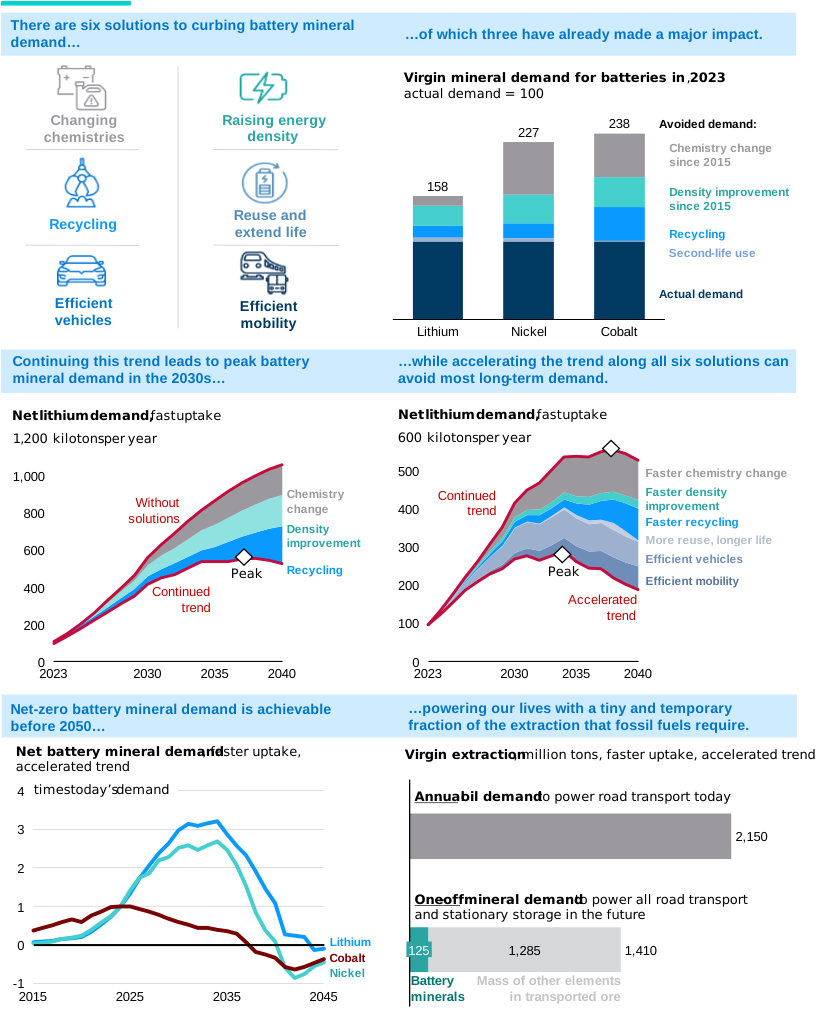
Change is already underway. Without the past decade of improvements in chemistry mix, energy density, and recycling, lithium, nickel, and cobalt demand would be 60–140 percent higher than they are today. Continuing the current trend means we will see peak virgin battery mineral demand in the mid-2030s.
Accelerating the trend along six key solutions — deploying new battery chemistries, making batteries more energy-dense, recycling their mineral content, extending their lifetime, improving vehicle efficiency, and improving mobility efficiency — means we can reach net-zero mineral demand in the 2040s.
At that point, end-of-life batteries will become the new mineral ore, limiting the need for any mining altogether. We have enough to get there; our known reserves of lithium, cobalt, and nickel are twice the level of total virgin demand we may require, and announced mining projects are already sufficient to meet almost all virgin demand.
Accelerated progress means we only need to mine a cumulative 125 million tons of battery minerals. This quantity alone can get us to circular battery self-sufficiency. That is 17 times smaller than the amount of oil we extract and process for road transport every year. And, at today’s commodity prices, about 20 times cheaper as well.
This means countries can rapidly and cost-effectively move from oil dependency to circular energy independence. So far, China leads the battery circularity race, with mineral independence projected by 2042, but the West and Global South are poised to come back in the race. To accelerate action, all stakeholders, from governments to corporate innovators, will need to lean in to capture the circular opportunity.
Authors

Will Atkinson
Senior Associate
Sudeshna Mohanty
Senior Associate
Amory Lovins
Cofounder and Chairman Emeritus
Daan Walter
Kingsmill Bond

Chiara Gulli
ManagerRelated Insights

For Clean Energy Projects, How Community Benefits Are Delivered Matters


Tracking WestTEC: Where 100+ Transmission Projects Stand and What Comes Next

Help build the clean energy future. Donate today.
Independent research. Real-world solutions. Supported by donors.
RMI can pursue the highest-impact climate and energy solutions because we’re supported by people who believe change is possible. Every gift helps advance the work needed to make clean energy the default choice worldwide.
For other ways to give to RMI, including checks or gifts of stock, please visit Other Ways to Give.