

Learn how we are working to transform how we use and produce energy.
Streamlining Carbon Credit Procurement
RMI and the Beyond Alliance are introducing an open-source template to simplify RFPs for the carbon market.
Why we share this work for free
RMI is an independent nonprofit working to accelerate the clean energy transition. We publish research like this to inform decision-makers and drive real-world impact.
Our work is supported by philanthropy as well as partnerships, including fee-for-service engagements. This support makes it possible for us to share our independent insights for free.
If you find this work valuable, you can support it anytime.
Get more insights like this
Stay up to date with the latest research, analysis, and tools from RMI by opting in to receive occasional emails below. You’ll get new reports, event invitations, and practical insights to help us all accelerate the clean energy transition.
Loading form...
Your download should start automatically. If it doesn’t, click the download button below.
This work is made possible by philanthropy
RMI is a nonprofit supported by donors and partners. Philanthropy enables us to produce independent research and make resources like this freely available.
If you find this report valuable, please consider supporting our work. You can also explore how we partner with organizations to drive impact.
Jump to Section
Carbon credits have the potential to mobilize large amounts of funding for climate solutions that otherwise would not find the support needed to scale. However, the market relies on opaque and inconsistent approaches to how buyers evaluate and purchase carbon credits, causing a disconnect between broader demand signals and how the market rises in response. Nearly all carbon credit requests for proposals (RFPs) ask roughly the same questions in slightly different ways — costing buyers duplicated effort and forcing project developers to repeatedly rebuild and tweak the same application. RMI and the Beyond Alliance built the Template for Carbon Credit Procurement (TCCP) to address this inefficiency for the 80% of questions applicable to all credit types. With 83 standardized questions, available in both analog and digital formats, the tool provides buyers with more consistent data in comparable formats to assess projects and offers developers more clarity and predictability in what they are expected to provide.
This template is designed to shed light and create structure to which information is sought and how buying decisions are made. To date, many carbon credits are procured through bespoke diligence processes, primarily informed by unique RFPs that are used for a myriad of reasons from price discovery to project diligence. These procurement processes are conducted based on inquiries, internal priorities, and quality judgments that vary by buyer and are not widely understood or communicated across the market.
This lack of clarity and consistency is stalling purchasing and driving frustration across the carbon market. Specifically:
- Project developers spend extensive time, money, and effort applying to each RFP, often without receiving feedback on how far their project advanced or what could have strengthened their application.
- Market intermediaries and service providers echo frustrations with the duplication, muddled guidance, and overall inefficiencies of the RFP process, specifically the lack of transparency around the ultimate decision-making process.
- Buyers note that existing procurement processes are often inefficient, with significant duplication of effort across buyers, because RFPs often seek similar information but ask for it in slightly different ways, formats, and levels of detail.
This procurement friction is not the only thing slowing carbon finance, but it is a constraint that can be alleviated directly, while easing transaction costs and creating momentum as the market builds consensus on other critical debates.
The Solution: A Standardized Template for Carbon Credit Procurement
To alleviate this issue, RMI and the Beyond Alliance are releasing the TCCP as a standardized, open-source tool to make the carbon credit buying process, particularly RFPs, more efficient, transparent, and accessible. Built on the procurement and due diligence practices of leading buyers, this tool provides a common application structure that carbon credit buyers can adopt or adapt across project types, geographies, portfolio strategies, and levels of market experience. It gives buyers clearer and more consistent data for assessing projects, while providing project developers with greater predictability and visibility into the information sought during procurement decisions.
Process and structure of the Template for Carbon Credit Procurement
To develop the standardized template, we recorded, mapped, and harmonized more than 500 questions directly from the RFPs of Beyond Alliance members and other leading market players. From there, we integrated details of 10 additional RFPs from government portals, credit buyer coalitions, and individual RFPs that our team uncovered through LinkedIn, Substack, and recommendations from project developers. Once the content was finalized, we organized all questions to match the three primary stages of the procurement process and confirmed the efficacy through consultations, interviews, and a rigorous external review process with nearly 30 voluntary carbon market experts.
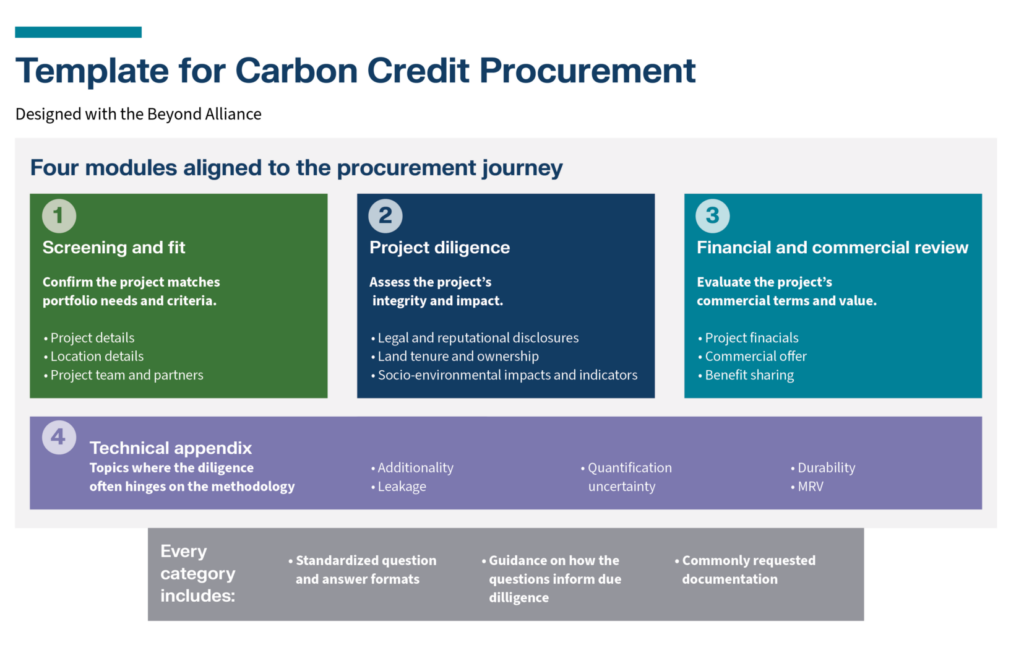
The final product is the TCCP: a standardized set of questions, organized around the procurement process, that can serve as a starting point for new buyers or a foundation for more mature buying processes (see Exhibit 1). It consists of 83 questions, broken into 12 thematic modules and a technical appendix, and organized across three procurement stages: 1) screening and fit, 2) project diligence, and 3) financial and commercial review.
Exhibit 1: Overview of the Structure and Content of the Template for Carbon Credit Procurement
This template is designed to be scoped or adapted to fit into smaller processes, and it can be accessed through two formats, depending on user need:
| Version | Format | What it can do | What it cannot do |
|---|---|---|---|
| Analog version | PDF and Excel | Provides an offline version of the TCCP for internal use, research, or collaboration | Power digital data rooms or online submissions |
| Digital version | Open-source HTML form | Provides an interactive way to view the TCCP and validate answers against it, akin to a stepping stone between the PDF and technical JSON code | Store or intake project data, run an RFP, or provide a fully developed user experience to exchange project data for a commercial transaction |
The core of the TCCP is project-agnostic, with a focus on the 80% of questions and topics that apply to all projects. This differs intentionally from the Beyond Alliance’s previous Common App for ARR, which was designed specifically for reforestation projects. We drew on lessons learned from that effort to develop a project-agnostic template that reflects the reality that most buyers’ intake processes are project-agnostic, while avoiding the fragmentation that could result from developing separate common applications across dozens of project types.
The TCCP’s 12 modules cover topics ranging from project type to financial due diligence. Each module includes an explanation of how these questions inform a due diligence assessment — both to help project developers understand how to prioritize or frame their responses and to help buyers think through how to adapt or expand this template to fit internal buying strategies or needs. The technical appendix includes the questions that were in our source material to assess project attributes, but that ultimately are defined by a methodology, such as additionality, leakage, permanence, and MRV. We included them to provide an initial foundation for these questions, while accepting that in true due diligence, buyers take a pathway-specific examination of these topics.
The toolkit is being adopted by the Beyond Alliance to support corporate procurement efforts. We are also releasing it in an open-source format that can be used or implemented by other buyers, procurement specialists, or project developers.
How Standardizing Procurement Can Enable Greater Investment
- Accelerate procurement efforts: Experienced buyers, including Beyond members, see the open-source tools and standardized questions as being instrumental in helping them to reduce the transaction costs of administering an RFP, enhance comparability among submissions, and improve efficiency in communications and data collection with project developers. Buyers who are embarking on their first RFPs saw the TCCP questions and format as a credible source material to build an RFP that meets their internal purchasing priorities.
- Reduce administrative burden: Project developers expressed optimism that this template can significantly reduce the paperwork and data burden they face when competing for multiple RFPs. By transparently disclosing the depth of due diligence questions, and their relevance at different stages of the assessment cycle, this template helps project developers better anticipate questions and proactively prepare the materials to demonstrate how they manage project risks, safeguards, and long-term financial and climate impact. By presenting their data in this format, project developers can put their resources into developing the strongest possible case for one application and avoid the burdens of otherwise duplicative work for other buyers.
- Strengthen market infrastructure: Throughout the ecosystem, the TCCP is seen as a key tool to expand and improve the accessibility of critical market infrastructure. Financial institutions see merit in using the template to build on by adding their own risk screening questions, rather than starting from scratch. Market utility and software providers anticipate the open-source nature of this template accelerating how quickly project documentation gets exchanged, reviewed, and acted upon. Over time, RMI will integrate these questions into the Carbon Data Open Protocol to ensure they are fully embedded in the carbon markets’ overall data infrastructure.
By making the template open-source and publicly available, RMI and the Beyond Alliance are making the practices and experience of leading buyers available as shared market resource. Its potential to reduce duplicative work at scale will depend on adoption — which is why we are releasing it openly and tracking how the market uses it. If you have ideas on how this tool can be useful to your work, get in touch at carbonmarkets@rmi.org.
Acknowledgments
We would like to express our gratitude to multiple organizations across the carbon market ecosystem for offering their guidance and expertise during this project. Special thanks go to members of the Beyond Alliance, who contributed time, resources, and trust to ensure this application was truly representative of market demand and current best practices. Additionally, we would like to acknowledge Tyler Marcus of GBB Strategy, Ratnika Prasad of Symbiosis Coalition, Anton Root of AlliedOffsets, Lauren Wilkinson and Sara De Peri of South Pole, Anastasia O’Rourke of Carbon Containment Lab and Yale University, Anna Stablum and Trevor Mueller of ClimeCo, Maddi Erdall of Centigrade, Scott Hernandez of Xpansiv, Jason Grillo of SPECTRA Super Pollutant Elimination Alliance, and the teams at GCMU and Emergent for lending time and expertise during the review process. This work is made stronger by the above participants and a number of additional reviewers.



Related Insights
Advance Market Commitments Today Can Build a Low-Carbon Tomorrow

Harnessing Green Demand to Drive Sustainable Chemicals Production

Unlocking Low-Carbon Cement and Concrete Through Book and Claim
Help build the clean energy future. Donate today.
Independent research. Real-world solutions. Supported by donors.
RMI can pursue the highest-impact climate and energy solutions because we’re supported by people who believe change is possible. Every gift helps advance the work needed to make clean energy the default choice worldwide.
For other ways to give to RMI, including checks or gifts of stock, please visit Other Ways to Give.
