

Learn how we are working to transform how we use and produce energy.
The United States’ Role in Limiting Warming to 1.5°C
Why we share this work for free
RMI is an independent nonprofit working to accelerate the clean energy transition. We publish research like this to inform decision-makers and drive real-world impact.
Our work is supported by philanthropy as well as partnerships, including fee-for-service engagements. This support makes it possible for us to share our independent insights for free.
If you find this work valuable, you can support it anytime.
Get more insights like this
Stay up to date with the latest research, analysis, and tools from RMI by opting in to receive occasional emails below. You’ll get new reports, event invitations, and practical insights to help us all accelerate the clean energy transition.
Loading form...
Your download should start automatically. If it doesn’t, click the download button below.
This work is made possible by philanthropy
RMI is a nonprofit supported by donors and partners. Philanthropy enables us to produce independent research and make resources like this freely available.
If you find this report valuable, please consider supporting our work. You can also explore how we partner with organizations to drive impact.
Jump to Section
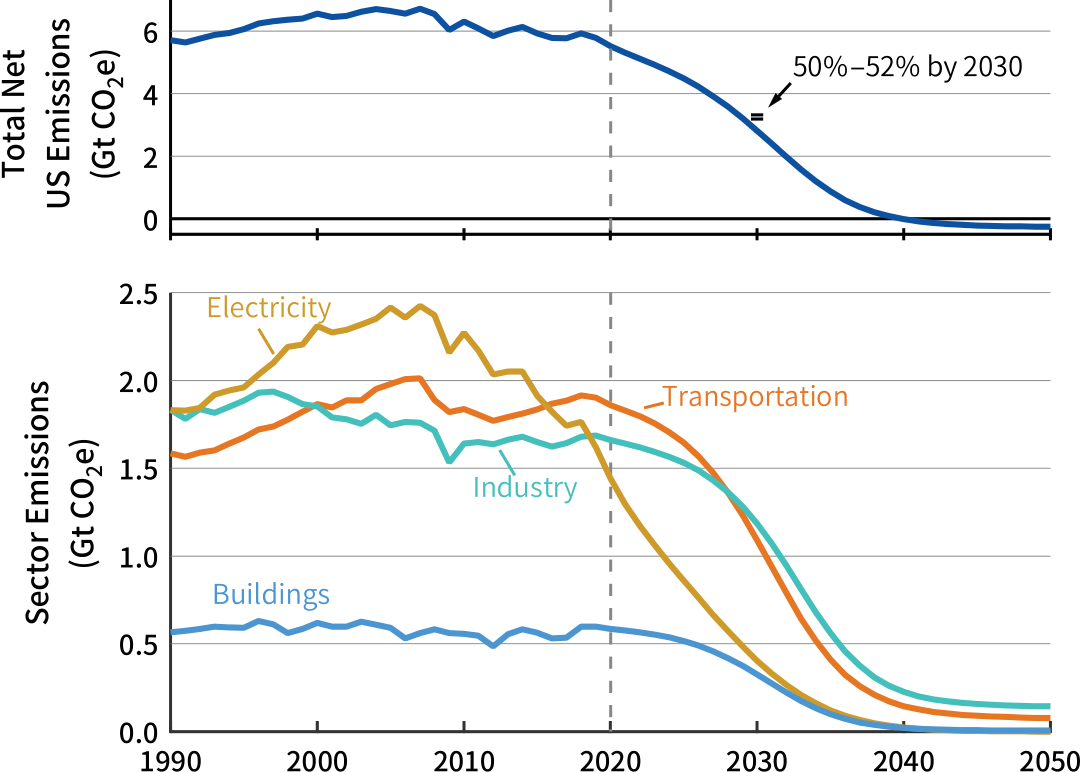
Scientists and the Intergovernmental Panel on Climate Change have called for the world to limit warming to 1.5°C (2.7°F) to avoid the worst climate impacts. The recent US nationally determined contribution (NDC) announcement, to reduce net US emissions in 2030 to at least 50%–52% below 2005 levels, is a critical step that recognizes this urgency. In Scaling US Climate Ambitions to Meet the Science and Arithmetic of 1.5°C Warming, we examine decarbonization paths that limit cumulative emissions, which set the extent of climate change. In a companion brief, US Sector-Level Strategies and Targets to Limit Warming to 1.5°C, we provide examples of 2030 sector-level targets and policies that would support near-term changes consistent with 1.5°C alignment.
Our analysis reveals that limiting cumulative emissions requires that the United States prioritize immediately replacing existing fossil fuel infrastructure with efficient, zero-emissions alternatives, wherever possible. Because these immediate investments reduce more total emissions, they both have the largest impact on reducing the extent of climate change and provide more time to learn and define the more technologically difficult options needed to get to net-zero emissions. In these reports, we also discuss the implications and tensions inherent to achieving rapid and equitable carbon reductions.
The two reports are intended to serve as a resource to federal and state policymakers, advocates, and organizations striving to contribute their part to limiting warming to 1.5°C.
Authors

Chaz Teplin
Principal
Jacob Corvidae
Senior Principal
Leia Guccione
Chief Program Officer, Sectors and Systems
Lena Hansen
Chief Program Officer
Jon Rea
Senior Associate
Katie Mulvaney
Krutarth Jhaveri
Zack Subin
Related Insights

Gas Utility Depreciation: Recommendations for an Uncertain Future



Help build the clean energy future. Donate today.
Independent research. Real-world solutions. Supported by donors.
RMI can pursue the highest-impact climate and energy solutions because we’re supported by people who believe change is possible. Every gift helps advance the work needed to make clean energy the default choice worldwide.
For other ways to give to RMI, including checks or gifts of stock, please visit Other Ways to Give.
