

Learn how we are working to transform how we use and produce energy.
Getting to Zero in Buildings
Why we share this work for free
RMI is an independent nonprofit working to accelerate the clean energy transition. We publish research like this to inform decision-makers and drive real-world impact.
Our work is supported by philanthropy as well as partnerships, including fee-for-service engagements. This support makes it possible for us to share our independent insights for free.
If you find this work valuable, you can support it anytime.
Get more insights like this
Stay up to date with the latest research, analysis, and tools from RMI by opting in to receive occasional emails below. You’ll get new reports, event invitations, and practical insights to help us all accelerate the clean energy transition.
Loading form...
Your download should start automatically. If it doesn’t, click the download button below.
This work is made possible by philanthropy
RMI is a nonprofit supported by donors and partners. Philanthropy enables us to produce independent research and make resources like this freely available.
If you find this report valuable, please consider supporting our work. You can also explore how we partner with organizations to drive impact.
Jump to Section
As we embark on a new decade, we are reflecting on the many exciting advancements in the building industry. One highlight from last year was the Getting to Zero Forum held in October in Oakland California. This event brought together over 600 leading policymakers, building owners, architects, designers, system manufacturers, technology companies and construction professionals to discuss how to transform the building industry toward net-zero carbon emissions.
Rocky Mountain Institute (RMI) and New Buildings Institute (NBI) organized an inaugural zLab to bring together industry leaders to brainstorm solutions and develop action plans around three topics: building electrification for decarbonization, advanced decarbonization policies for existing buildings, and unlocking new value through grid-interactive buildings. RMI has synthesized three write-ups that highlight more detailed findings from the zLab, available on the RMI website.
While we summarized the sessions in an earlier blog post, here are some additional insights that are explained further within the write-ups:
Building Electrification for Decarbonization
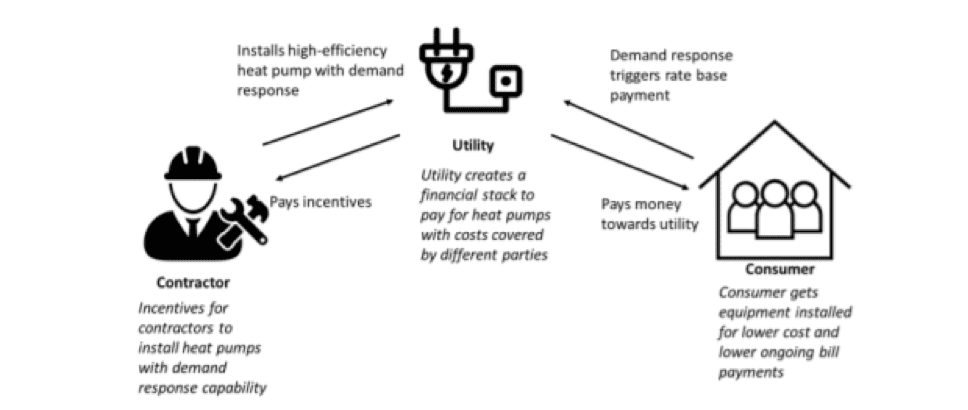
One of the solutions described in the report highlights an opportunity to lower cost with a rate-based design:
For example: A contractor would install a high-efficiency heat pump with demand response capability in a home. Through a demand response program, the utility could serve as a platform through which contractors receive incentives and consumers can get installations of highly efficient heat pumps at lower costs as shown below.
Other action items (detailed further in the writeup) included:
- Working with health professionals and institutes to inform people about health benefits
- Developing low-power specifications for utilities and manufacturers
- Increasing contractor capacity through workforce development
- Offering contractor incentives
Advanced Decarbonization Policies for Existing Buildings
City policymakers—many representing cities participating in the American Cities Climate Challenge—developed action plans to accelerate broader adoption of performance standards for existing buildings. The group developed a framework for stakeholder engagement to encourage inclusion of diverse perspectives and weighed the merits of various metrics in setting performance thresholds for different building types.
The group developed solutions in a variety of areas including:
- Measurement and Metrics: Including selecting energy versus carbon emissions metrics, setting performance thresholds for different building types, and ensuring adequate data for measuring compliance and tracking progress over time.
- Equity and Workforce Development: Including ensuring requirements are not overly burdensome on building owners and/or renters (especially lower-income) or disproportionately affect any particular population, design strategies to support affordability, and workforce training and inclusion.
- Incentives and Triggers: Including encouraging early adoption and compliance, phasing compliance deadlines versus transactional triggers (e.g., time of sale or rental), and financial strategies to offset or spread costs to building owners.
- Stakeholder Engagement: Including planning for likely concerns or pushback from various stakeholder groups, framing messaging to communicate the policy to affected groups, developing value propositions, and sequencing the stakeholder engagement process
Unlocking New Value through Grid-Interactive Buildings
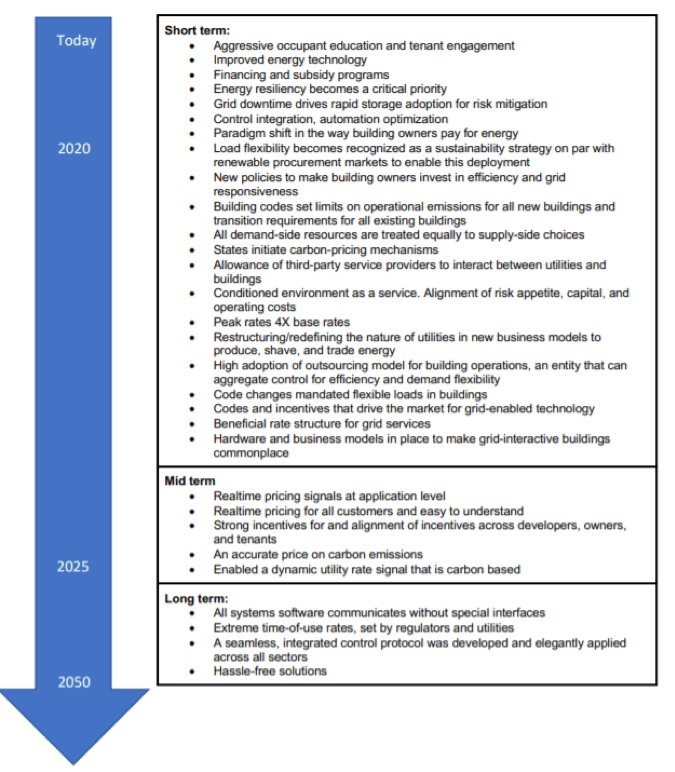
In addition to identifying key market barriers and value propositions to building owners, the group developed a set of short-, medium-, and long-term goals to achieve decarbonization through grid-interactive buildings.
As a result of this workshop, we will take the findings and create a work plan that will guide our work over the next year. Specifically, RMI and NBI are focused on advancing grid-interactive programs, policies, research, and pilot projects. What can you do? First, continue telling the story, emphasizing the importance of grid-interactive strategies and affirming the value that grid-interactive buildings can provide to both building owners and utilities. Second, investigate opportunities in your work to leverage grid-interactive building strategies. Understand rate structure alternatives, favoring time-based and demand-based rates wherever possible. Consider measures that build load flexibility.
What’s Next?
RMI and NBI would like to thank all those who set aside time to join us and lend us their brainpower for the afternoon. These write-ups serve as the beginning of an ongoing action and dialogue around these solutions. Decarbonizing buildings is an ongoing effort for RMI and many others. As a result of this workshop, we will integrate these ideas as appropriate into our work plans over the next year. We will also follow-up on the resolutions made by individual organizations at the event to support the advancement of these ideas. We encourage everyone to join us at the 2021 Getting to Zero Forum, March 15–17, 2021, in New York City. These great ideas and passion will help lead us into the future!
Authors

Greg Hopkins
Chief of Staff
Jacob Corvidae
Senior Principal
Laurie Stone
Managing Editor
Sneha Ayyagari
Cara Carmichael
Related Insights
Building Smarter, More Efficient Air Conditioners for Real World Conditions

How Heat Pumps Reduce Energy Bills and Air Pollution in the San Francisco Bay Area
Delivered Fuel Customers in Maryland See Strong Energy Bill Savings in a Switch to Heat Pumps
Gas Utility Depreciation: Recommendations for an Uncertain Future
Help build the clean energy future. Donate today.
Independent research. Real-world solutions. Supported by donors.
RMI can pursue the highest-impact climate and energy solutions because we’re supported by people who believe change is possible. Every gift helps advance the work needed to make clean energy the default choice worldwide.
For other ways to give to RMI, including checks or gifts of stock, please visit Other Ways to Give.
