

Learn how we are working to transform how we use and produce energy.
Reducing Emissions by Changing How We Work
Why we share this work for free
RMI is an independent nonprofit working to accelerate the clean energy transition. We publish research like this to inform decision-makers and drive real-world impact.
Our work is supported by philanthropy as well as partnerships, including fee-for-service engagements. This support makes it possible for us to share our independent insights for free.
If you find this work valuable, you can support it anytime.
Get more insights like this
Stay up to date with the latest research, analysis, and tools from RMI by opting in to receive occasional emails below. You’ll get new reports, event invitations, and practical insights to help us all accelerate the clean energy transition.
Loading form...
Your download should start automatically. If it doesn’t, click the download button below.
This work is made possible by philanthropy
RMI is a nonprofit supported by donors and partners. Philanthropy enables us to produce independent research and make resources like this freely available.
If you find this report valuable, please consider supporting our work. You can also explore how we partner with organizations to drive impact.
Jump to Section
Before we had to deal with a global pandemic, most of us drove to work. This commuting accounts for a significant portion of greenhouse gas (GHG) emissions. This was underscored by the impact of COVID-19 lockdowns in early 2020: by April 2020, daily emissions had dropped 17 percent, partly due to a decline in car use as many stopped their daily commutes. As people start returning to their offices, we need to change how we work and move in order to stay on a 1.5°C pathway.
In Canada, commuting by the government’s 150,000 employees in the National Capital Region (NCR) is the second-largest contributor to operations emissions, producing 138 kt CO2 equivalent in 2016. Most of these emissions result from employees driving to and from work.
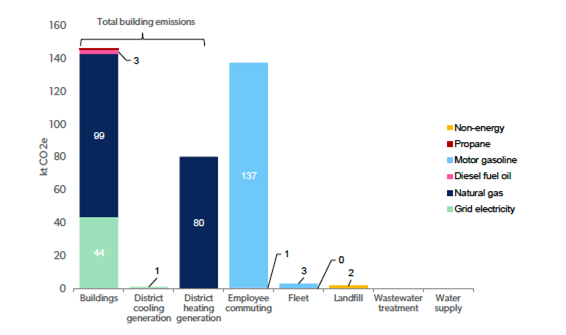
An analysis of these employee commuting habits shows that we can cut these emissions almost in half by changing how we move and work. As part of a larger study for the Government of Canada, Sustainability Solutions Group, RMI, and whatIf? Technologies explored how the government could decrease commutes and make commuting less fossil fuel intensive. It can do this by changing how we move—with public transit, cycling, and walking infrastructure, and zero-emissions vehicles, as well as by managing space and making it easy for employees to work from home. By 2050, these recommendations in the group’s subsequent report, Roadmap to Low-Carbon Operations in the National Capital Region, could reduce emissions by 45 percent.
Changing Where We Work
We found that a policy enabling employees to work from home two days per week can make a significant dent in commuting emissions at little additional cost. Implementing an effective teleworking policy requires robust IT communications infrastructure to connect employees remotely. And the Government of Canada, like many organizations, already has an initiative underway to provide this infrastructure.
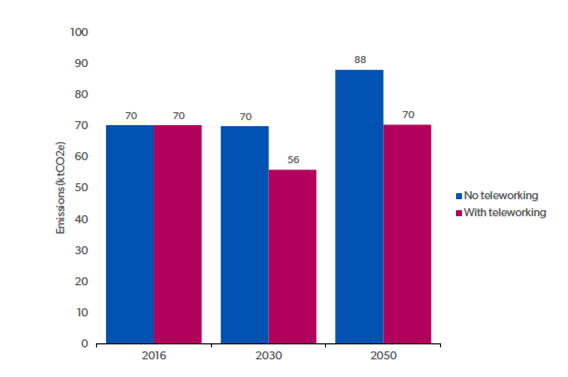
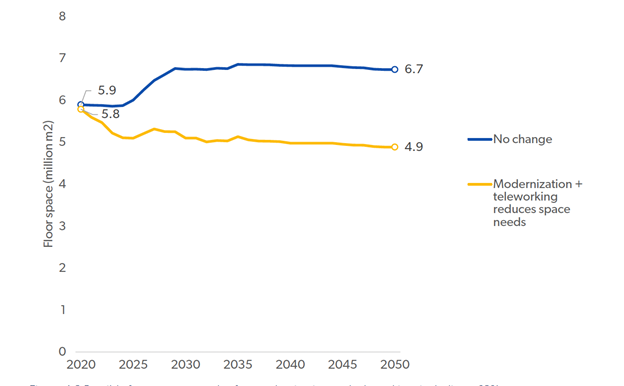
When combined with space modernization to enable employees to share desks or access co-working spaces, teleworking can reduce the floor area required by the workforce and, therefore, building emissions. At the same time, by offering employees access to co-working spaces in a variety of locations, the government can help reduce long-distance travel by enabling employees to work closer to where they live.
Changing How We Move
The number of employees who drive to work is influenced by office location. For example, compared with a single-use campus in Kanata, an Ottawa suburb, a federal building in downtown Ottawa has higher rates of transit, walking, and cycling commuting.
The Roadmap recommends the government locate new developments in areas with good transit, walking, and cycling access or design multi-use, transit-based developments where employees and residents live, work, eat, and access services and recreation within their immediate neighborhood.
Of course, even with all these changes, some employees would have to drive. Parking incentives, such as eliminating free parking except for zero-emissions vehicles, as well as promoting carpooling, could help drive those emissions down.
Capitalizing on a New Beginning
Changes to working life during the pandemic have demonstrated that the transformations recommended in the Roadmap to Low-Carbon Operations in the National Capital Region are viable. As organizations look to bring employees back to the office or redevelop or create new office space, transforming the way employees use space and offering them the flexibility to work from home can push down workplace emissions. Such changes can improve how we work and how we spend our time—and enable employers and employees to do their part in securing a safe and sustainable future.
Authors

Yuill Herbert
Erik Frenette
Related Insights



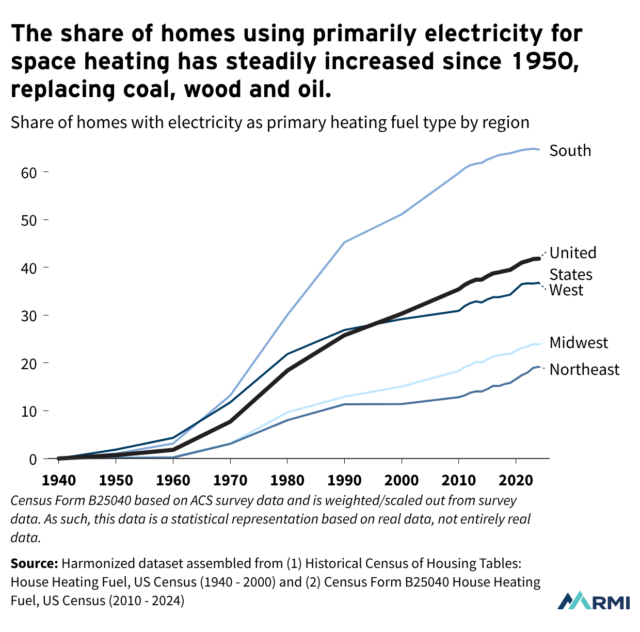
More Americans Are Heating Their Homes with Electricity than Ever Before
Help build the clean energy future. Donate today.
Independent research. Real-world solutions. Supported by donors.
RMI can pursue the highest-impact climate and energy solutions because we’re supported by people who believe change is possible. Every gift helps advance the work needed to make clean energy the default choice worldwide.
For other ways to give to RMI, including checks or gifts of stock, please visit Other Ways to Give.
