

Learn how we are working to transform how we use and produce energy.
Why we share this work for free
RMI is an independent nonprofit working to accelerate the clean energy transition. We publish research like this to inform decision-makers and drive real-world impact.
Our work is supported by philanthropy as well as partnerships, including fee-for-service engagements. This support makes it possible for us to share our independent insights for free.
If you find this work valuable, you can support it anytime.
Get more insights like this
Stay up to date with the latest research, analysis, and tools from RMI by opting in to receive occasional emails below. You’ll get new reports, event invitations, and practical insights to help us all accelerate the clean energy transition.
Loading form...
Your download should start automatically. If it doesn’t, click the download button below.
This work is made possible by philanthropy
RMI is a nonprofit supported by donors and partners. Philanthropy enables us to produce independent research and make resources like this freely available.
If you find this report valuable, please consider supporting our work. You can also explore how we partner with organizations to drive impact.
Jump to Section
The concrete and cement industry currently accounts for 7-8% of global CO2 emissions, and the sectoral emissions will continue to increase if we keep making concrete the way it is produced today. The coming years will see significant growth in demand for concrete, particularly in the Global South, which means bringing many brand-new plants online. This provides a prime opportunity for investing in low- and zero-carbon concrete and cement production capacities to avoid locking in emissions for decades.
There is no silver bullet to decarbonize concrete and cement. On the one hand, the technologies that are readily available today, such as energy efficiency improvements, will not get us to net-zero by 2050. On the other, the most mature carbon capture technology today can achieve significant emission savings, but is expensive and energy intensive. Many policy-makers, investors, researchers, and industry stakeholders have expressed interest in understanding the new and emerging technologies that can accelerate the sectoral transition.
RMI’s insight brief The 3Cs of Innovation in Low-Carbon Concrete: Clinker, Cement, and Concrete provides a one-stop shop for understanding the landscape of emerging and alternative technologies to decarbonize concrete and cement. The insight brief details the pros and cons of each innovation and provides a technology’s applicability evaluation framework for assessing which of these technologies are most effective for their unique conditions.
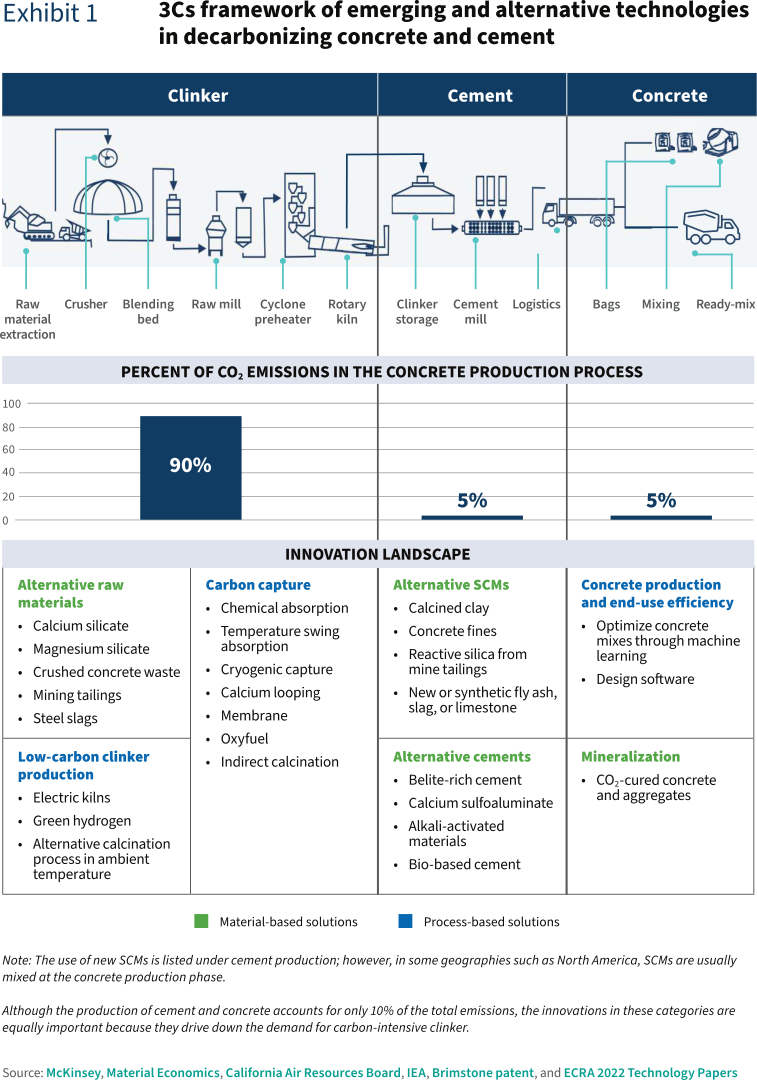
Key takeaways of this insight brief on the deployment of innovative technologies include:
- Innovations are actively happening in each production phase of the concrete and cement value chain.
- There is no one-size-fits-all solution. It is important to evaluate the technology applicability at regional and plant levels.
- Using innovative low-carbon materials in nonstructural components is a relatively low-risk way to start market penetration.
- In this decisive decade, the cheapest and fastest options should be deployed first while we prepare the industry for carbon capture technology commercialization in the 2030s.


Related Insights

How Better Policy Can Support South Korea’s Green Steel Opportunity
Help build the clean energy future. Donate today.
Independent research. Real-world solutions. Supported by donors.
RMI can pursue the highest-impact climate and energy solutions because we’re supported by people who believe change is possible. Every gift helps advance the work needed to make clean energy the default choice worldwide.
For other ways to give to RMI, including checks or gifts of stock, please visit Other Ways to Give.
