

Learn how we are working to transform how we use and produce energy.
How Better Policy Can Support South Korea’s Green Steel Opportunity
An analysis of policy impacts on low-emissions steelmaking in South Korea
Why we share this work for free
RMI is an independent nonprofit working to accelerate the clean energy transition. We publish research like this to inform decision-makers and drive real-world impact.
Our work is supported by philanthropy as well as partnerships, including fee-for-service engagements. This support makes it possible for us to share our independent insights for free.
If you find this work valuable, you can support it anytime.
Get more insights like this
Stay up to date with the latest research, analysis, and tools from RMI by opting in to receive occasional emails below. You’ll get new reports, event invitations, and practical insights to help us all accelerate the clean energy transition.
Loading form...
Your download should start automatically. If it doesn’t, click the download button below.
This work is made possible by philanthropy
RMI is a nonprofit supported by donors and partners. Philanthropy enables us to produce independent research and make resources like this freely available.
If you find this report valuable, please consider supporting our work. You can also explore how we partner with organizations to drive impact.
Jump to Section
Key Takeaways
A Transition to Greener Steelmaking can Build Resilience and Competitiveness
South Korea is the sixth largest steelmaker in the world, producing 62 million tons (Mt) of crude steel in 2025,1 which provides input to almost 40% of its manufacturing output.2 About 72% of South Korea’s steel production comes from coal-based blast furnace-basic oxygen furnace (BF-BOF), and the steel sector currently constitutes approximately 15% of the country’s total emissions.3
Emission-intensive steelmaking will face rising costs, as policies like the European Union’s Carbon Border Adjustment Mechanism (EU CBAM) will put an estimated US$36 to 70 billion in South Korea’s economic value at risk from 2026 to 2050.4 This exposure may increase as the EU is considering extending CBAM to steel embedded in some manufactured goods. Other importers of South Korean steel, such as Australia, Canada, and the United Kingdom, are considering or actively implementing CBAMs, which could put an additional 2.7 million tons of exports per year at risk.5 South Korea’s domestic emissions trading scheme (K-ETS) is also expected to impose costs as free allocations phase out in the future.
At the same time, demand for low-emission steel is growing globally. Estimated voluntary near-zero demand in Asia Pacific (not including China and India), Europe, and North America is about 20 Mt in 2030. Around 80% of this estimated volume will be for ore-based products, underscoring the opportunity for first-mover deployment of green hydrogen-based direct reduction and electric arc furnace (H2 DRI-EAF) capacity that can achieve the desired emission profile.6
The South Korean steel sector also faces several structural challenges, including competition from low-cost Chinese steel and declining profit margins stemming from global overcapacity. Leveraging product differentiation to capture clean markets will be key to increasing competitiveness. While China is predicted to have a relative cost advantage,7 most of China’s hydrogen-based steelmaking is expected to serve local demand, leaving an opening for South Korean steel producers to capture this green segment in other markets.8 With 22 Mt of blast furnace capacity up for reinvestment in the next 5 years, South Korean steel producers can either reline and risk locking in coal-based production for decades, or transition to cleaner production pathways to capture growing green demand and stay competitive amid tightening carbon regulations. POSCO has already made a headstart with its proprietary HyREX technology. Leveraging its technology leadership and competitive edge in manufacturing, Korea can capture opportunities along the clean steel production value chain, including a US$70 billion global tech market that will grow with worldwide demand.9
In this analysis, we test the impact of South Korea’s current and planned policy mix on the costs of various steel production routes from 2026 to 2050 to identify the most impactful instruments for deploying clean technologies in the steel sector.
South Korea’s Green Steel Policy Mix is Emerging in Response to Sector Transition Needs
The South Korean government has established and planned policy frameworks and interventions throughout the supply chain to support a sector-wide transition (details in Exhibit A1 in Appendix A). These include tax credits, capital and research and development (R&D) subsidies, carbon pricing, and other mechanisms. Previous government subsidies have primarily focused on R&D: in 2025, steelmaker POSCO received US$227 million to develop its proprietary hydrogen-based direct reduction (HyREX) technology.10 While POSCO’s HyREX is not analyzed in this study, further development in the technology could lead to substantial cost reductions in green ironmaking in the future.
The recent K-Steel Act has created the foundation for a low-carbon steel certification framework and low-carbon steel “special zones” with simplified licensing regulations and tax benefits. A detailed implementation framework is expected to be published in late 2026 and could include additional mechanisms that could impact steel production costs.11 In early 2026, the government also announced the upcoming Korea Green Transformation (K-GX) Strategy, which is expected to provide additional support for industrial decarbonization across multiple sectors.12
An overview of the key policies modeled in this brief is shown in Exhibit 1. Fossil fuel subsidy removals have not been passed or proposed but were modeled to explore the hypothetical impact of changing fuel costs. Similarly, the Clean Hydrogen Portfolio Standard’s contract-for-difference (H2 CfD) scheme currently only covers electricity made using low-carbon hydrogen. However, this analysis assumes the scheme also covers hydrogen as a stand-alone fuel to explore the potential impact of the scheme on hydrogen costs for steel production (see note in Appendix B for more details).
Exhibit 1
Expected Policies Still Leave Near-Zero Steel at a 24%–38% Premium in 2035
With current and expected policies, our analysis shows that H2 DRI-EAF steel does not break even with BF-BOF production by 2050 (Exhibit 2). In 2035, when EU CBAM will be fully phased in, domestic H2 DRI-EAF production still costs 38% more than BF-BOF production; when using green iron sourced from Australia, the H2 DRI-EAF cost premium comes down to 24%. Steel made using natural gas HBI from the United States with domestic EAF (NG DRI-EAF) is consistently lower than the hydrogen routes, but could be subject to price exposure. Moreover, NG DRI-EAF steel only reduces emissions by 37% (or 25% if based on 20-year global warming potential factors for upstream methane leakage), raising additional concerns around natural gas products’ ability to meet global emission standards with tightening carbon regulations.
Scrap EAF production can undercut BF-BOF steel production costs by 2035 with established and planned policies. However, scrap production cannot serve the volumes subject to CBAM as Korea’s EU exports mostly include flat products (i.e., hot rolled coil, cold rolled coil, and coated sheets). Around 80% of the projected 20 Mt green demand will also be for ore-based products. Moreover, regional scrap supply is limited. South Korea is a net importer of scrap steel, relying primarily on Japan, which is trending toward restricting future exports.13
Additional policy support will be needed beyond what is currently in place to bring ore-based, low-emission steel premiums closer to zero by 2035 and incentivize the deployment of more clean production capacity in coming years.
Exhibit 2
The impact of these individual policies on the green steel premium in 2035 is disaggregated in Exhibit 3 to show the effect of each policy.
Exhibit 3
The capital expenditure subsidies, coal subsidy removals, and K-ETS have some impact on reducing the green premium, particularly for the scrap EAF route, which has a much smaller green premium at the start. However, for H2 DRI-EAF routes, individual policies only reduce premiums by 7% or less, except for carbon pricing, which can bring premiums down by 11 to 16%. When combined, these policies can narrow the cost gap by 17%–25%, but still leave an overall cost premium of US$163 to 254 per tonne of hot rolled coil (HRC).
While capital subsidies such as the Green Steel Fund and H2 Steelmaking Demonstration subsidy can reduce some upfront investments, the operational costs for green steel plants make up a larger portion of total project costs, resulting in an overall insignificant impact on green premiums (2%–3% reduction). Production- and end-use-stage policies — akin to the Japanese low-carbon steel tax credit or clean energy vehicle (CEV) tax credit, which credits car buyers who purchase cars made with steel certified under Japan’s “green transformation” (GX) framework — may prove more effective at directly covering the remaining premiums.
Similarly, while removing coal subsidies proves more effective than removing natural gas or electricity subsidies, overall, upstream fuel subsidies or their removal have a minimal impact on lowering green premiums because of low subsidy values assumed in our model.14 The H2 CfD scheme, even when assumed to cover hydrogen as an input (instead of only electricity made using hydrogen), has no impact, as it is likely that sectors with a lower cost gap between conventional fuels and green hydrogen (e.g., trucking, fertilizer, and shipping) will outbid steelmakers in the reverse auction system (see note in Appendix B for more details).
As indicated in Exhibit 3, assuming free allowances for the steel sector are phased out, the K-ETS could reduce green premiums by 11–16% in 2035, under a mid-carbon pricing projection (see Exhibit B2). Higher carbon prices will enable more significant impacts. In 2025, K-ETS prices fluctuated around US$7 per ton of carbon dioxide (CO2), roughly 92% lower than EU ETS prices (US$83/tCO2).15 Phasing out free allocations and decreasing benchmarks to gradually cover all product emissions (including Scope 2 and 3 emissions) would also be effective in incentivizing a faster deployment of clean technologies. As of June 2026, it is still unclear when allocations for the steel sector will be adjusted.
The K-Steel Act has recently announced a low-carbon steel certification system that could qualify steel production zones for additional tax breaks or subsidies (details still forthcoming). The definition of low-carbon steel will determine the effectiveness of these subsidies: if too relaxed, the certification system could create counterproductive incentives, risking the lock-in of fossil fuel-based assets (e.g., coal-based BF-BOF or NG DRI-EAF). Additional incentives for green steel may also be included in the upcoming K-Steel Act guidance.
Stronger Policy Design Could Reduce Premiums to Below 10% in 2050
Assuming higher carbon prices and earmarked H2 CfD funds for the steel sector, H2 DRI-EAF using Australian green HBI reaches a 9% cost premium relative to NG DRI-EAF using US natural gas HBI, and a 21% cost premium over BF-BOF in 2035, which may be within some buyers’ willingness to pay.16 Integrated domestic H2 DRI-EAF still has a 21% cost premium over NG DRI-EAF and a 34% cost premium over BF-BOF in 2035, primarily driven by high hydrogen costs. The need to use higher-cost DR-grade iron ore pellets also adds to the remaining cost premium over BF-BOF. However, our analysis does not cover HyREX technology and its maturity over time, which could bring down costs in the future, as HyREX can utilize lower-grade fines. Again, scrap EAF production outcompetes BF-BOF production by 2035.
In 2050, an 8%–14% premium still exists for H2 DRI-EAF compared to BF-BOF; when compared to NG DRI-EAF, the premium is around 4%–9%. This underscores the need for stronger or supplementary measures that can help H2 DRI-EAF production compete (see Exhibit 4) and allow faster deployment of initial volumes to access carbon-conditioned markets and capture growing green demand segments. For lead markets like the automotive sector, the government can also consider implementing end-use incentives like Japan’s CEV credit to cover the remaining cost premium. Public procurement can also be leveraged to derisk some initial clean volumes. These measures can complement existing policy incentives to support the deployment of one or two pioneering commercial-scale plants by 2035, including POSCO’s HyREX, and help meet the Korea Iron and Steel Association’s target of producing 2.5 Mt of commercial-scale hydrogen-based steelmaking by 2035.
Exhibit 4
Recommendations
With competitive pressure from tightening carbon regimes, global overcapacity, and low-cost Chinese steel on the one hand, and opportunities to capture growing green demand on the other, product differentiation may be key to enhancing competitiveness for South Korean steel producers. Transitioning the steel sector toward cleaner production also creates opportunities for value creation along the clean steel supply chain. Current and planned policies tested in this analysis (i.e., capital subsidies, fuel subsidies, and the K-ETS) show that these policies as currently designed still leave a significant cost gap between H2 DRI-EAF and BF-BOF production in 2050.
Although further analysis will be needed to carefully design a policy mix that is fiscally efficient and impactful, we propose several measures (Exhibit 5) that can support the deployment of some initial clean volumes to help South Korea capture growing green demand and maintain access to markets with carbon regimes.
Exhibit 5
Preliminary recommendations for enabling policies
| Policy | Detail |
|---|---|
| End-use Incentives and Regulations |
|
| Green Public Procurement |
|
| K-Steel Act (Implementation Framework) |
|
| Strategic Partnership for Green HBI Sourcing |
|
Other policy considerations to enhance the competitiveness of near-zero production over time include the gradual phase-out of K-ETS allocations for the steel sector and raising prices under K-ETS. Revenues from K-ETS could be used for reinvestments in domestic clean production capacity. Additionally, developing a comprehensive policy framework for embodied carbon regulations beyond the current Green Standard for Energy and Environmental Design could open up a significant demand segment for low-emissions steel.
Appendices
Appendix A. Policy Details
Exhibit A1
Extended list of policies along the steel supply chain
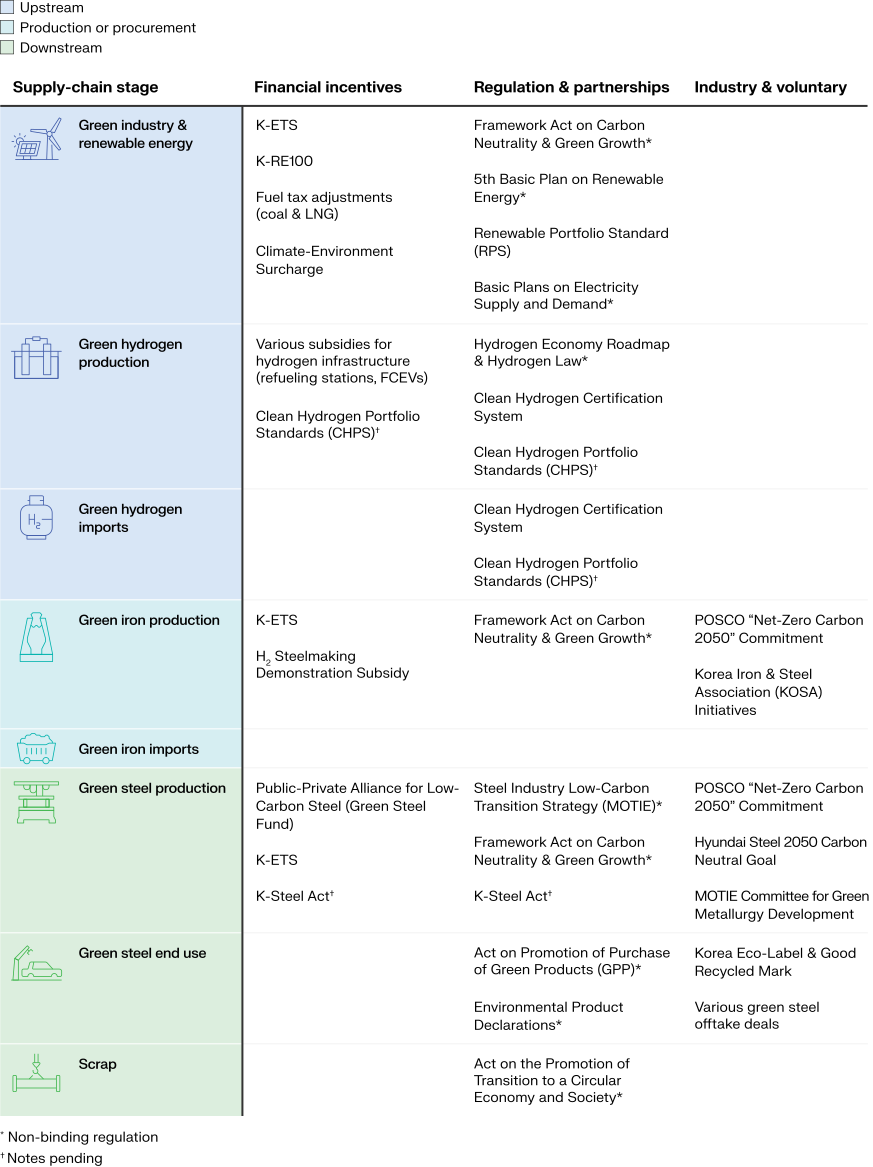
Appendix B. Modeling Methodology and Assumptions
Exhibit B1
Exhibit B2
Note: Under its current design, the Clean Hydrogen Portfolio Standard only covers electricity made from clean hydrogen. An estimated ₩5 trillion (US$3.54 billion) will be allocated over 15 years (US$236 million per year), based on previous bids, with a cap of US$0.35/kWh (~US$11.67/kg H2). The scheme includes four draft tiers for green hydrogen, with Tier 1 requiring 100% renewable energy for hydrogen production. This analysis assumes the scheme will cover hydrogen as a stand-alone fuel to explore the impact of a policy on green steel costs. To estimate the impact of the H2 CfD, the authors assumed that sectors with smaller cost gaps between conventional fuels and green hydrogen would be the first recipients of H2 CfD funding, covering the highest-willingness-to-pay sector’s total demand before allocating to other sectors, similar to other schemes in the EU and Japan.18 Sector green demand estimates are based on sector-specific targets and/or nationally determined contribution (NDC) targets. Hydrogen costs are expected to decrease as electrolyzer technology is deployed for various sectors, which could lower the estimated cost gaps between conventional fuel costs and green hydrogen.
Endnotes
- World Steel in Figures 2026, World Steel, 2026, https://worldsteel.org/data/world-steel-in-figures/world-steel-in-figures-2026. ↩
- Rachel Howard et al., Steel’s transformation: A new engine for South Korea’s growth and competitiveness, MPP, 2026, https://missionpossiblepartnership.org/wp-content/uploads/2026/08/MPP-South-Korea-green-industrial-growth-opportunity-2026-ENGLISH.pdf. ↩
- Yeongmin Kweon, “Enabling the Green Steel Future - Unlocking Government-led Investment in Core Technology Development for Carbon Neutrality,” Solutions For Our Climate, 2024, https://forourclimate.org/research/521; Ministry of Climate, Energy, Environment, “Strengthening On-Site Engagement to Advance the Decarbonized Green Civilization Transition in the Industrial Sector,” 2025, https://mcee.go.kr/eng/web/board/read.do. ↩
- Based on RMI analysis using current export volumes, announced EU CBAM benchmarks, and projected allowance prices. ↩
- “UN Comtrade Database,” United Nations, 2025, https://comtradeplus.un.org/. ↩
- Ariane Desrosiers et al., Asia Pacific’s Green Steel Demand Opportunity, RMI, 2026, https://rmi.org/resources/asia-pacifics-green-steel-demand-opportunity/. ↩
- Ali Hasanbeigi et al., Green Steel Economics, Global Efficiency Intelligence, Transition Asia, Solutions for Our Climate, 2024, https://www.globalefficiencyintel.com/green-steel-economics. ↩
- “Automakers Drive China Green Steel Development,” Lead the Charge and Transition Asia, 2025, https://leadthecharge.org/resources/greensteelchinacasestudy/. ↩
- Steel’s transformation: A new engine for South Korea’s growth and competitiveness, 2026. ↩
- “South Korea Advances Hydrogen-Based Steelmaking with $227M Investment in FINEX Technology,” Fuel Cells Works, 2025, https://fuelcellsworks.com/2025/06/27/h2/.... ↩
- Kim Suah, “K-steel act falls short as industry urges subsidies, power cost relief,” Chosun Business, 2026, https://biz.chosun.com/en/en-industry/2026/06/22/4ZA2IGGSNZAMPBGYD4EX5M4LWI/. ↩
- “Launch of the Public-Private Joint K-GX Task Force, Korea’s Green Transformation Gets Fully Underway,” MCEE, 2026, https://mcee.go.kr/eng/web/board/read.do. ↩
- Nodoka Murakami, “Japan to tighten restrictions on metal, plastic waste exports,” Nikkei Asia, 2026, https://asia.nikkei.com/spotlight/environment/japan-to-tighten-restrictions-on-metal-plastic-waste-exports. ↩
- Subsidy values in dollars per gigajoule (US$/GJ) are calculated by dividing the total subsidy for a fuel (US$ millions) with national consumption of the fuel in 2025. OECD, “Fossil Fuel Support,” 2025, https://www.oecd.org/en/topics/sub-issues/fossil-fuel-support.html. ↩
- “South Korea Emissions Trading System (K-ETS),” International Carbon Action Partnership, 2026, https://icapcarbonaction.com/en/ets/...k-ets; “EU Emissions Trading System (EU ETS),” International Carbon Action Partnership, 2026, https://icapcarbonaction.com/en/ets/eu-emissions-trading-system-eu-ets. ↩
- Jake Stones, “Stegra signs “very important” seven-year offtake deal for green steel with Microsoft,” ICIS, 2025, https://www.icis.com/explore/resources/news/2025/09/26/11141130/. ↩
- Rachel Eun Ko, Defining Low-Carbon Steel in South Korea: Technology Pathways under the K-Steel Act, NEXT group, 2026, https://ynafojsvljfevwkcitzr.supabase.co/…. ↩
- “How It Works: The H2Global Mechanism,” Hintco, 2026, https://hintco.eu/how-it-works; “Case study - Japanese government subsidy scheme / Government of Japan,” OECD, 2024, https://www.oecd.org/content/dam/oecd/en/about/programmes/cefim/green-hydrogen/2024-case-studies/Subsidy-scheme-Japan-case-study-2024.pdf. ↩
더 나은 정책으로 여는 한국의 그린 철강 기회
한국 녹색철강전환에 대한 정책 영향 분석
요약
친환경 철강 생산 전환으로 다지는 회복력과 경쟁력
한국은 세계 6위의 철강 생산국으로, 2025년 조강 6,200만 톤을 생산했으며1 이는 국내 제조업 생산의 약 40%에 투입된다.2 한국 철강 생산의 약 72%는 석탄 기반 고로-전로(BF-BOF) 방식에서 나오며, 철강 부문은 현재 국가 총배출량의 약 15%를 차지한다.3
배출집약적 철강 생산은 비용 상승 압박으로 이어질 전망이다. 유럽연합의 탄소국경조정제도(EU CBAM) 같은 정책으로 인해 2026년부터 2050년까지 한국의 경제적 가치 중 약 360억~700억 달러가 위험에 노출될 것으로 추정된다.4 EU가 일부 제조 완제품에 내재된 철강까지 CBAM 적용 범위를 확대하는 방안을 검토 중이므로 이러한 노출 위험은 더 커질 수 있다. 호주, 캐나다, 영국 등 한국산 철강의 다른 수입국들도 CBAM 도입을 검토하거나 이미 시행하고 있어, 연간 추가로 270만 톤의 수출 물량이 위험에 처할 수 있다.5 한국의 국내 배출권거래제(K-ETS) 역시 향후 무상할당이 단계적으로 축소되면서 비용 부담을 가중시킬 것으로 예상된다.
동시에 전 세계적으로 녹색 철강에 대한 수요는 증가하고 있다. 아시아·태평양(중국·인도 제외), 유럽, 북미 지역의 자발적 준제로 수요는 2030년 약 2,000만 톤으로 추정된다. 이 중 약 80%는 철광석 기반 제품에 해당하며, 이는 목표 배출 수준을 달성할 수 있는 그린 수소 기반 직접환원-전기로(H2 DRI-EAF) 설비의 선도적 도입 기회가 크다는 점을 보여준다.6
한국의 철강 산업은 저가 중국산 철강과의 경쟁, 글로벌 공급 과잉에 따른 수익성 악화 등 여러 구조적 과제에도 직면해 있다. 경쟁력을 높이려면 제품 차별화를 통해 청정 시장을 선점하는 것이 관건이다. 중국이 상대적 비용 우위를 가질 것으로 예상되지만,7 중국의 수소 기반 철강 생산량 대부분은 자국 수요를 충족하는 데 쓰일 전망이므로 한국 철강 생산업체가 타 시장의 그린 부문을 선점할 여지가 남아 있다.8 향후 5년 내 재투자 시점을 맞는 고로 설비가 22Mt에 달하는 가운데, 한국 철강 생산업체는 개수(reline)를 선택해 향후 수십 년간 석탄 기반 생산에 발이 묶이는 리스크를 감수하거나, 청정 생산 경로로 전환해 증가하는 그린 수요를 확보하고 탄소 규제 강화 속에서도 경쟁력을 유지하는 길을 택할 수 있다. POSCO는 자체 개발한 수소환원제철 기술(HyREX)로 이미 한발 앞서 나가고 있다. 기술 리더십과 제조 경쟁력을 활용하면, 한국은 세계 수요와 함께 성장할 700억 달러 규모의 글로벌 기술 시장을 포함해 녹색 철강 생산 가치 사슬 전반에서 기회를 확보할 수 있다.9
본 분석에서는 2026년부터 2050년까지 한국의 현행 및 예정된 정책 조합이 다양한 철강 생산 경로의 비용에 미치는 영향을 검토하여, 철강 부문에서 청정 기술 보급에 가장 효과적인 정책 수단을 파악한다.
철강 산업 전환 요구에 대응해 형성되고 있는 한국의 녹색 철강 정책 조합
한국 정부는 산업 전반의 전환을 지원하기 위해 공급망 전반에 걸쳐 정책 프레임워크와 개입 수단을 수립·계획해왔다(자세한 내용은 부록 A의 도표 A1 참고). 여기에는 세액공제, 자본 및 R&D 보조금, 탄소 가격제 등 다양한 정책 수단이 포함된다. 그동안 정부 보조금은 주로 R&D에 집중되어 왔는데, 국영 철강사로 시작한 POSCO는 2025년 HyREX 기술 개발을 위해 2억 2,700만 달러를 지원받았다.10 본 분석에서는 HyREX을 분석 대상으로 다루지 않지만, 향후 이 기술이 더 발전하면 그린 제선 비용을 크게 낮출 수 있을 것으로 보인다.
최근 제정된 K-스틸법은 녹색 철강 인증 체계와 인허가 절차 간소화 및 세제 혜택을 갖춘 녹색 철강 ‘특구’의 토대를 마련했다. 세부 이행체계는 2026년 말 발표될 예정이며, 철강 생산 비용에 영향을 줄 수 있는 추가적인 정책 수단이 포함될 수 있다.11 2026년 초 정부는 한국 녹색전환(K-GX) 전략도 발표했다. 이 전략은 여러 산업 부문에 걸친 탈탄소화를 추가로 지원할 것으로 예상된다.12
본 보고서에서 모델링한 주요 정책의 개요는 도표 1에 제시되어 있다. 화석연료 보조금 폐지는 아직 법제화되거나 제안된 바가 없지만, 연료 비용 변화가 미치는 가상의 영향을 살펴보기 위해 모델링에 포함했다. 마찬가지로, 청정수소발전 의무화제도(Clean Hydrogen Portfolio Standard, CHPS)의 수소 차액계약 제도는 현재 저탄소 수소로 생산한 전력에만 적용된다. 그러나 본 분석에서는 이 제도가 철강 생산용 수소 비용에 미칠 잠재적 영향을 살펴보기 위해 수소를 단독 연료로 사용하는 경우에도 이 제도가 적용된다고 가정했다(자세한 내용은 부록 B의 참고사항 참고).
도표 1
2035년 녹색 철강 프리미엄 24~38%, 예상 정책으로는 역부족
본 분석에 따르면 현행 및 예상 정책을 적용해도 H2 DRI-EAF 철강은 2050년까지 고로-전로(BF-BOF) 생산과 비용 동등성에 도달하지 못한다(도표 2). EU CBAM이 완전히 시행될 것으로 예상되는 2035년에도, 국내 H2 DRI-EAF 생산 비용은 여전히 BF-BOF 생산 대비 38% 높다. 호주산 그린 HBI를 사용할 경우 H2 DRI-EAF의 비용 프리미엄은 24%로 낮아진다. 미국산 천연가스 기반 HBI를 국내 전기로(EAF) 공정과 결합해 생산하는 철강(NG DRI-EAF)은 수소 기반 경로들보다 일관되게 낮은 비용을 보이지만, 가격 변동에 노출될 수 있다. 또한 NG DRI-EAF 철강은 배출량을 37%만 감축하며(상류 메탄 누출에 20년 지구온난화지수(GWP)를 적용할 경우 25%), 여러 시장에서 탄소 규제가 강화되는 가운데 천연가스 기반 제품이 국제 배출 기준을 충족할 수 있을지에 대한 추가적인 우려를 낳는다.
기존 정책과 계획된 정책을 적용하면 스크랩 EAF 생산은 2035년까지 BF-BOF 철강 생산 비용보다 낮아질 수 있다. 다만 한국의 EU 수출은 대부분 판재류(열연코일, 냉연코일, 도금강판 등)로 구성되어 있어 스크랩 기반 생산만으로는 CBAM 적용 대상 물량을 충당할 수 없다. 또한 예상되는 그린 수요 2,000만 톤 중 약 80%도 철광석 기반 제품에 해당한다. 뿐만 아니라 역내 스크랩 공급도 제한적이다. 한국은 스크랩 철강 순수입국으로 주로 일본산 스크랩에 의존하고 있는데, 일본은 향후 수출을 제한하는 방향으로 나아가고 있다.13
2035년까지 철광석 기반 녹색 철강의 프리미엄을 0에 가깝게 낮추고, 향후 몇 년간 더 많은 청정 생산 설비의 보급을 촉진하려면 현재 마련된 정책을 넘어서는 추가적인 정책 지원이 필요하다.
도표 2
이러한 개별 정책이 2035년 녹색 철강 프리미엄에 미치는 영향은 도표 3에서 정책별로 세분화하여 보여준다.
도표 3
설비투자(CAPEX) 보조금, 석탄 보조금 폐지, K-ETS는 그린 프리미엄을 낮추는 데 어느 정도 효과가 있으며, 특히 처음부터 그린 프리미엄이 훨씬 작은 스크랩 EAF 경로에서 그 효과가 두드러진다. 반면 H2 DRI-EAF 경로에서는 개별 정책이 프리미엄을 7% 이하로만 낮추는 데 그치는데, 예외적으로 탄소 가격제는 프리미엄을 11~16%까지 낮출 수 있다. 이러한 정책들을 모두 결합하면 비용 격차를 17~25% 좁힐 수 있지만, 그럼에도 열연코일(HRC) 톤당 163~254달러의 전체 비용 프리미엄이 남는다.
그린 철강 기금이나 수소 철강 실증 보조금과 같은 설비투자 보조금은 초기 투자 비용을 일부 낮출 수 있지만, 그린 철강 설비의 운영비가 전체 프로젝트 비용에서 더 큰 비중을 차지하기 때문에 그린 프리미엄에 미치는 전반적인 영향은 미미하다(2~3% 감소). 반면 생산 및 최종 사용 단계의 정책은 남은 프리미엄을 직접 상쇄하는 데 더 효과적일 수 있다. 일본의 저탄소 철강 세액공제나 청정에너지차(CEV) 세액공제가 대표적인 예인데, 이는 일본의 ‘녹색전환(GX)’ 체계 하에 인증된 철강으로 만든 자동차를 구매하는 소비자에게 세액공제를 제공하는 제도다.
마찬가지로, 석탄 보조금 폐지가 천연가스 보조금 폐지나 전력 보조금 신설보다 더 효과적이긴 하지만 전반적으로 상류 연료 보조금 신설이나 폐지가 그린 프리미엄을 낮추는 데 미치는 영향은 미미한데, 이는 본 모델에서 가정한 보조금 규모 자체가 작기 때문이다.14 수소 차액계약(H2 CfD) 제도가 전력 생산용 수소뿐 아니라 수소 자체를 투입 연료로도 포함한다고 가정해도 영향은 전혀 없다. 재래 연료와 그린 수소 간 비용 격차가 더 작은 부문(예: 화물운송, 비료, 해운)이 역경매에서 철강업체보다 더 낮은 가격을 제시해 낙찰받을 가능성이 크기 때문이다(자세한 내용은 부록 B의 참고사항 참고).
도표 3에서 볼 수 있듯이 철강 부문에 대한 무상할당이 단계적으로 폐지된다고 가정하면, K-ETS는 중간 수준의 탄소 가격 전망 하에서 2035년 그린 프리미엄을 11~16% 낮출 수 있다(도표 B2 참고). 탄소 가격이 높아질수록 그 효과는 더욱 커진다. 2025년 K-ETS 가격은 이산화탄소(CO2) 톤당 약 7달러 수준에서 변동했는데, 이는 EU ETS 가격(tCO2당 83달러)보다 약 92% 낮은 수준이다.15 무상할당을 단계적으로 폐지하고 벤치마크를 낮춰 Scope 2·3 배출량까지 포함한 전체 제품 배출량을 점진적으로 포괄하도록 하는 것 역시 청정 기술의 보급을 더 빠르게 촉진하는 데 효과적일 것이다. 2026년 6월 현재, 철강 부문에 대한 할당량이 언제 조정될지는 아직 불확실하다.
K-스틸법은 최근 녹색 철강 인증 체계를 발표했으며, 이를 통해 철강 생산 특구가 추가적인 세제 혜택이나 보조금 대상 자격을 얻을 수 있다(세부 사항은 추후 공개 예정). 녹색 철강의 정의가 이러한 보조금의 효과를 좌우할 것이다. 정의가 지나치게 느슨할 경우 인증 체계가 오히려 역효과를 낳는 유인을 만들어 화석연료 기반 자산(예: 석탄 기반 BF-BOF 또는 NG DRI-EAF)의 발이 묶일 위험을 키울 수 있다. 향후 발표될 K-스틸법 세부지침에는 그린 철강에 대한 추가 인센티브도 포함될 수 있다.
2050년 프리미엄 10% 미만, 관건은 더 강력한 정책 설계
탄소 가격이 더 높아지고 철강 부문에 배정된 수소 차액계약(H2 CfD) 재원이 있다고 가정하면 호주산 그린 HBI를 사용하는 H2 DRI-EAF는 2035년 기준 미국산 천연가스 HBI를 사용하는 NG DRI-EAF 대비 9%, BF-BOF 대비 21%의 비용 프리미엄을 기록하는데, 이는 일부 구매자의 지불 의향 범위 안에 들 수 있는 수준이다.16 국내에서 일관 생산하는 H2 DRI-EAF는 2035년에도 NG DRI-EAF 대비 21%, BF-BOF 대비 34%의 비용 프리미엄을 유지하며, 이는 주로 높은 수소 비용에서 비롯된다. 더 비싼 직접환원용(DR급) 철광석 펠릿을 사용해야 한다는 점도 BF-BOF 대비 남은 비용 프리미엄을 키우는 요인이다. 다만 본 분석에는 HyREX 기술과 그 기술 성숙도 변화가 포함되어 있지 않은데, HyREX는 저품위 분광(fines)도 활용할 수 있어 향후 비용을 낮출 수 있는 잠재력이 있다. 이번에도 스크랩 EAF 생산은 2035년까지 BF-BOF 생산을 앞지른다.
2050년에도 H2 DRI-EAF는 BF-BOF 대비 8~14%, NG DRI-EAF 대비 약 4~9%의 프리미엄이 남아 있을 것으로 전망된다. 이는 H2 DRI-EAF 생산의 경쟁력을 높일 더 강력하거나 보완적인 정책 수단이 필요하다는 점을 보여주며(도표 4 참고), 이를 통해 초기 물량의 보급을 앞당겨 탄소 조건부 시장에 진입하고 성장하는 그린 수요 부문을 선점할 수 있다. 자동차 산업과 같은 선도 시장에서는 정부가 일본의 CEV 세액공제와 유사한 최종 사용 인센티브를 도입해 남은 비용 프리미엄을 상쇄하는 방안도 고려할 수 있다. 공공조달을 활용해 초기 청정 제품 물량에 대한 리스크를 완화하는 방안도 고려할 수 있다. 이러한 조치들은 기존 정책 인센티브를 보완해 POSCO의 HyREX를 포함한 한두 개의 선도적 상업 규모 플랜트가 2035년까지 가동될 수 있도록 지원하고, 한국 철강 산업이 목표로 하는 2035년까지 상업 규모 수소 기반 철강 생산 250만 톤(2.5Mt) 달성에도 기여할 수 있다.
도표 4
정책 제언
탄소 규제 강화, 글로벌 공급 과잉, 저가 중국산 철강으로 인한 경쟁 압력이 있는 한편 성장하는 그린 수요를 확보할 기회도 있는 상황에서 제품 차별화는 한국 철강 생산업체의 경쟁력을 높이는 핵심 요인이 될 수 있다. 철강 부문을 청정 생산 방식으로 전환하면 청정 철강 공급망 전반에 걸쳐 가치를 창출할 기회도 생긴다. 본 분석에서 검토한 현행 및 계획된 정책(설비투자 보조금, 연료 보조금, K-ETS)을 보면, 현재 설계된 형태로는 2050년에도 H2 DRI-EAF와 BF-BOF 생산 간에 상당한 비용 격차가 남는다.
재정적으로 효율적이면서도 효과적인 정책 조합을 신중하게 설계하려면 추가 분석이 필요하겠지만, 본 보고서에서는 한국이 성장하는 그린 수요를 확보하고 탄소 조건부 시장에 대한 접근성을 유지할 수 있도록 초기 청정 물량의 보급을 지원할 몇 가지 방안을 제시한다(도표 5).
도표 5
이행 여건 조성을 위한 예비 제언
| 정책 | 세부 내용 |
|---|---|
| 최종 사용 인센티브 및 규제 |
|
| 녹색 공공조달 |
|
| K-스틸법(이행체계) |
|
| 그린 HBI 조달을 위한 전략적 파트너십 |
|
장기적으로 준제로 생산의 경쟁력을 높이기 위해 고려할 수 있는 그 밖의 정책으로는 철강 부문에 대한 K-ETS 무상할당의 단계적 폐지와 K-ETS 가격 인상이 있다. K-ETS를 통한 수익은 국내 청정 생산 설비에 대한 재투자에 활용할 수 있다. 또한 현행 녹색건축인증제도(G-SEED)를 넘어서는 내재탄소 규제에 대한 종합적인 정책 체계를 마련하면 저배출 철강에 대한 상당한 수요 부문을 새롭게 열 수 있다.
부록
부록 A. 정책 세부사항
도표 A1
철강 공급망 정책 상세 목록
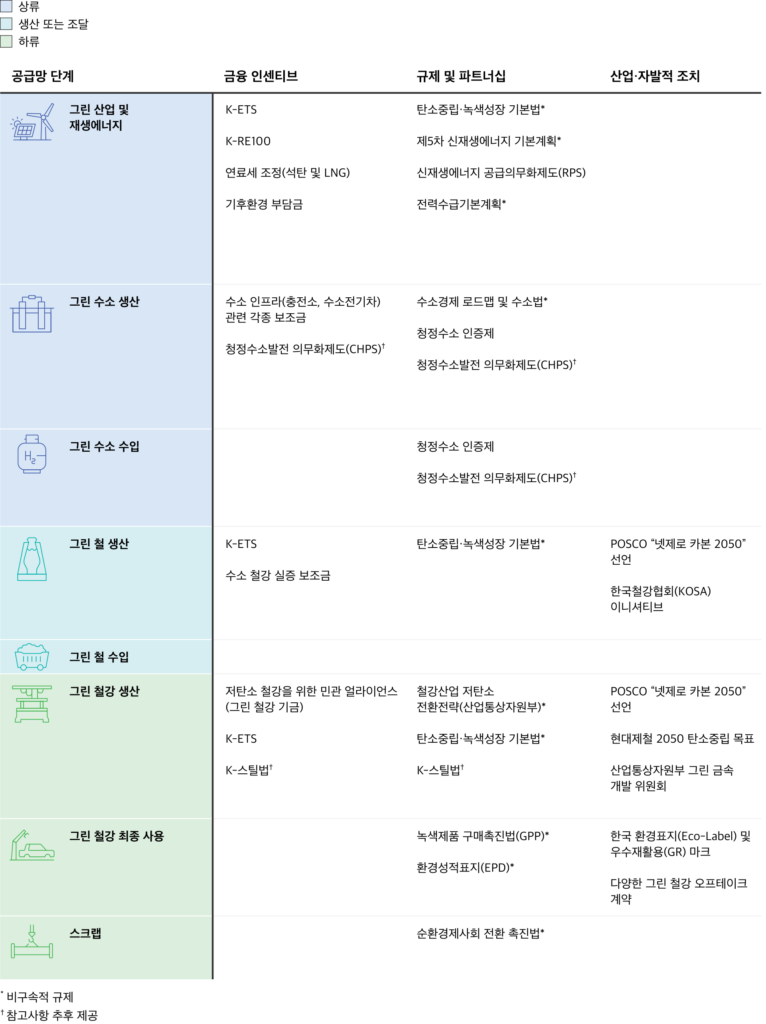
부록 B. 모델링 방법론 및 가정
도표 B1
도표 B2
참고: 현재 설계상 청정수소발전 의무화제도(CHPS)는 청정수소로 생산한 전력만을 대상으로 한다. 과거 입찰 결과를 기준으로 향후 15년간 약 5조 원(35억 4천만 달러)이 배정될 예정이며(연간 약 2억 3,600만 달러), 가격 상한은 kWh당 0.35달러(수소 kg당 약 11.67달러)이다. 이 제도는 그린 수소에 대해 4개의 초안 등급(tier)을 두고 있으며, 1등급은 수소 생산에 100% 재생에너지 사용을 요구한다. 본 분석에서는 정책이 그린 철강 비용에 미치는 영향을 살펴보기 위해, 이 제도가 수소를 단독 연료로도 보전 대상에 포함한다고 가정한다. 수소 차액계약의 영향을 추정하기 위해, 저자들은 EU와 일본의 다른 제도들과 마찬가지로 재래 연료와 그린 수소 간 비용 격차가 더 작은 부문이 H2 CfD 재원을 먼저 지원받는다고 가정했다.18 이에 따라 지불 의향이 가장 높은 부문의 전체 수요를 먼저 충당한 뒤, 나머지 부문에 순차적으로 재원이 배정된다. 부문별 그린 수요 추정치는 부문별 목표 및/또는 국가온실가스감축목표(NDC) 목표를 기준으로 한다. 수전해 기술이 여러 부문에 보급됨에 따라 수소 비용은 낮아질 것으로 예상되며, 이는 재래 연료 비용과 그린 수소 간의 예상 비용 격차를 줄일 수 있다.
미주
- World Steel in Figures 2026, World Steel, 2026, https://worldsteel.org/data/world-steel-in-figures/world-steel-in-figures-2026. ↩
- Rachel Howard et al., Steel’s transformation: A new engine for South Korea’s growth and competitiveness, MPP, 2026, https://missionpossiblepartnership.org/wp-content/uploads/2026/08/MPP-South-Korea-green-industrial-growth-opportunity-2026-ENGLISH.pdf. ↩
- Yeongmin Kweon, “Enabling the Green Steel Future - Unlocking Government-led Investment in Core Technology Development for Carbon Neutrality,” Solutions For Our Climate, 2024, https://forourclimate.org/research/521; Ministry of Climate, Energy, Environment, “Strengthening On-Site Engagement to Advance the Decarbonized Green Civilization Transition in the Industrial Sector,” 2025, https://mcee.go.kr/eng/web/board/read.do. ↩
- Based on RMI analysis using current export volumes, announced EU CBAM benchmarks, and projected allowance prices. ↩
- “UN Comtrade Database,” United Nations, 2025, https://comtradeplus.un.org/. ↩
- Ariane Desrosiers et al., Asia Pacific’s Green Steel Demand Opportunity, RMI, 2026, https://rmi.org/resources/asia-pacifics-green-steel-demand-opportunity/. ↩
- Ali Hasanbeigi et al., Green Steel Economics, Global Efficiency Intelligence, Transition Asia, Solutions for Our Climate, 2024, https://www.globalefficiencyintel.com/green-steel-economics. ↩
- “Automakers Drive China Green Steel Development,” Lead the Charge and Transition Asia, 2025, https://leadthecharge.org/resources/greensteelchinacasestudy/. ↩
- Steel’s transformation: A new engine for South Korea’s growth and competitiveness, 2026. ↩
- “South Korea Advances Hydrogen-Based Steelmaking with $227M Investment in FINEX Technology,” Fuel Cells Works, 2025, https://fuelcellsworks.com/2025/06/27/h2/.... ↩
- Kim Suah, “K-steel act falls short as industry urges subsidies, power cost relief,” Chosun Business, 2026, https://biz.chosun.com/en/en-industry/2026/06/22/4ZA2IGGSNZAMPBGYD4EX5M4LWI/. ↩
- “Launch of the Public-Private Joint K-GX Task Force, Korea’s Green Transformation Gets Fully Underway,” MCEE, 2026, https://mcee.go.kr/eng/web/board/read.do. ↩
- Nodoka Murakami, “Japan to tighten restrictions on metal, plastic waste exports,” Nikkei Asia, 2026, https://asia.nikkei.com/spotlight/environment/japan-to-tighten-restrictions-on-metal-plastic-waste-exports. ↩
- Subsidy values in dollars per gigajoule (US$/GJ) are calculated by dividing the total subsidy for a fuel (US$ millions) with national consumption of the fuel in 2025. OECD, “Fossil Fuel Support,” 2025, https://www.oecd.org/en/topics/sub-issues/fossil-fuel-support.html. ↩
- “South Korea Emissions Trading System (K-ETS),” International Carbon Action Partnership, 2026, https://icapcarbonaction.com/en/ets/...k-ets; “EU Emissions Trading System (EU ETS),” International Carbon Action Partnership, 2026, https://icapcarbonaction.com/en/ets/eu-emissions-trading-system-eu-ets. ↩
- Jake Stones, “Stegra signs “very important” seven-year offtake deal for green steel with Microsoft,” ICIS, 2025, https://www.icis.com/explore/resources/news/2025/09/26/11141130/. ↩
- Rachel Eun Ko, Defining Low-Carbon Steel in South Korea: Technology Pathways under the K-Steel Act, NEXT group, 2026, https://ynafojsvljfevwkcitzr.supabase.co/…. ↩
- “How It Works: The H2Global Mechanism,” Hintco, 2026, https://hintco.eu/how-it-works; “Case study - Japanese government subsidy scheme / Government of Japan,” OECD, 2024, https://www.oecd.org/content/dam/oecd/en/about/programmes/cefim/green-hydrogen/2024-case-studies/Subsidy-scheme-Japan-case-study-2024.pdf. ↩


Related Insights
Help build the clean energy future. Donate today.
Independent research. Real-world solutions. Supported by donors.
RMI can pursue the highest-impact climate and energy solutions because we’re supported by people who believe change is possible. Every gift helps advance the work needed to make clean energy the default choice worldwide.
For other ways to give to RMI, including checks or gifts of stock, please visit Other Ways to Give.
