

Learn how we are working to transform how we use and produce energy.
Why we share this work for free
RMI is an independent nonprofit working to accelerate the clean energy transition. We publish research like this to inform decision-makers and drive real-world impact.
Our work is supported by philanthropy as well as partnerships, including fee-for-service engagements. This support makes it possible for us to share our independent insights for free.
If you find this work valuable, you can support it anytime.
Get more insights like this
Stay up to date with the latest research, analysis, and tools from RMI by opting in to receive occasional emails below. You’ll get new reports, event invitations, and practical insights to help us all accelerate the clean energy transition.
Loading form...
Your download should start automatically. If it doesn’t, click the download button below.
This work is made possible by philanthropy
RMI is a nonprofit supported by donors and partners. Philanthropy enables us to produce independent research and make resources like this freely available.
If you find this report valuable, please consider supporting our work. You can also explore how we partner with organizations to drive impact.
Jump to Section
India has set a vision for energy independence by 2047, as part of the Atmanirbhar Bharat Abhiyaan (self-reliant India campaign). This, along with national goals such as achieving net-zero emissions by 2070, is setting a course for the country to transition away from a fossil-fuel-based, import-reliant energy system to one powered by domestically produced, renewable sources. Since 18% of India’s current energy demand comes from the transport sector, ensuring a transition to a clean mobility system will be critical to achieving energy independence.
RMI’s India at 2047 report analysis indicates that to achieve energy independence in the mobility sector, India would need to achieve 100% clean-fuel vehicle sales penetration (primarily electric vehicles) across all vehicle segments by 2043. The analysis also demonstrates the significant impact of this transition, including reductions of:
- 91% of crude oil consumption in the road transport sector by 2047, demonstrating a cumulative savings of INR 160 lakh crore (US$1,923 billion);
- 57% of energy demand from the road transport sector in 2047; and
- 87 % of carbon emissions from the road transport sector in 2047.
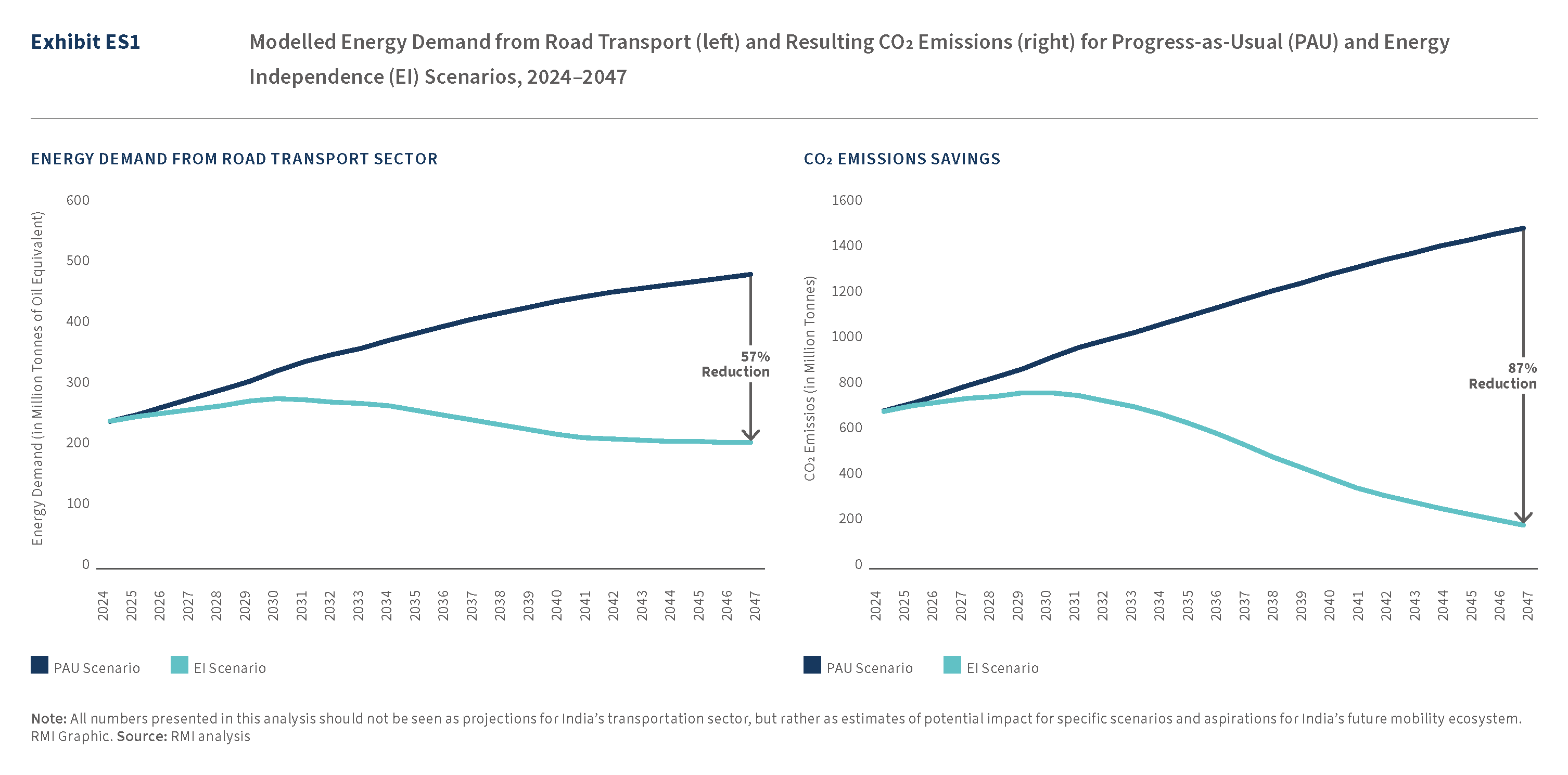
Much action is needed to get India to a future in which electric vehicles (EVs) account for the dominant share of vehicles on the road by 2047. RMI’s India at 2047 report provides key recommendations and actions to transition the country to an electric, shared, and energy-independent mobility system, including:
- Implementing cohesive supply- and demand-side policies
- Establishing accessible, affordable, and safe EV infrastructure
- Prioritizing innovative financing mechanisms
- Committing to a clean and reliable grid
- Developing a circular economy for EV batteries
- Promoting domestic EV production
This multifaceted approach requires collaboration between policymakers, industry stakeholders, and the public. Committing to bold actions and long-term strategies pave the way for a greener, healthier, and more prosperous India. Together, with stakeholder collaboration, India can achieve energy independence for its mobility sector and set an example for the world to follow.



Related Insights

India’s Used EV Battery Market Needs Trust. Battery Aadhaar Can Help.
Help build the clean energy future. Donate today.
Independent research. Real-world solutions. Supported by donors.
RMI can pursue the highest-impact climate and energy solutions because we’re supported by people who believe change is possible. Every gift helps advance the work needed to make clean energy the default choice worldwide.
For other ways to give to RMI, including checks or gifts of stock, please visit Other Ways to Give.
