

Learn how we are working to transform how we use and produce energy.
How the California Grid Can Become More Resilient to Wildfire
Why we share this work for free
RMI is an independent nonprofit working to accelerate the clean energy transition. We publish research like this to inform decision-makers and drive real-world impact.
Our work is supported by philanthropy as well as partnerships, including fee-for-service engagements. This support makes it possible for us to share our independent insights for free.
If you find this work valuable, you can support it anytime.
Get more insights like this
Stay up to date with the latest research, analysis, and tools from RMI by opting in to receive occasional emails below. You’ll get new reports, event invitations, and practical insights to help us all accelerate the clean energy transition.
Loading form...
Your download should start automatically. If it doesn’t, click the download button below.
This work is made possible by philanthropy
RMI is a nonprofit supported by donors and partners. Philanthropy enables us to produce independent research and make resources like this freely available.
If you find this report valuable, please consider supporting our work. You can also explore how we partner with organizations to drive impact.
Jump to Section
As the Bootleg Fire in Oregon continues to burn, the impacts of the largest US wildfire of 2021 have been felt well beyond the state’s border. Not only have the Bootleg Fire and other active fires blanketed skies with smoke as far away as New York City, but the fire also disrupted the delivery of electricity to nearby California, which depends on energy imports to keep the lights on.
The California grid operator issued a “flex alert” for July 12 after the Bootleg Fire took electric transmission lines offline that normally deliver electricity from the Pacific Northwest to Southern California. With California’s electric supply reduced by as much as 3,500 megawatts due to the fire, the California Independent System Operator (ISO) asked customers to reduce their energy use during a hot spell to relieve strain on the diminished grid.
The flex alert appears to have done the trick, as electricity demand remained below the day-ahead forecast for the duration of the evening demand peak (see graph below). Such voluntary reductions will continue to be an important part of California’s toolkit for responding to extreme weather events or supply shortages.
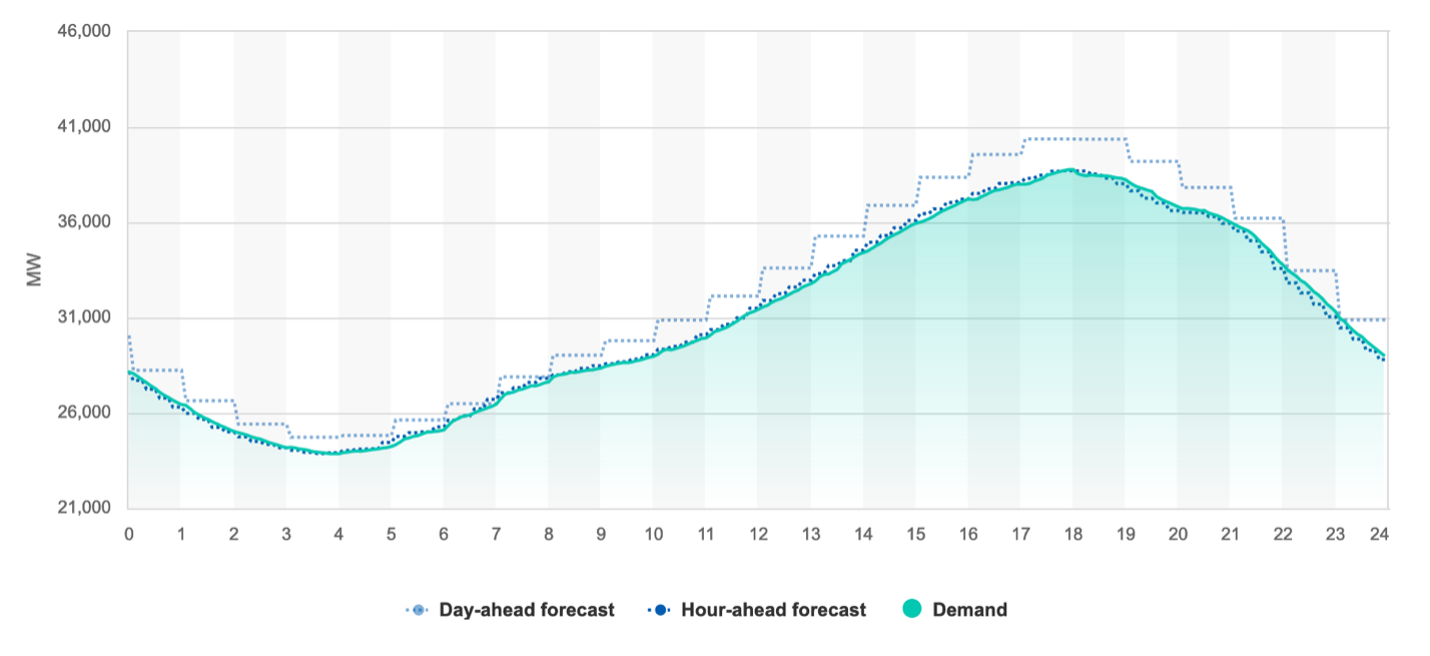
The actual electricity demand (shaded area) on the California ISO grid remained below the day-ahead forecast (dotted light blue line) during the July 12 flex alert window of 4 p.m. to 9 p.m. (16:00–21:00).
But the state can do much more to durably upgrade its energy resilience in the face of rising climate threats across the West. This includes both deploying distributed energy resources within the state’s borders and enhancing transmission infrastructure across state lines.
Resilience from the Rooftops
Distributed energy resources (DERs), such as rooftop solar and battery storage, provide multiple benefits to individual customers, the grid, and the climate:
- DERs relieve strain on the grid by providing on-site generation to reduce demand outright or by shifting demand away from peak hours.
- By reducing electric demand or shifting demand to times when renewable energy is abundant on the grid, DERs reduce the grid’s reliance on fossil generation and help eliminate the climate pollution from burning fossil fuels.
- During outages caused by fire, wind, extreme weather events, or public safety power shutoffs, DERs provide localized resilience, keeping the lights on, community services powered, and life-saving medical equipment running in the absence of grid power.
Similarly, lower-tech efficiency improvements like upgrading insulation and windows can both reduce electric demand and provide household resilience. Well-insulated, weatherproofed homes provide more “hours of safety” during an outage by keeping living spaces comfortable in the absence of electric cooling or heating.
DERs can be especially valuable for hospitals, emergency response centers, shelters, and other critical facilities. With public safety power shutoffs becoming part of “new normal” life in California, some organizations are examining how schools can use solar panels, battery storage, and “islanded” microgrids to create resilient schools that can stay open when the grid goes down.
At scale, hundreds of thousands of solar-plus-battery systems, deployed across homes and businesses, can serve as “virtual power plants” that feed energy back into the grid when needed. “It takes the Flex Alert and puts it on speed,” Bernadette Del Chiaro, executive director of the California Solar and Storage Association, told the Los Angeles Times in 2020. “It’s not just, ‘Turn off your lights and set your thermostat to 78.’ It’s do those things and give us 5 kilowatt-hours from your battery in your garage. And we’ll pay you for it.”
To accelerate resilience-focused upgrades, cities can ensure that the process for deploying solar and battery systems has as few barriers as possible. The new SolarAPP+ program, developed by the National Renewable Energy Laboratory with RMI and other partners, aims to do just that by streamlining the permitting process for residential solar and battery storage. The California cities of Menifee and Pleasant Hill were among the first municipalities to pilot SolarAPP+, and additional cities such as Stockton are planning to implement SolarAPP+ to help meet clean energy, climate, and community resilience goals.
Putting Eggs in More Baskets
For the past half-century, the Pacific Northwest–Southwest intertie has carried inexpensive hydro power generated at Pacific Northwest dams to the Los Angeles area. As the Bootleg Fire has shown, California depends heavily on this and other north-south transmission pathways, which are increasingly exposed to climate risks. As the graph below shows, losing 3,500 MW of electric supply puts a significant dent in the state’s energy imports, which make up one-quarter of California’s total electricity supply.
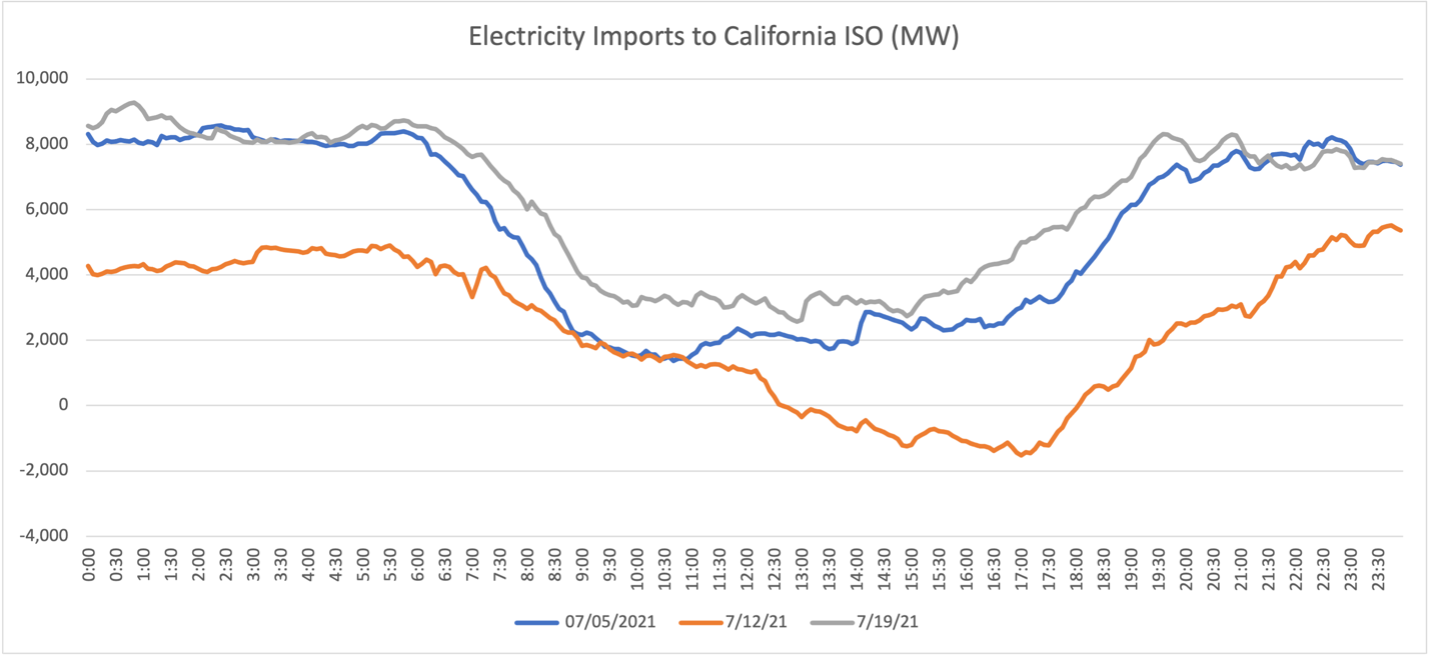
The orange line shows the electricity imported by California’s ISO on July 12, as compared with one week before (blue) and one week after (gray). Thousands of megawatts of supply were unavailable on July 12 due to the Bootleg Fire in Oregon.
Market integration across the West through the Energy Imbalance Market has already helped enable the electricity trade and bring economic benefits to states across the region. Further integrating markets while also expanding interstate transmission infrastructure would improve these economic benefits while also reducing the reliance on specific regions or generation facilities, spreading resilience benefits between states. Much as the Pacific Northwest–Southwest intertie has allowed Northwest dams to sell hydro power to population centers in Southern California, expanded interstate transmission would allow California to widely export solar energy when renewable energy is abundant but in-state demand is low. It would also provide more avenues for California to procure energy from windier states across the West when demand outstrips supply.
Modernizing and expanding the nation’s transmission system will also be key to decarbonizing the grid by enabling the deployment and utilization of wind and solar on a massive scale. That is part of the reason that RMI recently identified transmission investments as one of the top clean energy priorities for the federal infrastructure bills being crafted and debated in Washington, D.C.
Resilience at All Scales
As explained in a recent RMI blog post, clean energy is not a zero-sum game: we need both small-scale DERs and large-scale transmission to unlock the resilience and climate benefits of clean energy. With climate-driven heat waves and wildfires already reshaping the West, California and other states must simultaneously act to curb climate change while adapting to the effects that are already here. Fortunately, the best clean energy solutions that we have in our toolkit can address both problems at once, greening the grid and building resilience at the same time.
Authors

John Matson
Related Insights
Reality Check: For Power Plants, Changing the Fuel Doesn’t Fix the Economics
The Opportunity for Heat Pumps to Put Downward Pressure on Electricity Rates
For Clean Energy Projects, How Community Benefits Are Delivered Matters
Tracking WestTEC: Where 100+ Transmission Projects Stand and What Comes Next
Help build the clean energy future. Donate today.
Independent research. Real-world solutions. Supported by donors.
RMI can pursue the highest-impact climate and energy solutions because we’re supported by people who believe change is possible. Every gift helps advance the work needed to make clean energy the default choice worldwide.
For other ways to give to RMI, including checks or gifts of stock, please visit Other Ways to Give.
