

Learn how we are working to transform how we use and produce energy.
Ensuring an Inclusive Clean Energy Transition
A Two-Part Series on Supporting Coal Workers and Communities
Why we share this work for free
RMI is an independent nonprofit working to accelerate the clean energy transition. We publish research like this to inform decision-makers and drive real-world impact.
Our work is supported by philanthropy as well as partnerships, including fee-for-service engagements. This support makes it possible for us to share our independent insights for free.
If you find this work valuable, you can support it anytime.
Get more insights like this
Stay up to date with the latest research, analysis, and tools from RMI by opting in to receive occasional emails below. You’ll get new reports, event invitations, and practical insights to help us all accelerate the clean energy transition.
Loading form...
Your download should start automatically. If it doesn’t, click the download button below.
This work is made possible by philanthropy
RMI is a nonprofit supported by donors and partners. Philanthropy enables us to produce independent research and make resources like this freely available.
If you find this report valuable, please consider supporting our work. You can also explore how we partner with organizations to drive impact.
Jump to Section
1. A Recovery and Revitalization Framework for Coal Workers and Communities
2. How State Legislation Is Supporting Coal Communities and Workers as the Economy Shifts to Clean Energy
Across the United States, the transition from coal to a clean energy economy is accelerating. However, without thoughtful planning and robust resources, this transition will harm workers who depend on coal for their livelihoods, as well as the communities where they live and work. These people and places face serious risks in the shift to clean energy, including loss of well-paying jobs with good benefits, loss of health insurance, reduced property values, gaps in local tax revenues, unfunded liabilities for environmental cleanup, and uncertainty around future community economic development.
Governments are beginning to take notice of this risk and opportunity. Over the past few years, seven states passed or considered bills designed to support coal workers and communities facing economic transition. And federal policymakers recently passed the Inflation Reduction Act, which alongside the Bipartisan Infrastructure Law of 2021, represents the largest set of investments and resources available to support energy communities in history.
RMI’s recovery and revitalization framework, based on interviews with stakeholders as well as previous stakeholder-led platforms and principles for a fair transition, consists of three steps:
- Relief for coal workers and communities to alleviate losses of local revenue and jobs that occur immediately following coal closure
- Reclamation of remaining coal sites to prevent prolonged pollution risks and promote short- and medium-term job creation and local economic activity
- Reinvestment in coal communities to promote long-term economic resilience and diversification
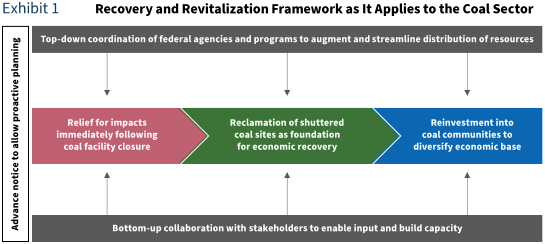
Our new report presents a comprehensive review of state legislation that supports coal communities and workers facing economic transition mapped onto our policy framework.
- The table below identifies important policies that are commonly covered by existing state legislation as well as common funding or policy-related gaps.
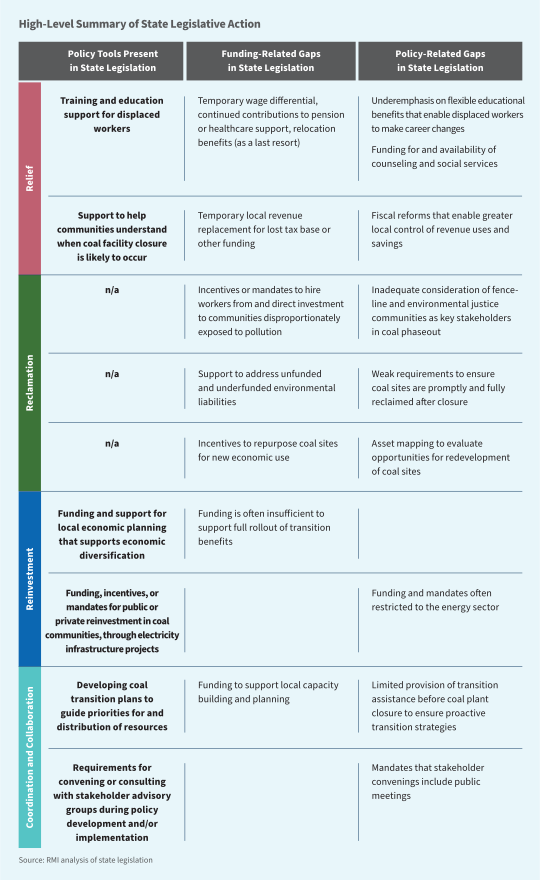
Climate policy that is effective and durable must comprehensively address these social and economic challenges. The framework presented here can help federal and state policymakers to design and implement comprehensive climate policy that works for communities affected by the energy transition — and equip advocates to fight for strong policies.


Related Insights
Reality Check: For Power Plants, Changing the Fuel Doesn’t Fix the Economics
The Opportunity for Heat Pumps to Put Downward Pressure on Electricity Rates
For Clean Energy Projects, How Community Benefits Are Delivered Matters
Tracking WestTEC: Where 100+ Transmission Projects Stand and What Comes Next
Help build the clean energy future. Donate today.
Independent research. Real-world solutions. Supported by donors.
RMI can pursue the highest-impact climate and energy solutions because we’re supported by people who believe change is possible. Every gift helps advance the work needed to make clean energy the default choice worldwide.
For other ways to give to RMI, including checks or gifts of stock, please visit Other Ways to Give.
