

Learn how we are working to transform how we use and produce energy.
Energy Efficiency and Net-Zero Buildings: GSA & RMI Answer the Call (Executive Summary)
Why we share this work for free
RMI is an independent nonprofit working to accelerate the clean energy transition. We publish research like this to inform decision-makers and drive real-world impact.
Our work is supported by philanthropy as well as partnerships, including fee-for-service engagements. This support makes it possible for us to share our independent insights for free.
If you find this work valuable, you can support it anytime.
Get more insights like this
Stay up to date with the latest research, analysis, and tools from RMI by opting in to receive occasional emails below. You’ll get new reports, event invitations, and practical insights to help us all accelerate the clean energy transition.
Loading form...
Your download should start automatically. If it doesn’t, click the download button below.
This work is made possible by philanthropy
RMI is a nonprofit supported by donors and partners. Philanthropy enables us to produce independent research and make resources like this freely available.
If you find this report valuable, please consider supporting our work. You can also explore how we partner with organizations to drive impact.
Jump to Section
THE GSA’S COMMITMENTThe nation’s largest landlord is answering President Obama’s call to pursue deep energy savings and net-zero energy in buildings. Earlier this spring, the President and Congress each issued directives that extended aggressive energy efficiency goals into the next decade, drawing attention to topics like net-zero energy and promoting sustainability more broadly in the federal government. Shortly after these mandates were passed, the U.S. General Services Administration (GSA) and Rocky Mountain Institute (RMI) held the 2015 Practice Into Performance Workshop, convening the GSA, a variety of other federal agencies, and private energy service companies (ESCOs) to help the federal government achieve deeper energy savings through performance contracting. The event provided the perfect platform for all stakeholders to share past successes, acquire new tools, and break down barriers to achieve deep energy savings.Translating deep energy retrofit best practices into performance is easier said than done, as demonstrated by the relatively low level of savings delivered from energy savings performance contracts (ESPCs) throughout the federal government, 19 percent on average. Research and experience demonstrates that we can retrofit buildings economically to deliver much deeper energy, cost, and carbon savings.
Authors

Cara Carmichael
Related Insights

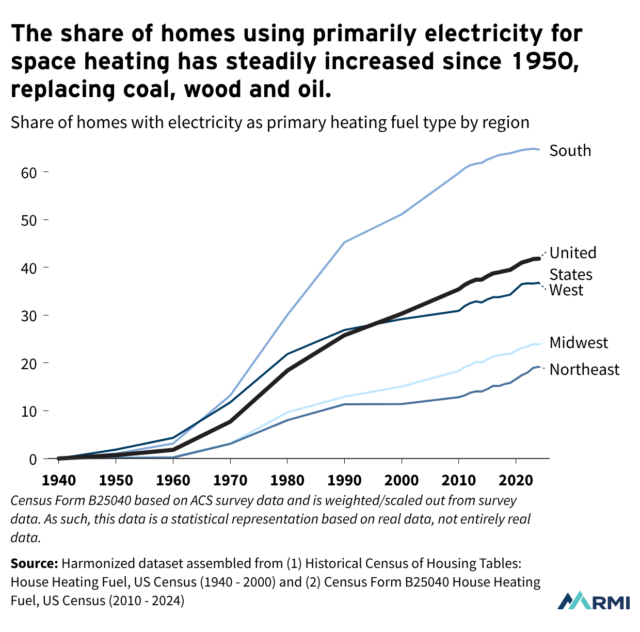
More Americans Are Heating Their Homes with Electricity than Ever Before
Help build the clean energy future. Donate today.
Independent research. Real-world solutions. Supported by donors.
RMI can pursue the highest-impact climate and energy solutions because we’re supported by people who believe change is possible. Every gift helps advance the work needed to make clean energy the default choice worldwide.
For other ways to give to RMI, including checks or gifts of stock, please visit Other Ways to Give.
