

Learn how we are working to transform how we use and produce energy.
Decarbonising the Indian Steel Industry: Roadmap towards a Green Steel Economy
Roadmap towards a Green Steel Economy
Why we share this work for free
RMI is an independent nonprofit working to accelerate the clean energy transition. We publish research like this to inform decision-makers and drive real-world impact.
Our work is supported by philanthropy as well as partnerships, including fee-for-service engagements. This support makes it possible for us to share our independent insights for free.
If you find this work valuable, you can support it anytime.
Get more insights like this
Stay up to date with the latest research, analysis, and tools from RMI by opting in to receive occasional emails below. You’ll get new reports, event invitations, and practical insights to help us all accelerate the clean energy transition.
Loading form...
Your download should start automatically. If it doesn’t, click the download button below.
This work is made possible by philanthropy
RMI is a nonprofit supported by donors and partners. Philanthropy enables us to produce independent research and make resources like this freely available.
If you find this report valuable, please consider supporting our work. You can also explore how we partner with organizations to drive impact.
Jump to Section
The importance of steel in supporting India’s growth will increase with economic development, infrastructure build-out, and urbanization in India. The emissions from the sectors are estimated to grow by 200 percent by 2050. This requires decarbonizing the steel industry to ensure India meets its economic ambitions and climate mitigation goals.
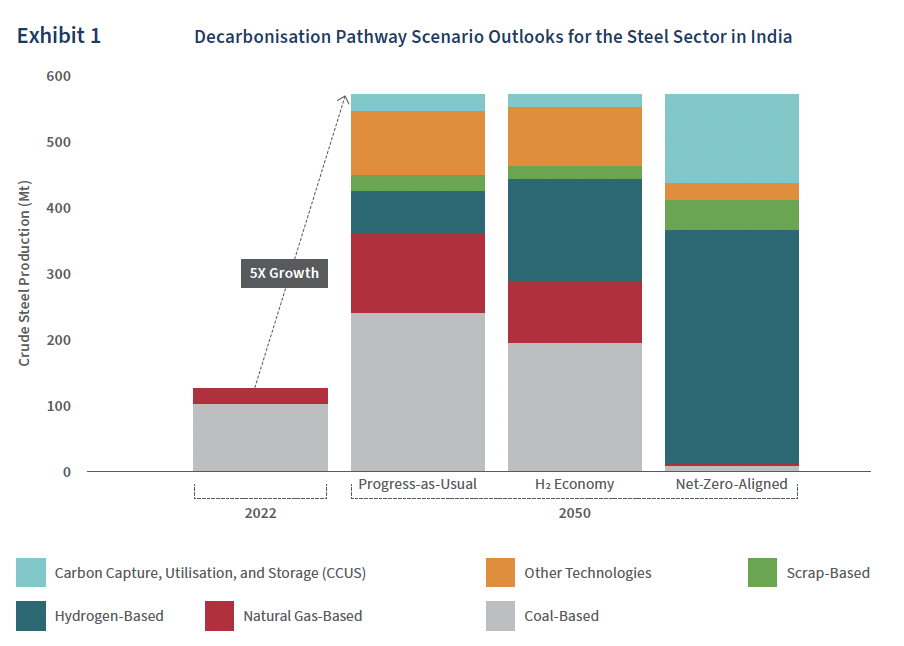
This report identifies five key levers to decarbonize steel: the use of green hydrogen for steel production; the introduction of a more significant share of renewable electricity in captive electricity consumption; carbon capture, utilization, and storage (CCUS) to decarbonize existing carbon-intensive steel production processes; greater use of scrap to make steel; and increasing energy efficiency across steel production processes.
The report proposes a roadmap for realizing a low-carbon steel economy in India, identifying six key objectives:
- Establishing the definition and standards of green and low-carbon steel: Key near-term actions include policy measures such as defining green/low-carbon steel and setting standards for green products. This would provide clear benchmarking of emissions mitigation requirements for the sector.
- Advancing the uptake of alternative green energy sources such as green H2 and renewable energy: Policy initiatives could range from mandating renewable electricity and green H2 usage to a near-term, government-led incentivizing mechanism for green steel manufacturers.
- Announcing a green steel procurement policy and targets to encourage market creation and demand aggregation: Raising the ambition of the National Steel Policy with more focus on breakthrough technologies like green H2 and CCUS would send action signals to steelmakers. In the medium and long term, required actions range from mandating green steel procurement targets to creating and supporting that emerging market to fast-track the transition.
- Supporting R&D to advance breakthrough technologies and solutions like H2 and CCUS: The transition toward low-carbon steel fundamentally depends on breakthrough technologies like green hydrogen and CCUS, which need dedicated R&D support to scale and compete with conventional technologies. In the longer term, R&D funding can be channeled to focus on direct electrification of steelmaking routes such as electrolyzer-based steelmaking.
- Promoting alternative emissions mitigation actions through pilots and clusters: Proof of concept through pilots and clusters will be instrumental in making stakeholders believe in the solutions’ viability. Demonstrations will establish trust in the technology, drawing investment and policy support.
- Framing mechanisms and frameworks for financing the green steel transition: Financing is critical in making the steel sector transition work. Increasing access to sustainable finance, such as green bonds or sustainability bonds, and access to concessional finance could move green investments in the near term.
Authors

Related Insights

India’s Used EV Battery Market Needs Trust. Battery Aadhaar Can Help.
Help build the clean energy future. Donate today.
Independent research. Real-world solutions. Supported by donors.
RMI can pursue the highest-impact climate and energy solutions because we’re supported by people who believe change is possible. Every gift helps advance the work needed to make clean energy the default choice worldwide.
For other ways to give to RMI, including checks or gifts of stock, please visit Other Ways to Give.
