

Learn how we are working to transform how we use and produce energy.
Why we share this work for free
RMI is an independent nonprofit working to accelerate the clean energy transition. We publish research like this to inform decision-makers and drive real-world impact.
Our work is supported by philanthropy as well as partnerships, including fee-for-service engagements. This support makes it possible for us to share our independent insights for free.
If you find this work valuable, you can support it anytime.
Get more insights like this
Stay up to date with the latest research, analysis, and tools from RMI by opting in to receive occasional emails below. You’ll get new reports, event invitations, and practical insights to help us all accelerate the clean energy transition.
Loading form...
Your download should start automatically. If it doesn’t, click the download button below.
This work is made possible by philanthropy
RMI is a nonprofit supported by donors and partners. Philanthropy enables us to produce independent research and make resources like this freely available.
If you find this report valuable, please consider supporting our work. You can also explore how we partner with organizations to drive impact.
Jump to Section
This is part I in a series of basic grid explainers. See part II, “How Rising Demand Is Driving a Grid Tech Revolution.”
Electricity powers nearly every aspect of modern life, from brewing morning coffee to running factories and hospitals. But as electricity demand grows, grid equipment ages, and extreme weather becomes more common, every part of the grid — its processes, infrastructure, and how we manage it — need to evolve to ensure that electricity is still available and affordable when people need it.
Thankfully, the United States and other regions with mature grids have the technology and know-how to transform a system first built in the 19th century into one better suited to 21st-century energy needs.
How the basic grid works
The electricity system is all around us, all the time. From outlets in our homes to wires overhead, its physical parts are so familiar we barely notice them.
Yet those familiar components are part of a continent-spanning network that links power plants, transmission lines, substations, and customers into a single system. Some have called it the world’s largest machine.
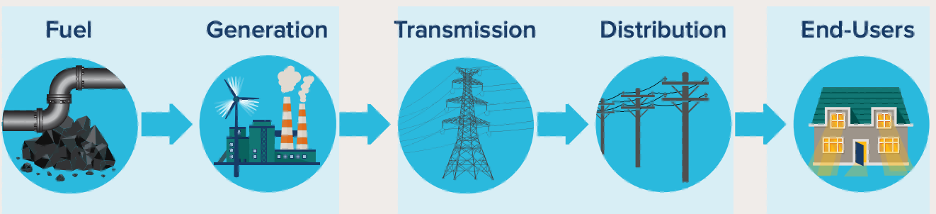
In a traditional, centralized system like those of the United States, Europe, and much of the developed world, every electron goes on a meandering journey before it gets to the outlets of our homes and businesses. It starts with generation:
| Fuel and Generation | Transmission and Distribution | End Uses |
|---|---|---|
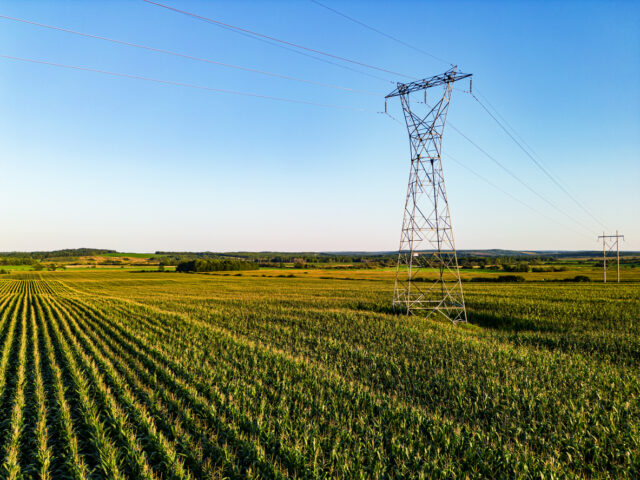
Thermal power plants — such as coal, gas, geothermal, and nuclear — use heat to create steam that spins a turbine that in turn drives a generator to create a flow of electricity. For hydro and wind power, generation relies on the mechanical force from the weight of water or the pressure of wind to spin a generator. Solar power involves no mechanical processes of any kind. Instead, semi-conducting materials react to radiation from the sun to generate a flow of electricity. | After it’s created, electric current is then “stepped up” — its voltage is increased — at substations so that it can travel long distances with less energy loss. These transmission lines spiderweb across America, radiating out from power plants, in the past powered mostly by coal, gas, or nuclear; more recently from solar or wind farms. As electricity gets closer to the end of its journey, it is stepped back down at substations from high voltage to levels better suited to the needs of homes and businesses. | Once that flow nears the end-user, it’s stepped down even further with transformers and other equipment to be delivered at a voltage usable out of outlets. In the United States that’s 120 or 240 volts for residential customers. Some businesses and factories require higher voltages to power heavy applications. |
This basic architecture has been the default worldwide since 1882, when Thomas Edison wired up the first buildings to a nearby generator at Lower Manhattan’s Pearl Street Station. In the United States, new plants, transmission lines, and related infrastructure spread rapidly, with investment peaking after World War II. But starting in the 1970s, electricity demand in the United States leveled off, with little need for new power plants, and scant investment in the grid.
This stability made it easy to plan the electricity supply to match users’ demand. Because of the substantial costs involved in planning, building, connecting, maintaining, and fueling big power plants, a centralized system made sense. It was most cost-effective to build one big generator and distribute electricity outward, rather than to build multiple smaller power plants that all needed maintenance and fuel.
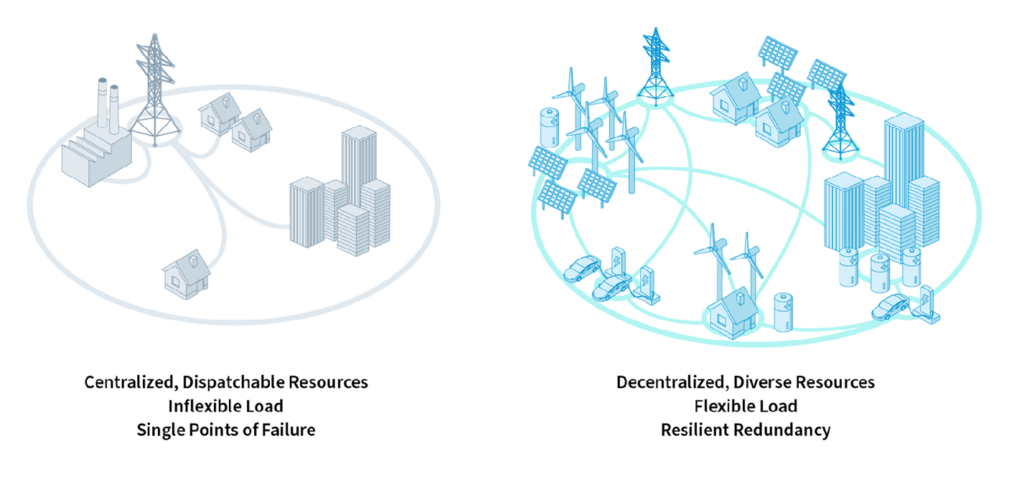
The centralized system approach has largely been dependable. For many years, supply and demand growth were consistent, fuel was plentiful and affordable, and the electricity delivery system operated effectively. However, in recent years, surging demand, volatile fuel prices, and extreme weather have threatened the integrity of US generation, transmission, and distribution infrastructure. At the same time, significant advances in technology, cost reductions, and policy have unlocked cost-effective solutions that are not served by the traditional, centralized, supply-oriented model.
A more flexible electricity system that can adapt to changing variables is needed to support electricity reliability moving forward.
Making the grid more flexible
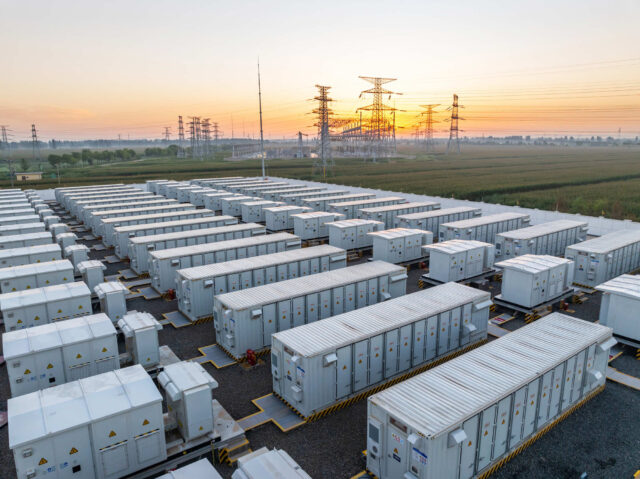
Cheaper, more flexible alternatives to this centralized grid model are emerging in the United States and beyond. As costs fall for solar panels, electricity storage technologies, and other clean technologies, distributed energy resources (DERs) are becoming more accessible.
DERs represent an evolutionary shift from the grid’s original design, when power was mostly centralized in one big power plant supplying many users, to a new era in which smaller sources of power are distributed among many users. Some DERs can foster resilience for communities even when they’re not connected to the grid. During Hurricane Helene, for example, heavy rains and flooding knocked out power to the town of Hot Springs, North Carolina, but solar and battery storage together were able to provide emergency electricity to the town center for almost a week during prolonged grid repairs.
For example, today, folks can pop a solar panel on their roof or in their backyard, whether they’re in Cairo, Ill. or Cairo, Egypt, and start generating low-cost power in mere minutes. Plus, with affordable battery storage widely available, they can access clean electricity even when the sun doesn’t shine.
Businesses have also seen the benefits of incorporating DERs. They can help prevent product loss during outages, stabilize electricity costs during periods of volatility, and be leveraged as a resource to sell electricity back to the grid.
Adding DERs to the grid creates more flexibility and resilience across the whole system — just as in an investment portfolio, diversification is key for stability — so getting new DERs connected quickly and including them in grid planning and management has benefits for all.
To learn more about how this shift from centralized to distributed will take shape, continue on in Part II >>.
Authors

Barbara Lantz
Social Content Lead
Help build the clean energy future. Donate today.
Independent research. Real-world solutions. Supported by donors.
RMI can pursue the highest-impact climate and energy solutions because we’re supported by people who believe change is possible. Every gift helps advance the work needed to make clean energy the default choice worldwide.
For other ways to give to RMI, including checks or gifts of stock, please visit Other Ways to Give.
