

Learn how we are working to transform how we use and produce energy.
Cities Designed to Shape and Enable New Mobility
Experimentation at the Interface of Urban Design and Mobility
Why we share this work for free
RMI is an independent nonprofit working to accelerate the clean energy transition. We publish research like this to inform decision-makers and drive real-world impact.
Our work is supported by philanthropy as well as partnerships, including fee-for-service engagements. This support makes it possible for us to share our independent insights for free.
If you find this work valuable, you can support it anytime.
Get more insights like this
Stay up to date with the latest research, analysis, and tools from RMI by opting in to receive occasional emails below. You’ll get new reports, event invitations, and practical insights to help us all accelerate the clean energy transition.
Loading form...
Your download should start automatically. If it doesn’t, click the download button below.
This work is made possible by philanthropy
RMI is a nonprofit supported by donors and partners. Philanthropy enables us to produce independent research and make resources like this freely available.
If you find this report valuable, please consider supporting our work. You can also explore how we partner with organizations to drive impact.
Jump to Section
With support from the Robert Wood Johnson Foundation, RMI is exploring and testing industry interest in a concept we’re calling MOD Cities, where “MOD” is short for “modular” and “modifiable” and also stands for “mobility-oriented development.” MOD Cities would be living test sites where local municipal governments, developers, financiers, the vehicle-service industry, and urban designers and architects actively collaborate to co-innovate at the nexus of urban design, vehicles, and new mobility services. MOD Cities would put people first and be seamlessly integrated with the communities and urban fabric at their edges.
Imagine a place—or combination of places—where groundbreaking urban design features can be complemented by innovative mobility services. A place where the vehicle-service and built environment industries can experiment in tandem and develop familiarity and ground-tested expertise about the relationship between their respective industries; where people can equitably participate in the design process, and the impact of new design features on people’s behavior, health, and livelihood can be concretely demonstrated and understood; and where policymakers from across the globe can directly observe the impact of enabling flexible and experimental approaches to urban design by revising zoning practices and land use codes.
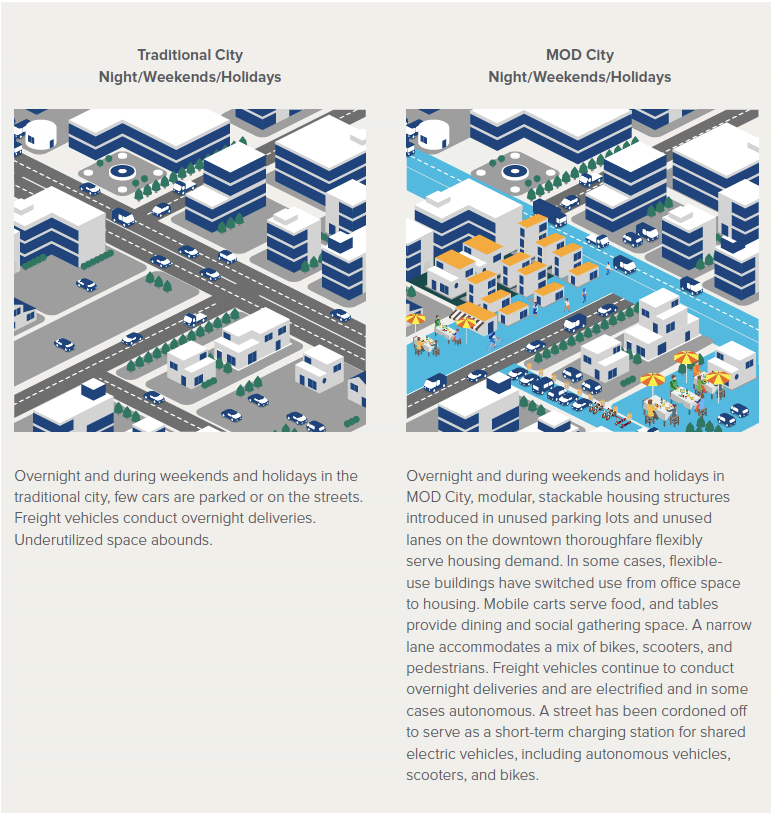
With sufficient interest, an initial team composed of representatives from key stakeholder groups could take the next steps to further define the concept, develop an operating model, and implement MOD Cities. This report aims to explore the concept of MOD Cities while providing cities and other mobility and built environment stakeholders with a toolkit and illustrative case studies for experimentation that puts them in a position to more quickly unlock the full potential of new mobility in cities designed to shape and enable it.
Authors

Greg Rucks
Ben Holland
Related Insights
The Opportunity for Heat Pumps to Put Downward Pressure on Electricity Rates

Gas Utility Depreciation: Recommendations for an Uncertain Future
Help build the clean energy future. Donate today.
Independent research. Real-world solutions. Supported by donors.
RMI can pursue the highest-impact climate and energy solutions because we’re supported by people who believe change is possible. Every gift helps advance the work needed to make clean energy the default choice worldwide.
For other ways to give to RMI, including checks or gifts of stock, please visit Other Ways to Give.
