

Learn how we are working to transform how we use and produce energy.
Building a Bigger Grid for PJM
Permitting regional transmission starts with better planning
Why we share this work for free
RMI is an independent nonprofit working to accelerate the clean energy transition. We publish research like this to inform decision-makers and drive real-world impact.
Our work is supported by philanthropy as well as partnerships, including fee-for-service engagements. This support makes it possible for us to share our independent insights for free.
If you find this work valuable, you can support it anytime.
Get more insights like this
Stay up to date with the latest research, analysis, and tools from RMI by opting in to receive occasional emails below. You’ll get new reports, event invitations, and practical insights to help us all accelerate the clean energy transition.
Loading form...
Your download should start automatically. If it doesn’t, click the download button below.
This work is made possible by philanthropy
RMI is a nonprofit supported by donors and partners. Philanthropy enables us to produce independent research and make resources like this freely available.
If you find this report valuable, please consider supporting our work. You can also explore how we partner with organizations to drive impact.
Jump to Section
After years of limited regional grid buildout, PJM is planning over $23 billion in new large-scale transmission projects that will strengthen reliability and help integrate new load (Exhibit 1).[1] Before 2022, PJM was largely planning only smaller-scale projects (Exhibit 2), which has limited total grid capacity and contributed to PJM’s interconnection queue backlog that has delayed new generation and load. In turn, this roadblock to adding generation has contributed to soaring capacity market prices and the region’s electricity affordability challenge. PJM’s recently proposed large-scale transmission projects will expand the grid, helping to bring new generation and load online and contributing to keeping electricity prices affordable.
However, before developers can construct these projects, they must obtain permits from each state through which they pass. The state permitting process is essential for these projects’ success and is also closely linked to PJM’s planning process. We believe that there are ways to better link these processes — what we call the planning-permitting nexus — to improve buy-in from states and communities and permit lines more quickly. PJM’s regional planning, for instance, can affect how state permitting agencies view the purpose and benefits of these projects. State permitting agencies in turn have the power to approve or deny PJM-planned projects, directly affecting these projects’ abilities to get built.
In this article, we draw on more than a dozen stakeholder interviews and literature review to further define the planning-permitting nexus and offer recommendations for steps that PJM and states can take to strengthen it by increasing transparency, coordination, and information sharing. We believe that these recommendations can together expedite the development timeline for large regional transmission projects, reducing systemwide costs for ratepayers.
Over the past three cycles of the annual Regional Transmission Expansion Plan (RTEP), PJM approved over 1,300 miles of new high voltage lines (Exhibit 1). If successfully permitted and built, these projects would represent a historic expansion of the PJM system (see RMI’s tracker of recent, large-scale new build line segments).
Exhibit 2
How PJM plans transmission
In the annual RTEP, PJM plans regional transmission projects, also known as baseline upgrades, to address reliability, economic, or public policy needs.[2] Nearly all the large-scale projects PJM plans today are classified as regional reliability solutions. These can be identified through either the short-term (5-year out base cases developed over 18 months) or longer-term (8-year out base cases developed every 24 months) (see PJM’s Manual 14 Section 2.1).
The planning process (Exhibit 3) begins with PJM identifying grid needs using data such as load forecasts, generation retirement information, policy requirements, and assumptions about future generation. PJM then opens a competitive bidding window for transmission developers to submit solutions, known as the sponsorship model. Following a multi-stage evaluation (see next paragraph), PJM selects its “shortlist” of top proposals for each need, solicits stakeholder feedback, and recommends a set of final selected project proposals for PJM board approval. Once projects receive PJM board approval, they progress to the developer-led siting and permitting process at the state level.
Exhibit 3. Overview of PJM planning process for reliability projects
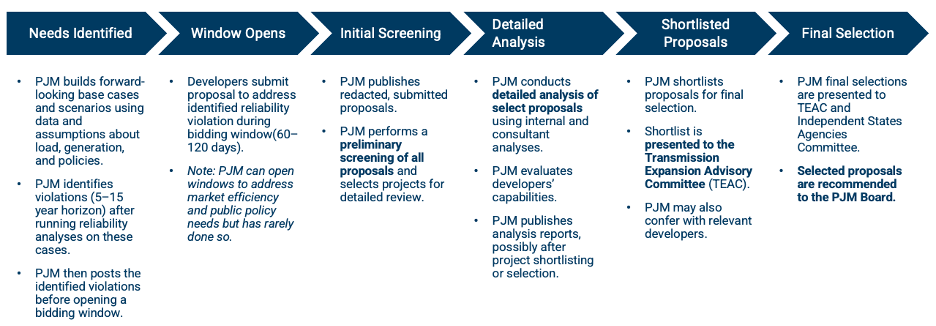
In its evaluation process, PJM assesses candidate projects by considering project cost, developer capabilities, outage coordination needs, and siting and permitting risks, including a proposal’s right-of-way, land needs, permitting timeline, and potential environmental impacts. PJM includes any history or likelihood of opposition in a proposed location. The PJM Constructability and Cost Analysis RTEP reports, particularly the Risk Assessment Matrix,[3] provide visibility into potential siting and permitting risks and how they may inform proposal selection. Notably, PJM may still select projects with high constructability risks if PJM determines the related reliability needs supersede those concerns.
How states site and permit transmission
After PJM approves a project, the project developer becomes responsible for securing permits in each state their project crosses (Exhibit 4). Typically, the key transmission permit is the Certificate of Public Convenience and Necessity (CPCN), which is overseen by state public utility commissions (PUCs) or siting boards (collectively referred to hereafter as state permitting agencies). Projects crossing multiple states require separate permits from each state they pass through.
Specific CPCN requirements, including the state agency responsible for issuing the permit, vary by state (Exhibit 5). New Jersey and Indiana, for instance, are the only two PJM states that do not require any state-level CPCN (permitting is done at the local level, with state environmental approvals necessary in some cases). For states that do require CPCNs, the permitting agency generally evaluates projects against two key questions: Is it necessary? Is it in the public interest?[4]
Exhibit 4. Overview of developer-led transmission siting and permitting process
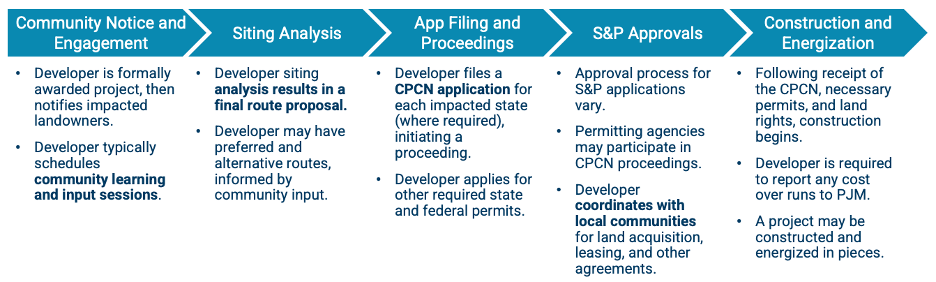
Exhibit 5. PJM State CPCN Requirements
| PJM State | CPCN Requirement | State Permitting Agency |
| Delaware | One-time CPCN required for each utility operating within the state (≥34.5 kV), but no CPCN required for transmission facility construction, modification, upgrade, or extension once the utility has been granted its one-time CPCN to operate. | Delaware Public Service Commission |
| District of Columbia | CPCN required for all new build transmission projects. | District of Columbia Public Service Commission |
| Illinois | CPCN required for all new build transmission projects. | Illinois Commerce Commission |
| Indiana | No CPCN required | Permitting done at local level |
| Kentucky | CPCN required for any project ≥138 kV and >1 mile in length; exemptions for rebuilds of existing infrastructure. | Kentucky Public Service Commission |
| Maryland | CPCN required for all overhead lines >69 kV. | Maryland Public Service Commission |
| Michigan | CPCN required for all projects ≥345 kV & >5 miles in length; voluntary for lower-voltage projects but a voluntary CPCN trumps local permits. | Michigan Public Service Commission |
| New Jersey | CPCN required for supplemental transmission projects ≥100 kV or higher, with localities still responsible for issuing a land use permit.* | New Jersey Board of Public Utilities and local governments |
| North Carolina | CPCN required for all projects >161 kV; exemptions for rebuilds of existing infrastructure. | North Carolina Utilities Commission |
| Ohio | CPCN required for >2 miles and ≥100 kV with lower-level applications required for smaller projects. | Ohio Power Siting Board |
| Pennsylvania | CPCN required for projects >100 kV. | Pennsylvania Public Utility Commission |
| Virginia | CPCN required for projects ≥138 kV with exceptions for “ordinary extensions” (see details here). | Virginia State Corporation Commission |
| West Virginia | CPCN required for projects ≥200 kV; exceptions for rebuilds of existing infrastructure. | West Virginia Public Service Commission. |
Source: RMI analysis and Consumer Advocates for PJM States (CAPS) analysis[5]
*Updated September 17, 2026 to reflect changes under the Advanced Grid Technologies Act.
Challenges along the planning-permitting nexus
Based on our research and interviews, when PJM-approved transmission projects enter state permitting processes, the state permitting agencies and the public often have two key questions in mind, which are frequently where challenges arise.
- Were alternative projects and siting impacts sufficiently considered?
State permitting agencies and stakeholders want assurance that PJM assessed less impactful and lower-cost alternatives before determining if a new build transmission project is necessary. These can include technology alternatives like advanced transmission technologies (ATTs) or Storage As a Transmission Asset (SATA), which PJM today does a poor job at communicating about during final project evaluation and selection. Uncertainty among host communities and state leaders about whether all economically and technologically feasible alternatives like these were evaluated can increase opposition to new build transmission projects. - Does the transmission project serve state and local interests?
Stakeholders often question who benefits from a transmission project. Host communities’ positions on projects can be influenced by whether they believe the benefits (to them, their community, or their state) outweigh the direct impact to their community. Even when projects serve regional grid reliability, stakeholders’ perceptions of a transmission line can be colored by what or who they think is ultimately driving a project (e.g., a specific data center) and whether they believe their state benefits from serving that need. Today, PJM does not quantify nor effectively communicate benefits for most projects, making it difficult for state permitting agencies or stakeholders to balance project benefits with state and local community concerns.
Recommendations to improve planning and permitting alignment
Below, we recommend a number of ways that PJM and states can address these two planning-permitting nexus challenges. By acting on these opportunities, PJM, transmission developers, state permitting agencies, and other stakeholders can build state and local support to site and permit new transmission projects that deliver tangible benefits to ratepayers by lowering systemwide costs.
Better acknowledge how PJM assesses siting impacts in final project selection.
As discussed above, PJM considers siting and permitting risk as part of project selection, but this is not always clear to stakeholders during the planning process, nor is how siting and permitting considerations influence final selection decisions. PJM often emphasizes in its Transmission Expansion Advisory Committee (TEAC) meetings that it does not site transmission, which, while legally accurate, can obscure how project planning and selection shapes downstream siting impacts.PJM’s Constructability and Financial Analysis reports currently provide incomplete visibility into constructability and feasibility considerations. For instance, these reports often rely on duplicative, cut-and-paste language across projects, despite the project-specific nature of siting and permitting. The scoring criteria for some categories of siting and permitting-related risks are also ambiguously defined based on expert judgement (see the gray columns in PJM’s Risk Assessment Matrix[6]). Furthermore, reports are almost exclusively written for an individual project proposal and do not offer discussion or a comparative analysis between competing proposals addressing the same need.
To enhance clarity here, PJM could provide more details on how it leverages its Constructability and Financial Analysis reports in preparing project “shortlists” and ultimately selecting a portfolio of final projects. PJM could, for instance, clarify the tradeoffs associated with different project proposals’ siting and permitting risks relative to the grid needs and benefits and how that informs final selection for each RTEP cycle. This could increase transparency and trust in PJM’s selection process by allowing stakeholders to more fully understand how siting plays into final project selection and why, for instance, large greenfield projects were still selected in some instances.
Develop transparent RTEP process tracking
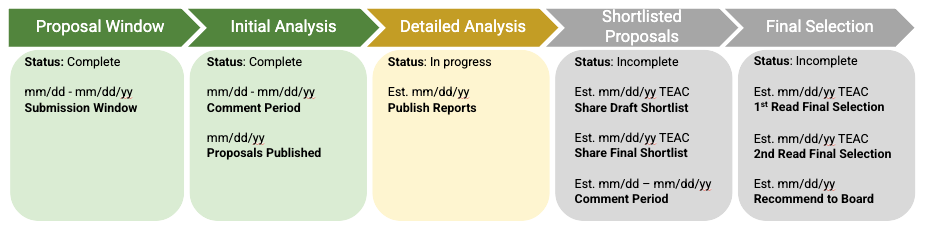
It can be difficult for stakeholders, advocates, and states to track where PJM is in its transmission planning process at any given moment. To remedy this, PJM can introduce a live RTEP process tracker (Exhibit 6) on its TEAC website, not unlike a Domino’s Pizza order tracker. It could be updated regularly with which planning window PJM is currently in and where they are within each planning process. For easier access, relevant planning files (e.g., project shortlists, final project selections) could be organized by project window rather than, or in addition to, organizing them by the TEAC meeting date (current practice). This would enable states and other stakeholders to find information more quickly on project needs, analyses, shortlists, and final selections, as well as to more easily understand opportunities to proactively engage.Exhibit 6. Example of a live RTEP process tracker that could reside on the PJM TEAC website.
Proactively solicit meaningful state agency and stakeholder feedback.
Although PJM has taken steps to educate stakeholders about the RTEP process and participation opportunities, the way in which stakeholder input informs final project selection remains vague or unaddressed.Whether and how extensively PJM engaged state permitting agencies to inform project evaluation and selection is particularly important — and lacking. According to interviewees and information shared in TEAC meetings, PJM often attempts to engage relevant states on project proposals only after a solution has been approved by the Board. Instead of waiting until a final project is selected or near final, PJM could engage state permitting agencies, experts, and state leaders during the shortlisting process to inform project selection, including which project proposals may face less permitting risk. States, in return, have a responsibility to attend these meetings ready to engage and share all relevant information. PJM can then use state feedback to inform final project selection that mitigates permitting risk and communicate this state feedback with other stakeholders transparently in TEAC meetings to demonstrate that relevant states were consulted. PJM could also incorporate state input into its Constructability and Financial Analysis reports to enhance transparency.
In addition to state input, PJM could also establish a formal notice-and-comment period in between the shortlist and final selection phases of PJM’s planning process. Currently, the primary way for stakeholders to provide input is through live attendance of multi-hour monthly TEAC meetings. This can be especially burdensome for stakeholders with limited time availability or familiarity with the TEAC process. Technically, individuals can send emails to PJM staff at any time with feedback, but this opportunity is unstructured and not well-advertised. A structured written notice-and-comment period with a clear submission portal on the TEAC website can help to ensure more effective, transparent, and inclusive stakeholder input.
Quantify and communicate project benefits.
PJM and transmission developers do not publicly disclose any broader economic or system benefits of transmission projects that are planned to address reliability needs (nearly all large new build projects currently proposed in PJM). While FERC Order 1920 establishes a framework for broader benefits quantification for long-term planning, near-term projects being planned in PJM today are predominantly planned and justified on reliability needs alone.Without a trusted technical analysis about how individual projects provide benefits to ratepayers, it can be tough for states and stakeholders to support project development. We therefore recommend that PJM begin quantifying comprehensive benefits for all Board-approved large projects, leveraging the work that PJM has already been doing to develop benefits quantification methodologies for Order 1920 compliance. Regional-level benefits analyses can clarify and substantiate a project’s value proposition. Quantifying state or local-level benefits could also make a project’s benefits more tangible and relevant to affected communities.
- Transparently assess alternatives to new build transmission.
To build trust in PJM’s determination that a new build transmission project is needed, PJM could publish independent assessments of whether ATTs or SATA offered alternative options to address the need. If PJM finds that a more cost-effective or efficient ATT/SATA solution is a viable alternative to new build proposals submitted by transmission developers, PJM could then reopen the bidding window or select its own ATT/SATA solution (see PJM Operating Agreement Schedule 6, Section 1.5.8 (g) and (h)). Such analyses would help to build trust and reduce opposition to new build permitting.
Additional actions states can take
To complement these recommended PJM actions, states within PJM can take several steps to inform PJM project selection and streamline transmission permitting.
- Authorize the usage of existing rights-of-way for transmission line co-location.
Most states in PJM today do not allow for the co-location of transmission within existing transportation rights-of-way, such as highways or railroads (see the NextGen Highways’ Co-Location Policy Map). This constrains the PJM transmission siting landscape to utilize only existing transmission corridors or greenfield land. States can legislatively authorize the usage (and prioritization) of existing rights-of-way such as highways and railroads for transmission co-location (see for example Virginia’s HB889/SB497). By making these new routing options available, developers can propose projects in these lower-risk corridors that PJM can prioritize during project selection. Identify priority corridors for transmission siting.
States can inform PJM planning by proactively identifying areas they would like large-scale regional transmission buildout to be prioritized in their state. Arizona provides an example of state leaders embracing this approach in another region. In March 2026, the Arizona Governor’s Office of Resiliency recommended statewide mapping to identify low-conflict corridors that support future state grid planning and permitting.[7] PJM states could pursue a strategic corridor mapping and designation process within their states by way of executive order, existing regulatory authority, or new legislation depending on their state’s context.The identification process for priority corridors could be based on clear criteria shaped by public input, such as avoidance of sensitive habitats, ability to unlock high energy resource areas, opportunity for local economic benefit, and minimized impact on productive agricultural land. Because identified corridors would already have undergone a high-level impact and benefit review, states could also offer streamlined permitting processes for projects in these areas. Those projects would likely be more attractive to transmission developers and PJM planners due to lower scheduling, regulatory, and constructability risks, thus reducing costs to ratepayers through faster build timelines.
Streamline permitting across state agencies through memoranda of understanding.
To increase intrastate permitting efficiency and communication, states can create a memorandum of understanding (MOU) among the state agencies involved in the permitting process. An MOU can clarify agencies’ responsibilities where there is potential overlap and designate a lead agency that ensures permit applications advance in a timely fashion. In the case of transmission projects, this would likely be the state agency responsible for issuing the CPCN. Streamlining interagency coordination could also improve and simplify engagement with PJM, wherein the designated lead agency is responsible for (1) tracking regional planning by attending TEAC meetings and (2) collecting and communicating their state’s input to PJM.Certain states across the country have already done this. The Virginia State Corporation Commission and Department of Environmental Quality have had an MOU to coordinate environmental impact reviews of transmission lines in place since 2002 (Case No. PUE-2002-00315), streamlining permitting timelines within their state. And in California in 2022, the California Public Utility Commission, California Energy Commission, and California Independent System Operator signed a multi-part MOU that formalized coordination on transmission planning and permitting, including a commitment to give substantial weight to permit applications that aligned with regional transmission plans. An advantage of streamlining interagency coordination in this way is that it does not require legislation.States can also consider entering into inter-state compacts to enhance coordination around permitting interstate lines (see model framework). While this model has not been adopted yet in PJM, the Northeast States Collaborative on Interregional Transmission and PJM Governors’ Collaborative are two promising endeavors that could in theory be extended into the interstate permitting space.- Introduce broader transmission permit process improvements legislatively.
PJM states can also improve permitting outcomes by updating the laws governing transmission siting and permitting. New York’s RAPID Act offers an instructive example of process reforms that could help PJM states streamline transmission deployment while strengthening community engagement and benefits. In addition to consolidating review of major transmission projects under a single siting office, the law introduced pre-application local consultation requirements, review and decision deadlines, automatic approvals when regulatory deadlines are not met, and community benefit agreement requirements. New York claims the reforms will trim permit timelines in half. Ohio also has a statutory requirement for the Ohio Power Siting Board to issue CPCNs for transmission projects within 195 days of application filing, with CPCNs issued automatically past 195 days. Other PJM states could adopt similar approaches to support regional transmission deployment while maintaining rigorous review and public engagement.[8]
Regional planning with permitting in mind is essential to grid buildout
Looking ahead, more regional transmission buildout will be needed in PJM to integrate new generation supply and load growth in a cost-effective and efficient manner. However, whether these future projects move through the state siting and permitting process on time and with minimal opposition will depend in part on how aligned the planning-permitting nexus is.
PJM can take steps to strengthen transparency, engagement, and benefits communication within its planning process to reduce downstream friction in the state-level permitting phase. In parallel, states can support this by increasing and coordinating proactive engagement in PJM’s planning process and taking actions of their own to further streamline their permitting processes. Making these changes can enable more rapid, efficient buildout of new transmission in a way that benefits ratepayers, supports state economic and energy policies, and maximizes the use of cost-saving alternatives.
[1] This value is based on the project proposal cost estimates that transmission developers provided to PJM. This total value is inclusive of upgrades beyond the new-build line components this article focuses on, such as substations, reconductoring, and rebuilds.
[2] Network upgrades and supplemental (local) transmission projects are the two other types of transmission in PJM. Network upgrades are identified by PJM through the interconnection process for new generators or merchant transmission facilities. Supplemental transmission projects are lower-voltage, non-competitive upgrades planned and built by transmission owners to serve local needs, including connecting large loads. In recent years, supplemental transmission investments have soared in PJM, driven by a gap in regulatory scrutiny.
[3] See page 339 of PJM’s report for a recent example of the matrix, Constructability and Cost Report: 2025 RTEP Window 1.
[4] A recent federal ruling (Transource Pa.,LLC v. DeFrank) increases deference to PJM’s assessment of whether a transmission project is necessary in state permitting processes. The US Court of Appeals found that states can deny a PJM-approved transmission project’s permits based on siting concerns (e.g., environmental, safety, or routing), not disagreement with PJM’s need determination. However, a group of states are now asking the US Supreme Court to overturn the decision (Docket 25-1095).
[5] For more information, see Appendix D of CAPS’s pre-technical conference filing in FERC Docket No. AD22-8.
[6] See page 339 of PJM’s report for a recent example of the matrix, Constructability and Cost Report: 2025 RTEP Window 1.
[7] See page 71 of Arizona Energy Promise Taskforce: Report to Governor Katie Hobbs.
[8] Though primarily designed for generation, RMI’s Permitting Power Tool can offer states additional siting and permitting reforms proposals to address their state’s specific challenges.





Help build the clean energy future. Donate today.
Independent research. Real-world solutions. Supported by donors.
RMI can pursue the highest-impact climate and energy solutions because we’re supported by people who believe change is possible. Every gift helps advance the work needed to make clean energy the default choice worldwide.
For other ways to give to RMI, including checks or gifts of stock, please visit Other Ways to Give.
