

Learn how we are working to transform how we use and produce energy.
Why we share this work for free
RMI is an independent nonprofit working to accelerate the clean energy transition. We publish research like this to inform decision-makers and drive real-world impact.
Our work is supported by philanthropy as well as partnerships, including fee-for-service engagements. This support makes it possible for us to share our independent insights for free.
If you find this work valuable, you can support it anytime.
Get more insights like this
Stay up to date with the latest research, analysis, and tools from RMI by opting in to receive occasional emails below. You’ll get new reports, event invitations, and practical insights to help us all accelerate the clean energy transition.
Loading form...
Your download should start automatically. If it doesn’t, click the download button below.
This work is made possible by philanthropy
RMI is a nonprofit supported by donors and partners. Philanthropy enables us to produce independent research and make resources like this freely available.
If you find this report valuable, please consider supporting our work. You can also explore how we partner with organizations to drive impact.
Jump to Section
India’s economy is experiencing robust growth, with its building stock expanding proportionately. It is estimated that India will more than double its floor area by 2050, nearly quadrupling the associated carbon emissions. According to an analysis done by RMI and the National Institute of Urban Affairs in 2020, India’s building construction sector accounts for a third of India’s energy consumption, while an additional 10 percent of the national energy consumption can be attributed to the manufacture of building materials and construction activities. In a previously published report, we recommended a whole-system approach for India’s building construction sector to maximize its contribution towards achieving India’s ambitious Nationally Determined Contribution (NDC) 2030 climate goals. In this report, we build on the foundational work done in the From the Ground Up report by standardizing the definition of net-zero carbon buildings in India, and delving into interventions to decarbonize the sector and associated pathways for its implementation at the national and subnational level.
Due to rapid urbanization, India’s urban population is projected to be 612 million in 2030 and 843 million by 2050 due to natural growth, urban migration, and recategorization. This creates a need for housing to accommodate this increase in population. The timing of this development presents India with a unique opportunity to build right the first time. The building sector will play an important role in India meeting its ambitious carbon reduction goals — to reduce carbon intensity by 45 percent by 2030 (compared to 2005 levels) or to create an additional carbon sink of 2.5 to 3 gigatons of carbon emissions through forest and tree cover by 2030, ultimately achieving net zero by 2070.
This report proposes five high-impact decarbonization measures to mainstream net-zero carbon buildings in India’s building sector. The interventions in this report prioritize reducing emissions from space cooling and decreasing embodied carbon from steel and cement use in the building sector. It provides a data-based assessment of the potential benefits of high-impact decarbonization measures relying on the best available information. By offering these insights, we hope to guide the strategic implementation of decarbonization strategies across India’s growing building sector.
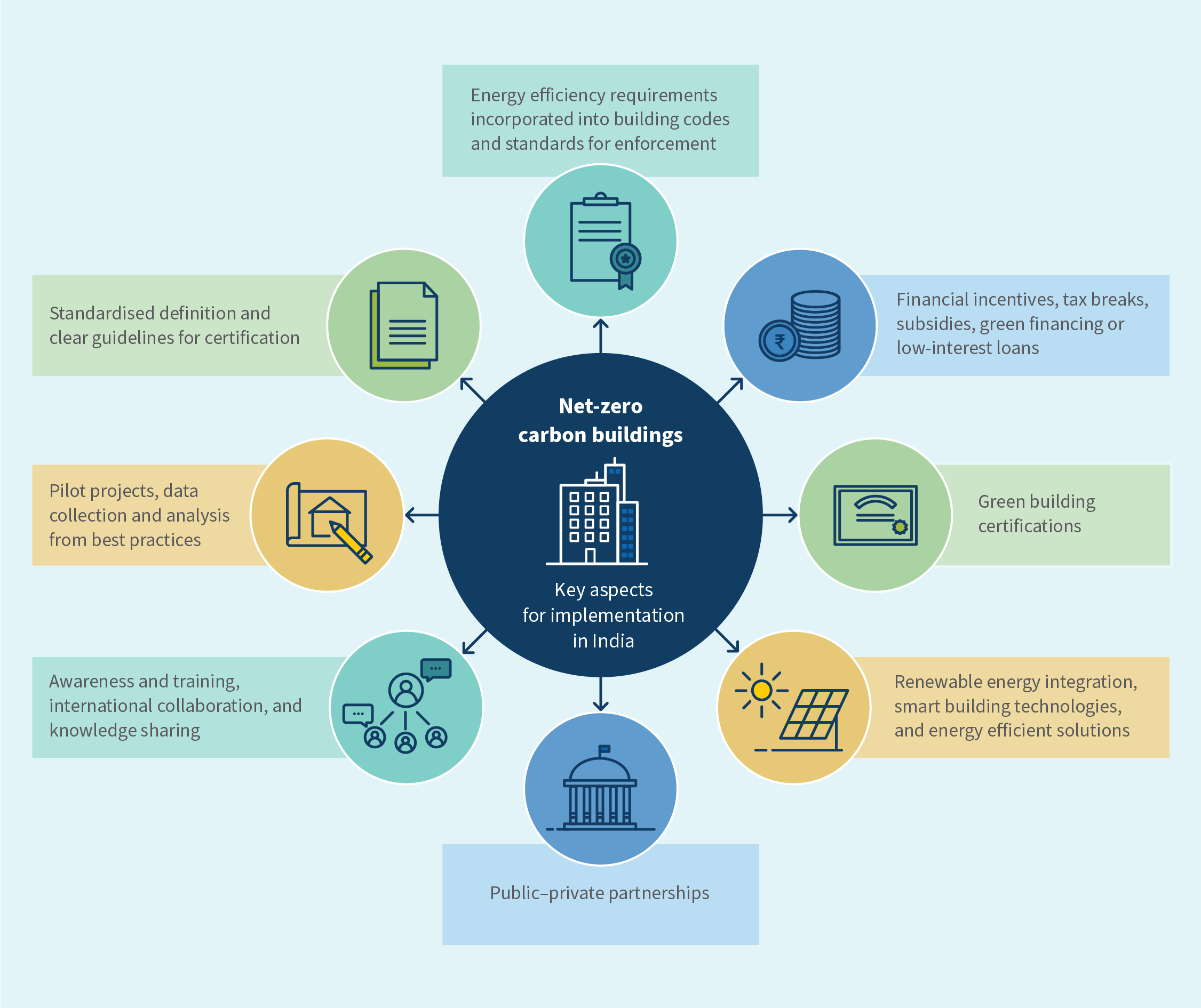
Specifically, this report:
- Proposes a standardized definition of “net-zero carbon building” in the Indian context;
- Provides in-depth analysis of five high-impact decarbonization measures and their potential to reduce operational and embodied carbon emissions;
- Quantifies the total building sector CO2 emissions, energy and emission reduction potential, and the total cost of adopting each measure;
- Introduces a behavior change framework to encourage the adoption of net-zero carbon buildings in India, targeting various stakeholders including policymakers, real estate developers, and industry professionals; and
- Recommends national and subnational policy interventions to facilitate the implementation of the proposed measures at the sector level.
This report was informed by extensive analysis and engagement with various stakeholders, market research, and pilot projects. We hope the report empowers policymakers, industry leaders, and real estate stakeholders to navigate the path towards a sustainable and decarbonized building sector in India.


Related Insights

India’s Used EV Battery Market Needs Trust. Battery Aadhaar Can Help.
Help build the clean energy future. Donate today.
Independent research. Real-world solutions. Supported by donors.
RMI can pursue the highest-impact climate and energy solutions because we’re supported by people who believe change is possible. Every gift helps advance the work needed to make clean energy the default choice worldwide.
For other ways to give to RMI, including checks or gifts of stock, please visit Other Ways to Give.
