

Learn how we are working to transform how we use and produce energy.
Aligning Regulatory Processes for Distribution Cost Containment
Opportunities to manage growing distribution system costs
Why we share this work for free
RMI is an independent nonprofit working to accelerate the clean energy transition. We publish research like this to inform decision-makers and drive real-world impact.
Our work is supported by philanthropy as well as partnerships, including fee-for-service engagements. This support makes it possible for us to share our independent insights for free.
If you find this work valuable, you can support it anytime.
Get more insights like this
Stay up to date with the latest research, analysis, and tools from RMI by opting in to receive occasional emails below. You’ll get new reports, event invitations, and practical insights to help us all accelerate the clean energy transition.
Loading form...
Your download should start automatically. If it doesn’t, click the download button below.
This work is made possible by philanthropy
RMI is a nonprofit supported by donors and partners. Philanthropy enables us to produce independent research and make resources like this freely available.
If you find this report valuable, please consider supporting our work. You can also explore how we partner with organizations to drive impact.
Jump to Section
Since 2014, investments in distribution have been the fastest growing category of utility spending. Why? Utilities must replace aging infrastructure while preparing the grid for new load growth, more extreme weather, and new technologies.
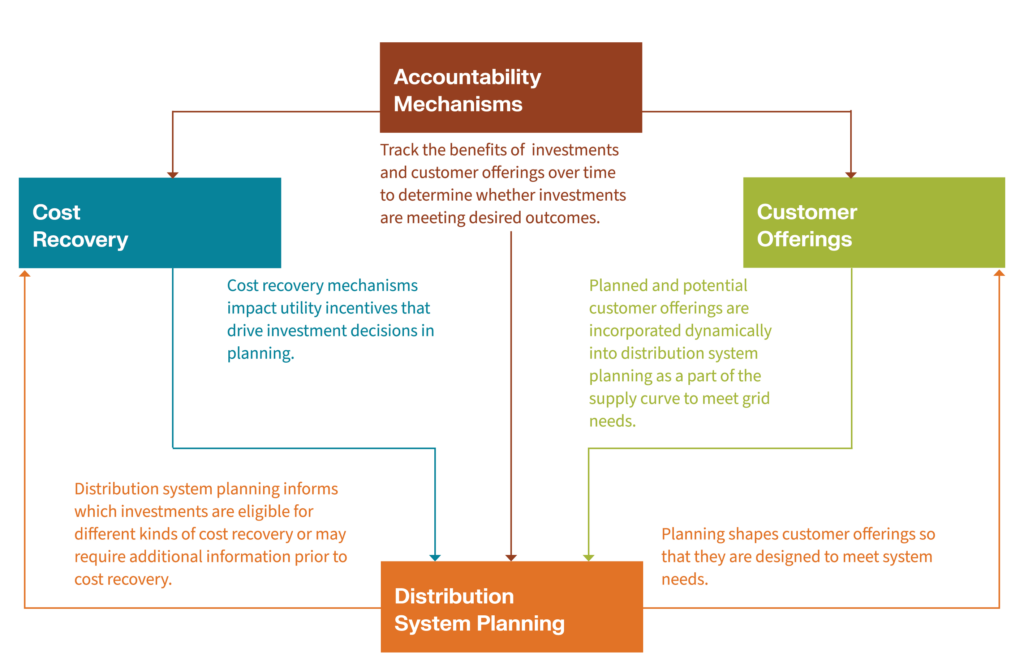
Meeting these needs while containing costs can be aided by considering how distribution system planning, customer offerings, cost recovery, and accountability mechanisms interact with one another. By thinking of these processes holistically, public utility commissions (PUCs) can:
- Maximize investment value: Ensure that distribution investments are efficient and meet multiple objectives, including grid needs and policy goals, at the lowest possible cost.
- Make utility distribution investment strategies and decisions more transparent: Enable better visibility of utility processes that support decision-making.
- Monitor performance to ensure investments deliver benefits: Minimize the risk of underutilized investments through increased accountability that allows for iteration, adjustments, and in some cases, disallowance.
We are already seeing positive results from states that coordinate these processes. For instance, Illinois now leverages the utilities’ investment plans that emerge from their planning process to determine the forecasted rate base for the utilities’ multi-year rate plans. This has unlocked more thorough cost-benefit analyses and stakeholder feedback on investments prior to cost recovery decisions. Coordinated approaches maximize the value of grid investments, improve accountability, and provide regulators with clearer tools to manage rising distribution costs.
This report acts as a roadmap for regulators, utilities, and stakeholders seeking to manage distribution costs, improve transparency, and ensure benefits are delivered to customers. Readers can learn from leading state examples and identify opportunities to better align planning, customer programs, accountability, and cost recovery in their own state contexts.
Interested in learning how this may work in your state? Download our report or reach out to RMI at stephanie.bieler@rmi.org.
Authors

Stephanie Bieler
Senior Associate
Katie Ebinger
Associate
Rachel Gold
Senior Principal
Cara Goldenberg
Principal
Alex Walmsley
Manager
Help build the clean energy future. Donate today.
Independent research. Real-world solutions. Supported by donors.
RMI can pursue the highest-impact climate and energy solutions because we’re supported by people who believe change is possible. Every gift helps advance the work needed to make clean energy the default choice worldwide.
For other ways to give to RMI, including checks or gifts of stock, please visit Other Ways to Give.
