

Learn how we are working to transform how we use and produce energy.
Why we share this work for free
RMI is an independent nonprofit working to accelerate the clean energy transition. We publish research like this to inform decision-makers and drive real-world impact.
Our work is supported by philanthropy as well as partnerships, including fee-for-service engagements. This support makes it possible for us to share our independent insights for free.
If you find this work valuable, you can support it anytime.
Get more insights like this
Stay up to date with the latest research, analysis, and tools from RMI by opting in to receive occasional emails below. You’ll get new reports, event invitations, and practical insights to help us all accelerate the clean energy transition.
Loading form...
Your download should start automatically. If it doesn’t, click the download button below.
This work is made possible by philanthropy
RMI is a nonprofit supported by donors and partners. Philanthropy enables us to produce independent research and make resources like this freely available.
If you find this report valuable, please consider supporting our work. You can also explore how we partner with organizations to drive impact.
Jump to Section
Battery energy storage will play a critical role in India’s push toward accelerating electricity and transportation decarbonization. The recently finalized $2.5 billion Production Linked Incentive (PLI) Scheme on advanced cell chemistry (ACC) battery storage has signaled India’s intent to meet the need for batteries through domestic manufacturing. With the announcement of the bid winners for the scheme, the momentum has finally shifted from planning to actions on the ground.
Within this background, this report is the last of a three-report series designed to create a shared understanding among stakeholders of the status and future trends that are emerging in ACC batteries. This report outlines the contour of the PLI Scheme, looks at key leverage points for maximizing the success of the scheme, and explores long-term sustainable growth of a domestic battery manufacturing sector.
Beyond the central and state incentives, the report analyzes complementing steps that can be taken to build investor confidence within the sector. The principles of public-private partnership can ensure an optimal sharing of risk between the beneficiary firm and the government, while demand creation initiatives and a circular economic framework will be crucial. India has the perfect opportunity to pave the way for battery manufacturers to invest in India and could guide the sector toward breakthrough technologies.
As with any new technology, there are numerous risks associated with setting up battery manufacturing plants in India. Establishing the entire value chain presents a challenge, given the steep learning curve associated with rapidly evolving battery technologies and the investment risks associated with adapting to new technologies and manufacturing processes.
Figure 1: Risk Allocation Across Stakeholders
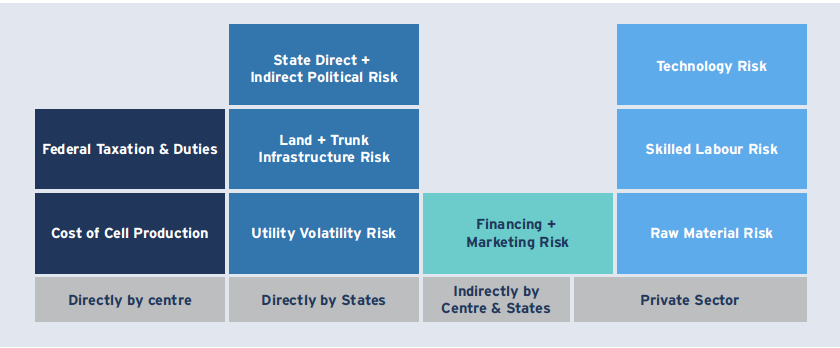
Understanding and mitigating these risks will be critical to the success of the scheme and India’s battery manufacturing ambition. It will allow for optimal strategies to mitigate potential roadblocks and establish India as a center for cutting-edge research and innovation, boost its manufacturing capabilities, create new jobs, and foster economic growth.


Related Insights

India’s Used EV Battery Market Needs Trust. Battery Aadhaar Can Help.

Help build the clean energy future. Donate today.
Independent research. Real-world solutions. Supported by donors.
RMI can pursue the highest-impact climate and energy solutions because we’re supported by people who believe change is possible. Every gift helps advance the work needed to make clean energy the default choice worldwide.
For other ways to give to RMI, including checks or gifts of stock, please visit Other Ways to Give.
