

Learn how we are working to transform how we use and produce energy.
Why we share this work for free
RMI is an independent nonprofit working to accelerate the clean energy transition. We publish research like this to inform decision-makers and drive real-world impact.
Our work is supported by philanthropy as well as partnerships, including fee-for-service engagements. This support makes it possible for us to share our independent insights for free.
If you find this work valuable, you can support it anytime.
Get more insights like this
Stay up to date with the latest research, analysis, and tools from RMI by opting in to receive occasional emails below. You’ll get new reports, event invitations, and practical insights to help us all accelerate the clean energy transition.
Loading form...
Your download should start automatically. If it doesn’t, click the download button below.
This work is made possible by philanthropy
RMI is a nonprofit supported by donors and partners. Philanthropy enables us to produce independent research and make resources like this freely available.
If you find this report valuable, please consider supporting our work. You can also explore how we partner with organizations to drive impact.
Jump to Section
The COVID-19 crisis has had a massive impact on economies across the world, with several governments now seeking to design recovery programs. Ideally such programs should not only support recovery from recession but help achieve greener and more sustainable economies for the future.
China has come through the COVID-19 pandemic with far fewer infections and deaths per capita than major Western countries. Its factories and distribution systems have returned to normal operations faster than expected. But with exports to Europe and the United States now likely to be severely depressed by recessions in those regions, China faces a year of slow growth and will need to stimulate domestic demand to spur economic recovery and job creation.
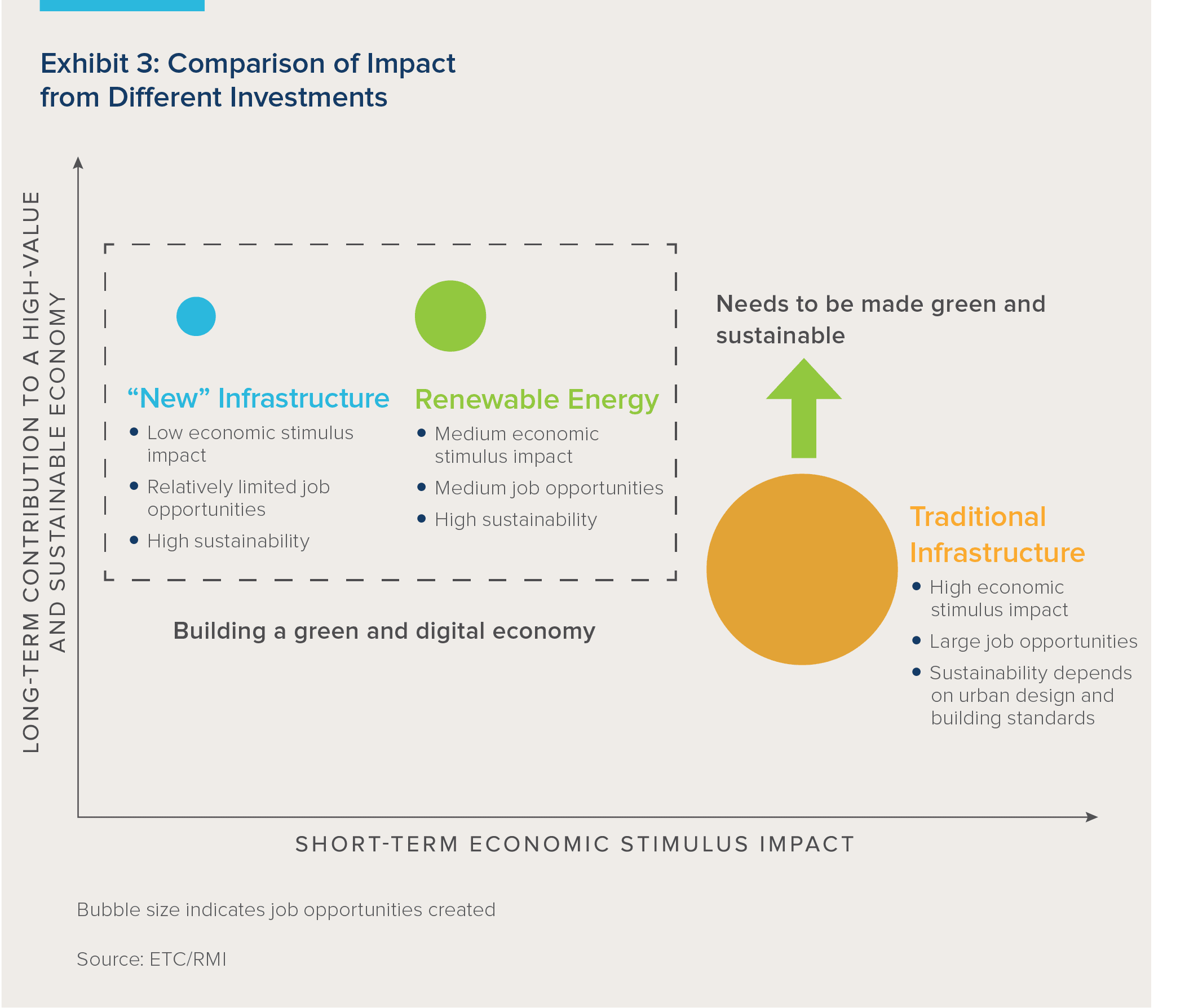
Based on specific characteristics of the Chinese economy and policies already in place, China’s stimulus should aim as best possible to encourage domestic consumption, and investment stimulus must play a significant role in economic recovery programs. If designed well it could not only stimulate the economy but help build a higher value-added and more environmentally sustainable Chinese economy. According to the government annual work program announced in May 2020, the Chinese government has acknowledged the importance of investing in new infrastructure, supporting new forms of higher-quality urban development, and accelerating the shift to new energy vehicles. Zero-carbon electrification should be a key focus alongside these priorities already identified.
China’s green recovery package should combine four main thrusts with the first one, zero-carbon electrification, at the core:
- Accelerate investment in zero-carbon electrification This should combine increased investment in wind and solar capacity, ultra-high voltage transmission lines, energy storage, and distribution grids, plus the accelerated rollout of electric vehicle charging infrastructure.
- Strengthen investment in “new” technology-based forms of infrastructure, such as 5G, artificial intelligence, internet of things, data centers, and optical fiber, which will build Chinese capacity in a range of vital future technologies.
- Ensure that investment in traditional infrastructure supports green and energy efficient urbanization.
- Promote green consumption, including via support for electric vehicles and more efficient electric heating systems.
Authors

Ji Chen
Jiayin Song
Lord Adair Turner
Related Insights

Steel’s Transformation: China and Australia’s next horizon of clean steel

Efficiency Reimagined: The next phase of China’s industrial energy transition

Help build the clean energy future. Donate today.
Independent research. Real-world solutions. Supported by donors.
RMI can pursue the highest-impact climate and energy solutions because we’re supported by people who believe change is possible. Every gift helps advance the work needed to make clean energy the default choice worldwide.
For other ways to give to RMI, including checks or gifts of stock, please visit Other Ways to Give.
