

Learn how we are working to transform how we use and produce energy.
Why we share this work for free
RMI is an independent nonprofit working to accelerate the clean energy transition. We publish research like this to inform decision-makers and drive real-world impact.
Our work is supported by philanthropy as well as partnerships, including fee-for-service engagements. This support makes it possible for us to share our independent insights for free.
If you find this work valuable, you can support it anytime.
Get more insights like this
Stay up to date with the latest research, analysis, and tools from RMI by opting in to receive occasional emails below. You’ll get new reports, event invitations, and practical insights to help us all accelerate the clean energy transition.
Loading form...
Your download should start automatically. If it doesn’t, click the download button below.
This work is made possible by philanthropy
RMI is a nonprofit supported by donors and partners. Philanthropy enables us to produce independent research and make resources like this freely available.
If you find this report valuable, please consider supporting our work. You can also explore how we partner with organizations to drive impact.
Jump to Section
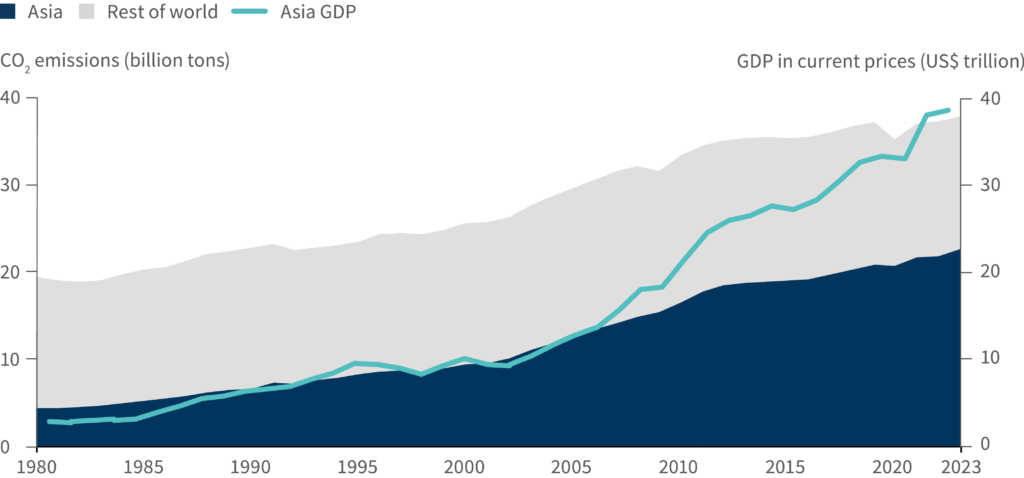
As global decarbonization accelerates, transition finance has become increasingly important in supporting emissions-intensive sectors that are critical to economic development yet difficult to decarbonize. These Industries face growing pressure to transition toward lower-carbon pathways, while often lacking sufficient access to suitable financing instruments. This challenge is particularly significant in Asia, where many economies are rapidly developing and remain highly dependent on energy-intensive industries, making the region central to the future of global climate transition.
Exhibit – Asia’s economic and emissions growth
Against this backdrop, this report provides a comparative review of how major Asian economies are developing transition finance ecosystems to support real-economy decarbonization. The report examines the evolution of policy frameworks, taxonomies design, market mechanisms, pilot initiatives, and financial instruments across the region.
To better reflect the diversity of economic structures and market functions within Asia, the report groups major economies into three categories: international financial hubs, industrialized powerhouses, and rapidly developing economies. Through this framework, the report highlights how different economies are contributing to the broader regional transition finance landscape in distinct yet complementary ways.
Exhibit – Cross-jurisdiction comparison of transition finance development
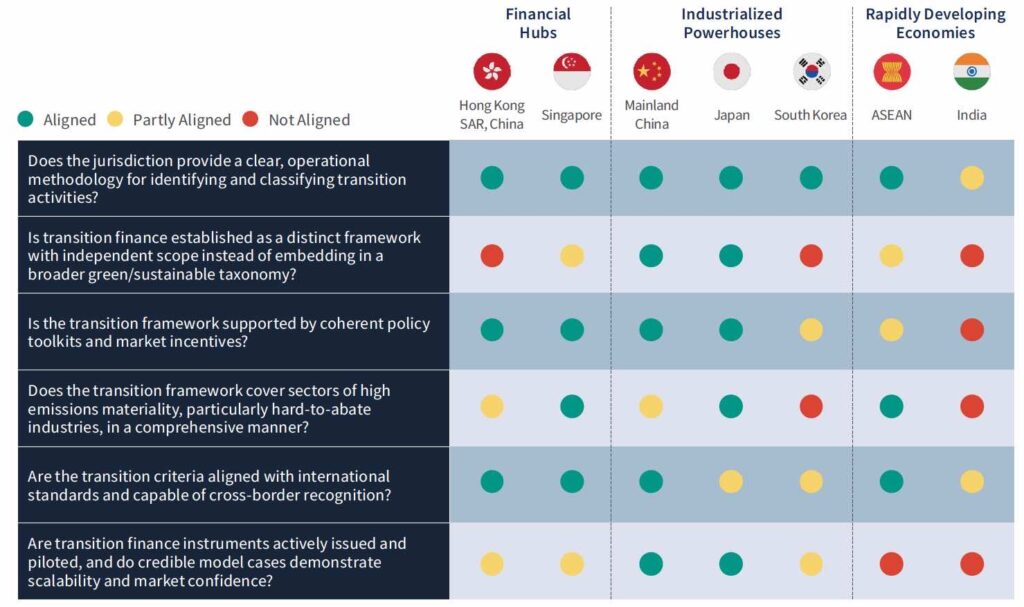
The report summarizes key achievements already made across Asia in transition finance, including the establishment of dedicated policy guidance, regulatory coordination mechanisms, pilot programs, and increasing alignment with international standards. It also identifies remaining challenges, such as transition plan credibility, bankability constraints, implementation capabilities, and the mismatch of regional capital versus fragmented market systems.
By providing a regional comparison of policy and market practices, the report aims to support broader stakeholder engagement across governments, financial institutions, corporations, investors, and international organizations. It is hoped that the findings can contribute to deeper collaboration and more effective capital mobilization for Asia’s energy transition, while also supporting the development of a more inclusive and credible global transition finance ecosystem.
Additional Contributors: Mier Dong
The authors would like to acknowledge the Alliance for Green Commercial Banks, a global initiative of IFC, for its valuable insights and expert network support for this report.
The authors also gratefully acknowledge Yunwen Bai from Institute of Finance and Sustainability, Wei Li from RMI and Wenhong Xie from the Climate Bonds Initiative for their valuable comments, suggestions, and support during the preparation of this report.
Authors

Ting Li
Chief Representative and Managing Director of RMI China
Shutong (Lucy) Lu
Manager
Guangyu Tan
Senior Associate
Zhe Wang
PrincipalRelated Insights

Steel’s Transformation: China and Australia’s next horizon of clean steel

Efficiency Reimagined: The next phase of China’s industrial energy transition

Help build the clean energy future. Donate today.
Independent research. Real-world solutions. Supported by donors.
RMI can pursue the highest-impact climate and energy solutions because we’re supported by people who believe change is possible. Every gift helps advance the work needed to make clean energy the default choice worldwide.
For other ways to give to RMI, including checks or gifts of stock, please visit Other Ways to Give.