Learn how we are working to transform how we use and produce energy.
Strategies for Managing End-of-Life EV Batteries in Island Nations
Lessons for building practical management systems in remote economies
Why we share this work for free
RMI is an independent nonprofit working to accelerate the clean energy transition. We publish research like this to inform decision-makers and drive real-world impact.
Our work is supported by philanthropy as well as partnerships, including fee-for-service engagements. This support makes it possible for us to share our independent insights for free.
If you find this work valuable, you can support it anytime.
Get more insights like this
Stay up to date with the latest research, analysis, and tools from RMI by opting in to receive occasional emails below. You’ll get new reports, event invitations, and practical insights to help us all accelerate the clean energy transition.
Loading form...
Your download should start automatically. If it doesn’t, click the download button below.
This work is made possible by philanthropy
RMI is a nonprofit supported by donors and partners. Philanthropy enables us to produce independent research and make resources like this freely available.
If you find this report valuable, please consider supporting our work. You can also explore how we partner with organizations to drive impact.
Jump to Section
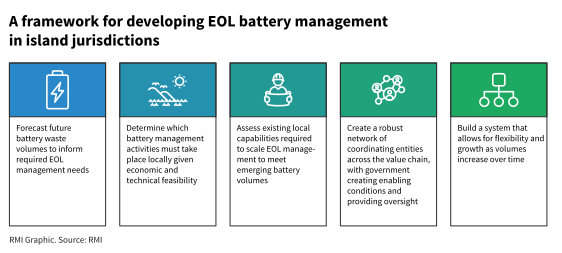
As electric vehicles (EVs) and battery energy storage systems become more widespread, island nations and other remote geographies need strategies to safely manage batteries that eventually reach end of life (EOL). The journey from an EOL battery’s initial identification to reuse, repurposing, or recycling can involve condition assessment, electrical isolation or discharge, safe removal, temporary storage, specialized packaging, and transport — each with its own technical and safety requirements.
Large markets such as the United States, Europe, and China benefit from relatively high and predictable battery volumes and established networks of specialized service providers. These conditions make it more economical to invest in the infrastructure, workforce, and services needed to collect, handle, transport, and process EOL batteries.
For islands and remote regions, smaller and less predictable battery volumes make it difficult to replicate this ecosystem. Instead, the near-term priority is often to build the local capabilities needed to safely manage batteries on-island and connect them to qualified off-island facilities. Doing so requires coordination among battery owners, dealers and fleets, waste authorities, emergency responders, dangerous-goods specialists, transporters, ports, shipping lines, insurers, and downstream facilities, while navigating complex regulatory, maritime, and destination-specific requirements. Governments play an important role in establishing the policy, institutional, and investment foundations needed to make the system work.
Informed by RMI’s work with the Government of Bermuda on EOL EV battery management, this report provides a practical framework for island and remote-market decision makers. It outlines the capabilities and coordination needed across the battery journey and offers a phased approach to meeting near-term needs while preserving flexibility as battery volumes grow and technologies, markets, and local capabilities evolve.
Learn more about RMI’s Battery Circular Economy Initiative.
Authors

Aradhana Gahlaut
Senior Associate
Edward J. Klock-McCook
Principal
Sudeshna Mohanty
Senior Associate
Kriti Singh
AssociateRelated Insights
Help build the clean energy future. Donate today.
Independent research. Real-world solutions. Supported by donors.
RMI can pursue the highest-impact climate and energy solutions because we’re supported by people who believe change is possible. Every gift helps advance the work needed to make clean energy the default choice worldwide.
And right now, your impact goes twice as far. Thanks to generous donors and our special match, every $1 you give becomes $2, up to $150,000, through December 31, 2026.