Learn how we are working to transform how we use and produce energy.
Clean Energy 101: Efficiency
How reducing energy waste saves money and improves the energy system
Why we share this work for free
RMI is an independent nonprofit working to accelerate the clean energy transition. We publish research like this to inform decision-makers and drive real-world impact.
Our work is supported by philanthropy as well as partnerships, including fee-for-service engagements. This support makes it possible for us to share our independent insights for free.
If you find this work valuable, you can support it anytime.
Get more insights like this
Stay up to date with the latest research, analysis, and tools from RMI by opting in to receive occasional emails below. You’ll get new reports, event invitations, and practical insights to help us all accelerate the clean energy transition.
Loading form...
Your download should start automatically. If it doesn’t, click the download button below.
This work is made possible by philanthropy
RMI is a nonprofit supported by donors and partners. Philanthropy enables us to produce independent research and make resources like this freely available.
If you find this report valuable, please consider supporting our work. You can also explore how we partner with organizations to drive impact.
Jump to Section
Global energy consumption has increased nearly every year for more than half a century. And demand is expected to keep growing as economies expand and more people gain access to air conditioning, appliances, vehicles, and other technologies that improve living standards.
Much of the conversation about meeting this growing energy demand focuses, understandably, on supply: how quickly can we build new power plants, transmission lines, and other energy infrastructure? We will, no doubt, need more clean energy and the infrastructure to deliver it. But what if we could meet some of that demand without producing more energy at all? We can — by getting more value from the energy we already use. In other words, by working smarter, not harder.
To understand how, we first need to look at what happens to all the energy we use today.
Energy waste is everywhere, largely invisible, and shockingly valuable.
When you fill up your car at the gas station, less than 25% of the energy in that gasoline gets converted into motion — the rest goes missing as heat, friction, and exhaust — and less than 1% ends up moving your car. In your kitchen, only a third or so of that blue-flame heat penetrates the kettle while the remainder vents away. And in data centers humming to serve up videos and answer questions, just a third of the electricity is powering the calculations — another two-thirds goes toward heating the centers’ power supplies, spinning their fans, and chilling their waste heat.
Layer those losses together and the inefficiency compounds — only about 0.01% of power-plant fuel ends up delivering customer value. RMI estimates the value of these losses across the global energy system at roughly $4.5 trillion each year, equivalent to nearly 5% of global GDP.
What’s more, consumers pay for this wasted energy, which still requires the energy system to build and maintain generation, wires, pipelines, and other infrastructure to supply the energy that ultimately provides no useful benefit.
Think of how much demand we could meet by simply wasting less.
Efficiency means getting more from less
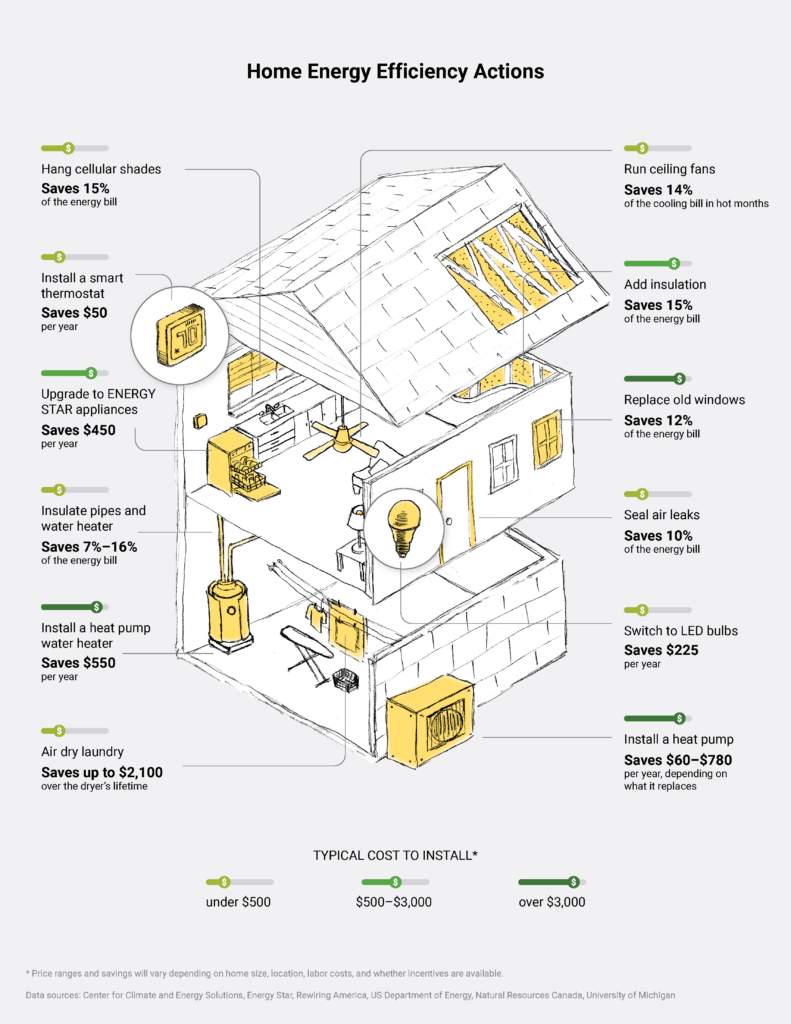
At its simplest, energy efficiency means using less energy to provide the same or better result. On a micro scale, this could mean swapping an incandescent bulb with an LED that provides the same light with 90% less electricity. Or replacing an inefficient furnace with a heat pump, which uses about 50% less energy. Or driving an electric vehicle that uses about 65% less energy compared to equivalent gasoline cars.
Opportunities like these exist across nearly every sector of the economy, from the appliances in our homes to the equipment in factories. Better technologies can dramatically reduce the energy needed to provide the same services, but the bigger opportunity appears when we stop looking at devices in isolation and start thinking about how entire systems are designed.
The “whole systems” efficiency opportunity
People don’t fundamentally want more kilowatt-hours of electricity or gallons of gasoline. They want the services that energy provides — “hot showers and cold beer,” as RMI cofounder Amory Lovins puts it. That simple distinction is at the heart of what Amory calls “integrative design,” or “whole-systems thinking.” Rather than focusing only on making an individual machine more efficient, this thought process looks at how we can design entire systems more efficiently.
Take a home, for example. If the goal is to maintain a comfortable temperature, replacing an old furnace with an efficient heat pump can help, but a whole-systems approach goes even further by asking how to reduce the need for heating and cooling in the first place. Better insulation, airtightness, windows, shading, and passive design can reduce energy demand enough to require a smaller heat pump, lowering both energy use and equipment costs. When you scale those improvements across thousands of homes, they can also reduce strain on the grid at peak times.
We can apply that same principle to the transportation sector, looking beyond a single vehicle’s efficiency to creating a mobility system that allows people to get where they need to go using less energy. For example, expanding public transit options, making walking and cycling infrastructure more practical, increasing vehicle occupancy, and designing communities where homes, jobs, schools, and shops are closer together, can all reduce the energy required for mobility.
The same thinking can extend to factories, data centers, power grids, and so on. When you reduce the energy required at the point where it provides a useful service, you don’t need to generate, move, and deliver as much energy in the first place.
Prioritizing efficiency means everyone wins
If a home needs less energy to stay comfortable, the people who live there can spend less on their utility bills. If thousands of buildings reduce their electricity needs during peak hours, utilities may be able to avoid or defer costly investments in new generation and grid infrastructure. And if vehicles, buildings, and businesses need less fuel to operate, they are less vulnerable when energy prices suddenly rise. The 2026 disruption of oil and gas shipments through the Strait of Hormuz further revealed the value of that resilience, as soaring fuel prices caused increased prices for goods and services around the world. While efficiency cannot prevent a geopolitical crisis or an energy price shock, reducing the amount of energy we need can soften the blow when one occurs.
Authors

Lillian Mercho
Digital Content StrategistRelated Insights

Solid-State Cooling Works. Meet the Founders Who Want to Bring it to Market.
Help build the clean energy future. Donate today.
Independent research. Real-world solutions. Supported by donors.
RMI can pursue the highest-impact climate and energy solutions because we’re supported by people who believe change is possible. Every gift helps advance the work needed to make clean energy the default choice worldwide.
For other ways to give to RMI, including checks or gifts of stock, please visit Other Ways to Give.