Learn how we are working to transform how we use and produce energy.
Reality Check: For Power Plants, Changing the Fuel Doesn’t Fix the Economics
Why converting coal plants to gas can perpetuate the same uneconomic operating patterns that have contributed to higher customer costs
Why we share this work for free
RMI is an independent nonprofit working to accelerate the clean energy transition. We publish research like this to inform decision-makers and drive real-world impact.
Our work is supported by philanthropy as well as partnerships, including fee-for-service engagements. This support makes it possible for us to share our independent insights for free.
If you find this work valuable, you can support it anytime.
Get more insights like this
Stay up to date with the latest research, analysis, and tools from RMI by opting in to receive occasional emails below. You’ll get new reports, event invitations, and practical insights to help us all accelerate the clean energy transition.
Loading form...
Your download should start automatically. If it doesn’t, click the download button below.
This work is made possible by philanthropy
RMI is a nonprofit supported by donors and partners. Philanthropy enables us to produce independent research and make resources like this freely available.
If you find this report valuable, please consider supporting our work. You can also explore how we partner with organizations to drive impact.
Jump to Section
Over the past decade, much of the US coal fleet has struggled to compete economically, generating billions of dollars in losses as revenues from wholesale power markets have failed to cover basic operating costs. These losses reflect sustained pressure from aging infrastructure as well as plants being used less often due to competition from lower-cost resources such as wind, solar, and battery storage.
In competitive power markets, persistent losses typically push power plant owners to reduce output or retire assets that can no longer compete. But, as RMI has previously found, that market discipline is weaker for rate-regulated utilities, which can recover many operating costs directly from ratepayers and therefore face less financial pressure to respond to unfavorable market signals. Now, some utilities are proposing to convert aging coal plants to natural gas rather than retire them. RMI’s analysis of the existing US gas fleet and plants that have already made this coal to gas transition suggests that fuel conversion can perpetuate the same uneconomic operating patterns that have contributed to higher customer costs from the coal fleet. In other words, changing the fuel does not necessarily change the economics. A coal plant converted to gas can continue operating at a loss, with those costs ultimately borne by customers.
The shift: From retirement to conversion, warning signs in the gas fleet
Three examples of utilities that have chosen to extend aging coal plants’ lives by converting them to burn natural gas rather than retire them include Tucson Electric Power, TransAlta, and Arizona Public Service:
- Tucson Electric Power previously planned to retire Springerville Units 1 and 2 in 2027 and 2032, respectively, but now plans to convert both units to natural gas by 2030.
- In Washington, TransAlta had committed to end coal operations at Centralia Unit 2 in 2025 but announced a conversion that could keep the plant operating on natural gas through 2044.
- Arizona Public Service announced plans to bring two units at the Cholla Power Plant back online as natural gas generators after the plant completed its coal retirement in March 2025.
These are not simply aging plants receiving a new fuel source. These are assets that had been headed toward — or had already reached — retirement and are now being considered for years or decades of additional operation. And the plants have already shown signs of poor economics: RMI’s analysis finds that these three facilities collectively accumulated approximately $136 million in losses from uneconomic dispatch over the past decade, meaning they sometimes operated when the estimated cost of producing electricity exceeded its market value.
However, the economics of the existing gas fleet suggests that fuel switching alone may not solve the underlying problem. RMI’s analysis finds that steam turbines account for only 15% of installed gas capacity but are responsible for 46% of the fleet’s losses, roughly $2.3 billion from 2021 to 2024. In other words, steam turbines account for losses at three times their share of installed capacity.
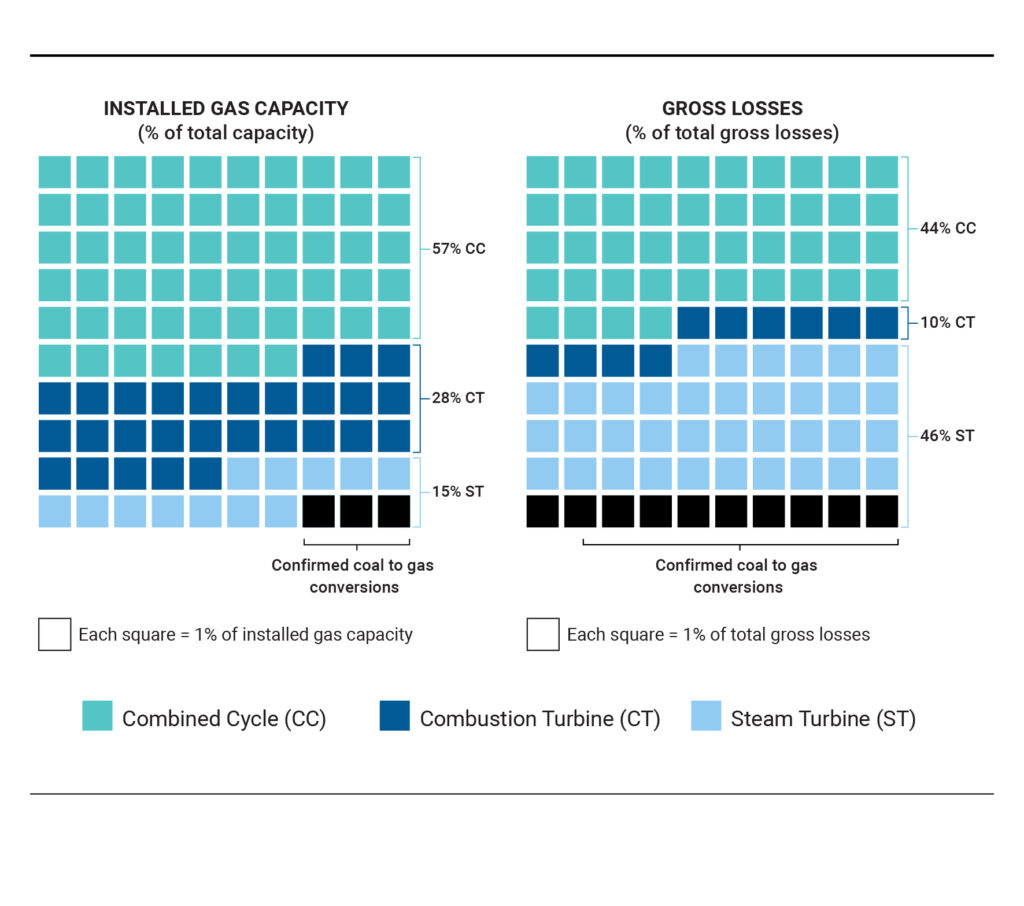
This disparity is particularly relevant for coal-to-gas conversions because existing coal boilers are commonly converted into gas steam units rather than replaced with modern combined-cycle technology. These conversions retain the existing steam cycle and much of the aging plant infrastructure. As a result, switching fuels does not transform an older coal plant into a modern gas plant. It carries forward the efficiency and operational limitations of an aging steam unit while layering on new conversion costs and exposure to natural gas prices.
Switching fuels does not transform an older coal plant into a modern gas plant. It carries forward the efficiency and operational limitations of an aging steam unit while layering on new conversion costs and exposure to natural gas prices.
Changing fuel doesn’t necessarily eliminate losses
The experience of plants that have already converted from coal to natural gas reinforces the warning from the broader gas fleet. RMI examined losses and generation at six converted plants before and after they stopped burning coal. The results vary substantially across plants, but conversion did not eliminate uneconomic operation.
Florida’s Gulf Clean Energy Center plant, for example, accumulated roughly $231 million in losses from 2015 through 2019 before its transition away from coal. After converting its coal units to natural gas in 2020, the plant continued to experience losses, including approximately $30 million in 2021, $46 million in 2022, $18 million in 2023, and $14 million in 2024. The conversion improved the plant’s economics relative to some of its worst coal years, but it did not make uneconomic operation disappear. The plant continued to incur costs above the market value of the electricity it produced — costs that can ultimately contribute to higher customer bills when recovered.
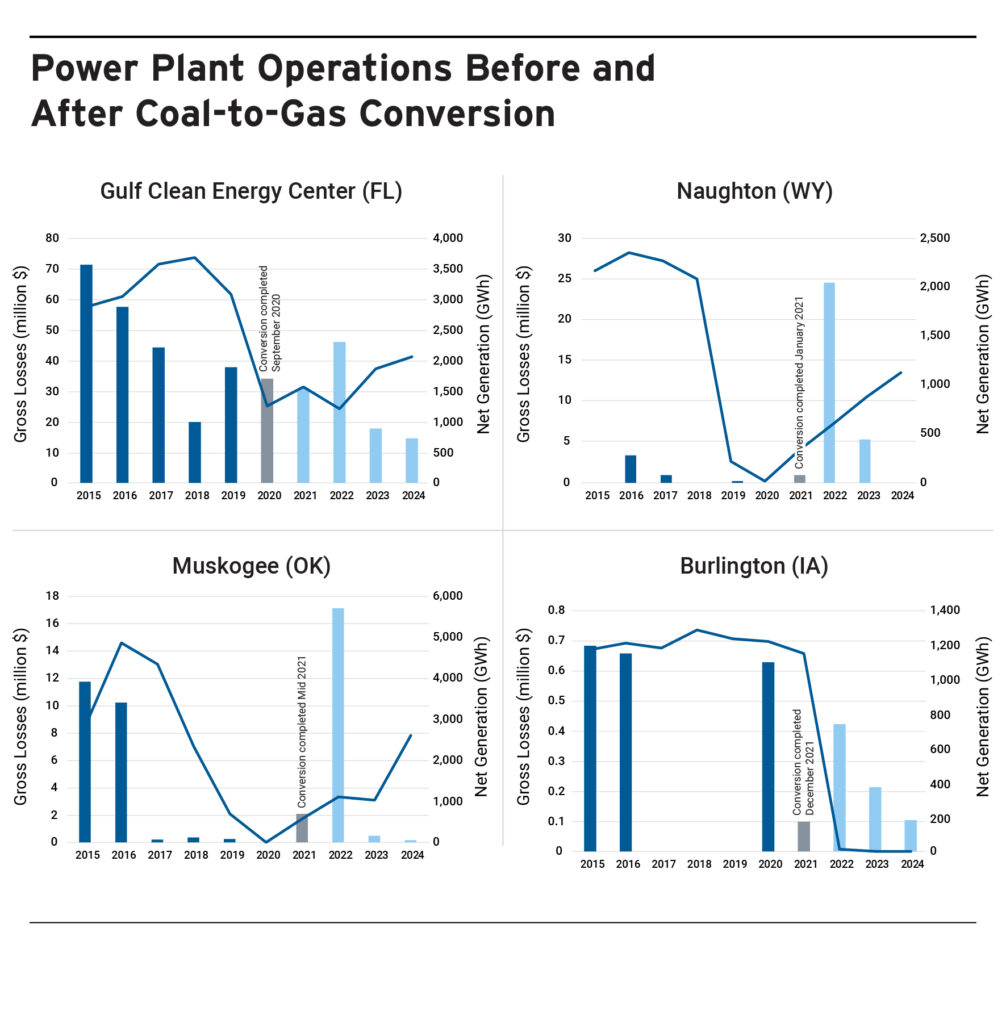
Wyoming’s Naughton Unit 3 provides an even sharper example. PacifiCorp stopped burning coal at the unit in January 2019 and completed its natural gas conversion in 2020. After conversion, the unit accumulated approximately $31 million in losses from 2021 through 2023, including $24.5 million in 2022 alone. With only about 576,000 MWh of generation that year, those losses amounted to approximately $43/MWh generated.
Other converted plants show variations of the same pattern. OG&E’s Muskogee coal units in Oklahoma switched to natural gas in March 2019; OG&E reported investing $57 million in the conversion. Yet Muskogee experienced more than $17 million in losses from operating the plant in 2022 — on top of the $57 million already sunk into equipment upgrades. Interstate Power and Light’s Burlington plant in Iowa illustrates a different risk: generation fell from more than 1 million MWh annually before conversion to fewer than 17,000 MWh after it stopped burning coal. Lower losses at a converted plant therefore do not necessarily indicate improved competitiveness; they can also reflect a plant running far less often.
Taken together, these cases show why both losses and utilization matter when assessing a conversion. Converting to gas may reduce losses, but it can also leave customers supporting an aging asset that continues to lose money when it operates or runs only sparingly after substantial new capital and customer dollars have been invested to extend its life.
The risk: Repeating the same pattern under a different fuel
Regulatory design plays a central role in shaping conversion decisions. Under traditional cost-of-service regulation, utilities can recover approved conversion investments through customer rates while earning a regulated return, and fuel costs are typically passed through to customers. Customers therefore bear both the up-front cost of converting a plant and the ongoing cost of fueling it.
These investments can be substantial: DTE sought approval for $135 million to convert the Belle River coal plant in Michigan to natural gas. The projects now being proposed can be larger still: TransAlta estimates that extending the life of Centralia and converting to natural gas will require approximately $600 million in capital investments. Tucson Electric Power’s planned Springerville conversion also carries risks beyond the estimated $170 million conversion costs; in April 2026, it entered long-term gas transportation agreements supporting new pipelines, with estimated purchase commitments totaling approximately $2.6 billion over 20–25 years.
These investments can create a two-sided risk for customers. First, they may pay for capital investments that extend the life of an aging plant; then, customers remain exposed to the plant’s fuel costs and operating performance for years or decades to come. If the converted plant subsequently struggles to compete, as our analysis shows some existing gas steam units already do, customers can bear the costs of both extending the asset’s life and supporting its continued operation.
Recommendations: Test conversion against the alternatives and create incentives for better fuel cost management
Coal-to-gas conversion should not be treated as the default alternative to coal retirement. Regulators considering these proposals can take several steps to protect customers:
- Require conversion to compete against retirement and replacement alternatives. Regulators can require utilities to demonstrate that conversion is lower-cost than retirement paired with alternative portfolios, including renewables, storage, demand-side resources, transmission, market purchases, and other firm resources. That comparison should include the full cost of conversion, plant modifications, pipelines and gas transportation commitments, future fuel costs, maintenance, and the risk that an aging steam unit operates less than projected.
- Stress-test the economics rather than relying on a single forecast. Conversion proposals should be evaluated under a range of natural gas prices, capacity factors, market revenues, load forecasts, and asset lives. Regulators can also examine the historical economics of the plant itself: a history of uneconomic dispatch is relevant when deciding whether customers should fund additional capital to extend that asset’s life.
- If a conversion is approved, give utilities greater exposure to operating decisions through fuel cost-sharing. Fuel cost-sharing mechanisms can better align utility incentives with plant economics. Rather than automatically passing all fuel costs through to customers, fuel cost-sharing gives utilities some financial exposure to their fuel-management and operating decisions, creating stronger incentives to minimize costs. Fuel cost-sharing cannot make an uneconomic conversion economic, but it can reduce the incentive to continue operating a converted plant regardless of its performance.
- Require ongoing performance review after conversion. Approval should not end regulatory scrutiny. Regulators can establish reporting and review requirements that compare actual generation, fuel costs, market value, and operating costs with the assumptions used to justify the conversion. Significant underperformance can then trigger additional review rather than allowing losses to persist indefinitely.
Changing the fuel doesn’t change the fundamentals
Coal-to-gas conversions may appear to offer a pragmatic middle path between continued coal operation and retirement, but evidence from the gas fleet and plants that have already converted suggests that changing fuels alone does not guarantee better economics. Without changes to the incentives that insulate utilities from poor market performance, conversions risk extending the same dynamics that have allowed uneconomic coal plants to remain online.
For customers, the stakes extend beyond the cost of natural gas: conversion can mean committing new capital to an aging asset and then paying its operating and fuel costs for decades. Regulators can require clear evidence that extending that asset is preferable to retiring and replacing it and should ensure that utilities share in the financial consequences if the promised economics fail to materialize.


Related Insights

For Clean Energy Projects, How Community Benefits Are Delivered Matters
Tracking WestTEC: Where 100+ Transmission Projects Stand and What Comes Next

Help build the clean energy future. Donate today.
Independent research. Real-world solutions. Supported by donors.
RMI can pursue the highest-impact climate and energy solutions because we’re supported by people who believe change is possible. Every gift helps advance the work needed to make clean energy the default choice worldwide.
For other ways to give to RMI, including checks or gifts of stock, please visit Other Ways to Give.