

Learn how we are working to transform how we use and produce energy.
Turning Local Strengths into Advanced Energy Economies
By playing to their local strengths, regional leaders can maximize economic development opportunities in advanced energy technology.
Why we share this work for free
RMI is an independent nonprofit working to accelerate the clean energy transition. We publish research like this to inform decision-makers and drive real-world impact.
Our work is supported by philanthropy as well as partnerships, including fee-for-service engagements. This support makes it possible for us to share our independent insights for free.
If you find this work valuable, you can support it anytime.
Get more insights like this
Stay up to date with the latest research, analysis, and tools from RMI by opting in to receive occasional emails below. You’ll get new reports, event invitations, and practical insights to help us all accelerate the clean energy transition.
Loading form...
Your download should start automatically. If it doesn’t, click the download button below.
This work is made possible by philanthropy
RMI is a nonprofit supported by donors and partners. Philanthropy enables us to produce independent research and make resources like this freely available.
If you find this report valuable, please consider supporting our work. You can also explore how we partner with organizations to drive impact.
Jump to Section
Advanced energy technologies are key drivers to unlock economic development, and each place has unique strengths and characteristics that are best suited to certain advanced energy sectors. Decision makers need to understand their regions’ own strengths and constraints to identify the projects they can compete for, the kinds of workforce development they need, and the policy and finance gaps that need to be addressed. Having a clear picture of the opportunities can help all stakeholders — workforce training organizations know the skills that they need to provide, and economic developers understand which technologies are competitive and viable.
RMI has worked with regions across the United States to identify the advanced energy sectors where they are most competitive and help regional decision makers understand how to address constraints and attract investment in competitive sectors. As described below, we use the “three Cs” of competitiveness, constraints, and coordination to organize our analysis and stakeholder engagement and develop a roadmap that regions can follow to leverage strengths, address constraints, and ultimately attract investment. Stakeholder conversations include economic development organizations (EDOs), community lenders, industry, state and local governments, workforce training organizations, business associations, and community-based organizations.
Competitiveness
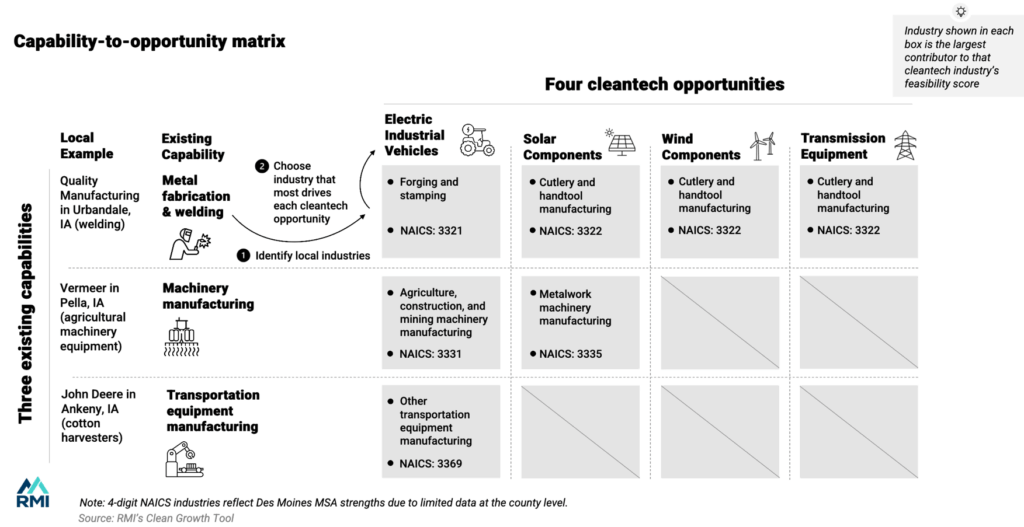
To know how to compete in the advanced energy economy, decision makers must know where their region currently stands. We begin each regional engagement by assessing a region’s competitiveness — the existing industries, workforce skills, and innovation assets that position a community to capture advanced energy opportunities. Using RMI’s Clean Growth Tool and qualitative analysis, we map the region’s existing strengths to advanced energy industries that have a strong market outlook, that can build off the region’s existing industrial base, and that carry strong economic development potential.
For example, central Iowa’s ag-tech manufacturing base, anchored by companies like John Deere and Vermeer, has strong existing capabilities including metal fabrication and welding, machinery manufacturing, and transportation equipment manufacturing. These capabilities map directly onto advanced energy opportunities that do not yet exist locally but are promising for the region: electric industrial vehicles, solar components, wind components, and transmission equipment. Capability mapping also shows how regions can move existing skills into faster-growing markets: ag-tech manufacturing employment in central Iowa has been flat over the past decade, but the workers who build tractors and harvesters today have the skills to build electric industrial vehicles tomorrow.
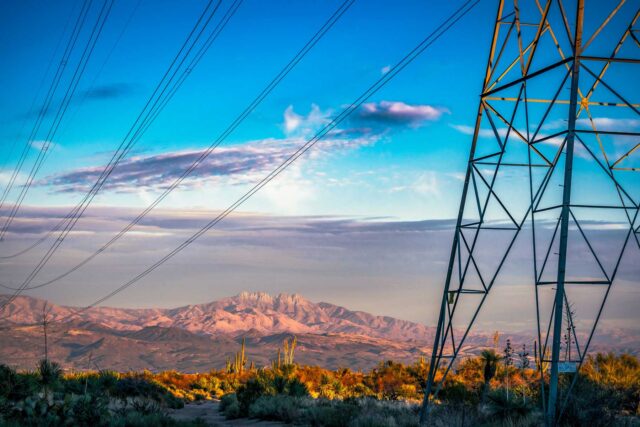
The same process surfaces different priorities in each region. In the Huntsville, Alabama, region, grid equipment manufacturing emerged as one of the clearest priority sectors. Grid equipment includes the technology that moves electricity from generators to end-users, such as transformers. Demand for this hardware is rising as aging infrastructure, load growth, and federal support for grid modernization converge, with US grid capital expenditures projected to exceed $120 billion annually by the 2040s. Stakeholder interest in grid equipment manufacturing, especially complex systems like switchgear, aligned with Huntsville’s existing strengths in systems engineering and integration and precision manufacturing, as well as its proximity to the Tennessee Valley Authority (TVA) grid and its growing needs.
Constraints
Understanding the constraints to investment and deployment for advanced energy in a region is imperative, because each region faces different challenges. Through conversations with local stakeholders, we identify regional constraints related to manufacturing capabilities, finance, workforce, and housing.
In New Orleans, housing stock upgrades and energy efficiency retrofits emerged as a critical need. Many buildings in the region need complicated and costly repairs, as well as weatherization and roof fortification, before they are ready for measures like energy efficiency improvements or rooftop solar. Limited funding for weatherization programs and eligibility rules that leave out moderate-income groups hinder these efforts. Many stakeholders expressed concern with disadvantaged communities not being able to access resources for desperately needed building upgrades and new construction, positioning housing as a key condition for regional economic development. By identifying these constraints and convening stakeholders to align goals, the region can continue to address housing and building needs and seek out incentive opportunities to support this work.
Coordination
Stakeholder coordination is critical to overcome constraints and bring new investment to a region. Although EDOs are often instrumental in elevating and advancing key priority sectors, other stakeholders such as financial institutions, local government, housing organizations, workforce training and educational institutions, and community-based organizations can be key drivers in advancing priority sectors. Looking across advanced energy, workforce factors, economic development, and finance, we identify key coordination opportunities and needs for the region. We highlight where coordination is strong and where existing coalitions and connections can break down silos to secure investment and scale deployment in advanced energy economies, and we recommend next steps for additional coordination opportunities.
The Twin Cities in Minnesota have a strong stakeholder ecosystem without major gaps. But whereas similar organizations coordinate well across the region, organizations of different types are siloed. A shared understanding of regional advanced energy opportunities is important to stakeholders including the Minnesota Community Development Financial Institution (CDFI) Coalition, an alliance helping to prepare CDFIs for advanced energy lending. CDFIs are community lenders focused on providing capital and services to underserved communities; they can play an important role in helping individuals and businesses in those communities to access affordable solutions. The Minnesota CDFI Coalition is using RMI analysis to empower community lenders to pursue advanced energy financing opportunities, like green steel and transmission upgrades, which were highlighted as promising investment opportunities in the region due to the proximity to the Iron Range and the presence of a workforce with transferable skills. This coordination by the coalition provides the region with a foundation to operationalize economic development.
As part of our work with a region, we support coordination by convening key stakeholders representing economic development organizations, finance, workforce, government, education, housing, community organizations, and industries, and we present the insights from our analysis.
The convening in South Florida brought together 21 organizations working across Miami-Dade, Broward, and Palm Beach counties to consider insights related to innovation in building cooling technologies, building energy efficiency retrofits, industrialized construction (manufacturing prefabricated construction materials), and port electrification. Stakeholders started ideating solutions and next steps, like using government properties for cleantech pilot projects. Previously disconnected finance and housing entities met for the first time. In-person, facilitated engagement between often-siloed groups can be instrumental in moving new opportunities forward.
Securing Advanced Energy Opportunities
RMI is helping regional leaders understand the potential for clean and equitable economic development in their respective regions — and how to play to local strengths. Regional leaders can use the insights to attract funding opportunities, convene stakeholders, and engage with their communities to build resilience, create jobs, and lower energy costs. You can download the insights for Minnesota, New Orleans, South Florida, central Iowa, and the Huntsville region below.



Related Insights

Help build the clean energy future. Donate today.
Independent research. Real-world solutions. Supported by donors.
RMI can pursue the highest-impact climate and energy solutions because we’re supported by people who believe change is possible. Every gift helps advance the work needed to make clean energy the default choice worldwide.
For other ways to give to RMI, including checks or gifts of stock, please visit Other Ways to Give.