

Learn how we are working to transform how we use and produce energy.
Building the United States’ Electro-Industrial Economy
A framework for state public investment and finance institutions
Why we share this work for free
RMI is an independent nonprofit working to accelerate the clean energy transition. We publish research like this to inform decision-makers and drive real-world impact.
Our work is supported by philanthropy as well as partnerships, including fee-for-service engagements. This support makes it possible for us to share our independent insights for free.
If you find this work valuable, you can support it anytime.
Get more insights like this
Stay up to date with the latest research, analysis, and tools from RMI by opting in to receive occasional emails below. You’ll get new reports, event invitations, and practical insights to help us all accelerate the clean energy transition.
Loading form...
Your download should start automatically. If it doesn’t, click the download button below.
This work is made possible by philanthropy
RMI is a nonprofit supported by donors and partners. Philanthropy enables us to produce independent research and make resources like this freely available.
If you find this report valuable, please consider supporting our work. You can also explore how we partner with organizations to drive impact.
Jump to Section
Executive Summary
States across the United States are competing to attract and retain the infrastructure, manufacturing, and energy assets required to support growing demand for electricity, advanced industry, and digital infrastructure. The global shift to an economy built on electricity and computerization represents a new economic development undertaking both for the United States as a whole and for individual states.
These high-value industrial and infrastructure projects bring jobs, investment, and additional businesses, making them a worthwhile prize. But whereas most of these projects are commercially viable in the long term, some struggle to obtain private financing because they face permitting, market, infrastructure, or first-of-a-kind deployment risks.
Traditional state economic development attraction tools such as tax incentives and grant packages remain important, but they are generally designed to attract projects that are already financeable and to accelerate deployment of commercialized technologies. These tools are not built to rapidly adapt to the risk profile of the new technologies and businesses becoming central to the economy. A growing number of states are instead turning to state public investment and finance institutions (SPIFIs) to strategically reduce project risk, coordinate sector investment, and attract private capital for these types of projects.
This report examines how existing state financing institutions — including infrastructure banks, green banks, public investment funds, and development authorities — can expand their activities and strategies to support private investment in these emerging energy technologies. We explore three models for how SPIFIs can be structured — with the state as facilitator, as financier, and as investor — and provide case studies that illustrate what each looks like in practice. We also examine various one-time and ongoing funding sources that can support the capitalization of SPIFIs.
The rest of the report proposes a set of best practices to help states design more targeted financing interventions to address emerging technological challenges while advancing long-term, regionally tailored economic development objectives:
- Build on regional strengths and national priorities
- Define economic outcomes before designing financial tools
- Design for flexible governance with the right mix of leadership
- Prioritize additionality over capital deployment volume
- Coordinate infrastructure, industry, and market development
- Optimize for system outcomes over individual projects
- Maintain patient capital across economic cycles
- Measure mobilization, coordination, and capability creation
By leveraging SPIFIs as a tool in their economic development and energy security strategy, states can maximize the impact of already constrained public resources, accelerate private investment, and strengthen their position in the rapidly growing electrified economy.
Guide to using this report
| If your state wants to: | See: |
|---|---|
| Understand the scale of the economic development opportunity | Section 1: Introduction |
| Coordinate transmission infrastructure, land use, permitting, and utilities to reduce risk and increase bankability | Section 2: Model A: State as Facilitator |
| Finance major infrastructure projects via risk management and strategic loans | Section 2: Model B: State as Financier |
| Support emerging industries with equity capital | Section 2: Model C: State as Investor |
| Learn from leading state institutions that have implemented similar deal structures | Section 2: Case studies throughout |
| Design or adapt an existing financing institution to support energy supply chain and infrastructure projects | Section 3: Design Principles for Effective SPIFIs |
1. Introduction: Capturing the Electro-Industrial Opportunity Requires New Capital Approaches
The next wave of economic competitiveness will be dominated by electricity. Across the country, demand for data centers, advanced manufacturing facilities, grid infrastructure, and other energy supply chain facilities continues to grow, and states are competing to win these projects for the investment and jobs that accompany them.
The economic development opportunity embedded in the electro-industrial era is significant because these industries can pioneer a new type of production. This gives the local workforce a national edge, attracts additional small suppliers, and develops clusters of similar businesses to support their industry. Unfortunately, many projects from strategic electro-industrial sectors face financing barriers that traditional economic development tools were not designed to solve. States can introduce new risk management tools to help these industries succeed.
States routinely invest public resources into attracting businesses for the purposes of economic development. The question is not whether public dollars should be used, but how they can be deployed most effectively. Which regions capture the economic benefits of the electro-industrial era will depend on which can guide the investment and innovation required to spur that specific growth. Because many of the strategically important electro-industrial investments remain too risky for conventional financing (see Exhibit 3 for further detail on sector-level risks that inhibit bankability), states have a unique opportunity to step up and shape the industries that will underpin their future economic competitiveness and resilience. Moreover, when designed well, these financing tools will recycle capital, attract private investment, and reduce the need for repeated subsidy packages.
1.1. The electro-industrial transition is a national priority
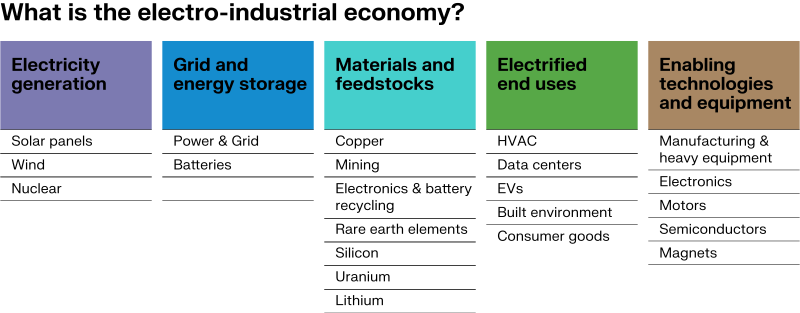
Today, only a small fraction of the electro-industrial supply chain is being funded and built outside of China. In the United States, activity is highly concentrated in data center construction, with over $1.6 trillion spent between 2020 and 2026.1 Numerous other industries needed to power the US electro-industrial economy have yet to receive a fraction of this investment. Exhibit 2 offers a nonexhaustive but representative breakdown showing the interconnections in what is less a supply chain and more of a supply web.
Exhibit 2.
Electro-industrial projects ready to scale
- Electricity generation
- Grid and energy storage
- Materials and feedstocks
- Electrified end uses
- Enabling technologies and equipment
RMI Graphic.
To promote a resilient and prosperous electro-industrial market, the United States needs to channel more investment into sectors where domestic firms have been outsourcing capacity for a quarter century. In sectors such as critical minerals, industrial heat, and advanced grid technologies, much of the science is solved and the equipment is ready to go, but deploying hard tech takes capital, and financing new things can be complicated and expensive. We are stuck in an economic environment full of potential growth that cannot proceed without the right investment.
1.2. The electro-industrial transition presents an economic opportunity for states
States have the power to attract jobs and development in this new environment, but capturing the economic opportunity requires more than one-off tax breaks to bid for individual projects. For the past several decades, the chief means of attracting companies to operate in a state has been tax incentives, but they are not always fit-for-purpose. Because firms generally incur costs before receiving tax benefits, typical economic development packages work best for projects that can already find financing rather than for technologies that require up-front cost supports.
Green banks have recently stepped up to fund projects left behind by economic development organizations, but they are restricted in both what kinds of activities they support and what kinds of support they can provide. In a forthcoming review of 45 green banks in the United States, only three offered financial products for manufacturing and supply chain facilities, with most institutions focused instead on residential and commercial solar or home efficiency retrofits.
New solutions are needed to change the game at scale: a full suite of tools that states can use to create a financial landscape that is attractive to the industries they are best suited to host. This need is especially urgent as federal recovery funds approach spending deadlines and states face a more constrained fiscal environment. The most competitive states will nurture stable, coordinated economic hubs by building interconnected systems of infrastructure, supply, workforce, energy, and money.
There are numerous success stories of state industrial investment paying off in the form of regional revitalization. Consider the over $9 billion return on South Carolina’s $100 million incentive package to bring a BMW factory to Spartanburg County.2 As in most cases with incentives, these returns are measured in jobs and related spillovers. Incentive packages consisting of grants and tax breaks do not get paid back to the state in actual dollars, but rather in state-desired outcomes such as higher wages and lower unemployment. This ratio of returns is also referred to as a benefit-cost ratio.3 Recent analysis of 50 projects across the United States finds that state incentive spending on electro-industrial projects yields a positive benefit-cost ratio, with the median at 1.47, meaning that the state per capita income boost is 47% greater than the up-front state investment in incentive packages.4
Despite the success of traditional economic tools in attracting traditional manufacturing, these specialized state support tools are not necessarily well suited or sufficient to attract the electro-industrial projects of the future. One way to improve benefit-cost ratios and recoup more of the state’s value is through exploring new ways to fund projects, including low-interest financing solutions, that further insulate state dollars from being put to inefficient use, as in the case of some economic development packages.5 State green banks, for example, see an average leverage ratio of 4.25 — for every public dollar spent, more than four dollars are spent by the private sector. This “crowding in” effect is one of the chief benefits of using public financing tools.
1.3. Where risk bottlenecks limit private investment in strategic industries, states can use public financing tools to de-risk investment
Building the new US electro-industrial economy will require billions of dollars invested into projects with varying risks. Some technologies have not been deployed at scale before. Others require major up-front infrastructure investments. Still others rely on markets that are not yet mature. Most projects face multiple problems at once because the risks are systemic (see Exhibit 3). Private investors:
- see revenue certainty/bankable offtake risk when the output from a project is not guaranteed to be purchased over several years by customers with strong credit ratings.
- see permitting and grid interconnection risk as existential, and a project without full grid access and permits is often a nonstarter.
- see feedstock risk when a project’s revenues falter because it cannot consistently access the inputs needed to operate the project.
- cite regulatory risk and policy uncertainty when a project relies heavily on government incentives that could be paused or removed due to political shifts.
- view a lack of enabling infrastructure as a risk, especially when it is unclear how a project’s output will be stored or transported to customers.
- flag technology performance and operations and maintenance risk when it is not clear how consistently a project can operate a new technology due to a lack of skilled workforce or spare parts.
Those risks make private investors nervous and reluctant to spend their cash, especially when several are stacked together. In Exhibit 3, barriers marked High have generally not been solved at scale, whereas those marked Medium have been solved in only a few cases.
Exhibit 3. Different electro-industrial technologies have different financing barriers. Select a technology to read why each barrier applies.
High barrierMedium barrier– Not a meaningful constraint
- Revenue Certainty / Bankable Offtake Medium barrier
- Some projects secure offtake, but revenue remains exposed to commodity price volatility.
- Permitting & Grid Interconnection High barrier
- Mining permitting can be lengthy and volatile. Unpermitted projects are non-starters.
- Regulatory / Policy Uncertainty High barrier
- Threats of political interference in operations, tariffs, and expropriation often dissuade investors.
- Enabling Infrastructure Medium barrier
- Minerals can be expensive to move and rely on third-party rail and roads.
Sources: WEF (2026), Making Critical Minerals Bankable
- Revenue Certainty / Bankable Offtake High barrier
- Often difficult to secure bankable offtake.
- Feedstock (incl. power, water & labor) Medium barrier
- Reliable ore supply and low-cost power, water, and logistics are sometimes difficult.
- Regulatory / Policy Uncertainty Medium barrier
- Trade rules, tariffs, and local-content policies can raise project risk.
- Technology Performance / O&M Medium barrier
- Processing quality, yield, and customer qualification requirements can delay customer qualification and revenue ramp-up.
Sources: WEF (2026), Making Critical Minerals Bankable
- Revenue Certainty / Bankable Offtake High barrier
- Often difficult due to customer qualification, product specifications, and limited long-term contracts.
- Feedstock (incl. power, water & labor) Medium barrier
- Access to processed inputs (refined lithium, nickel, graphite) can be constrained and geographically concentrated.
- Regulatory / Policy Uncertainty Medium barrier
- Trade policy and industrial policy can distort market access and competitiveness.
- Technology Performance / O&M Medium barrier
- Customer qualification and quality consistency affect ramp-up.
Sources: DOE (2024), Supply Chain Review; WEF (2026)
- Revenue Certainty / Bankable Offtake Medium barrier
- Demand uncertainty and EV market volatility can reduce revenue visibility.
- Feedstock (incl. power, water & labor) Medium barrier
- Access to battery materials remains concentrated and can constrain production.
- Regulatory / Policy Uncertainty High barrier
- Project economics are majorly reliant on subsidies and trade rules.
- Technology Performance / O&M High barrier
- High capex and complex ramp-up make scale-up difficult and reduce returns.
Sources: DOE (2023), Li-Bridge; DOE (2024), Supply Chain Review
- Revenue Certainty / Bankable Offtake Medium barrier
- Revenue depends on volatile commodity prices and limited long-term contracts.
- Feedstock (incl. power, water & labor) High barrier
- Inconsistent and fragmented battery collection limits reliable feedstock supply.
- Regulatory / Policy Uncertainty Medium barrier
- Policy and recycling incentives are still evolving and affect project viability.
- Technology Performance / O&M Medium barrier
- Recovery rates, chemistry variation, and process performance can impact economics.
Sources: DOE (2024), Supply Chain Review; WEF (2026), Making Critical Minerals Bankable; DOE / Li-Bridge (2023)
- Revenue Certainty / Bankable Offtake Medium barrier
- Module prices are volatile and margins are compressed by global oversupply and competition.
- Feedstock (incl. power, water & labor) Medium barrier
- Access to upstream inputs (polysilicon, wafers) is concentrated and globally traded.
- Regulatory / Policy Uncertainty High barrier
- Trade policy, tariffs, and subsidies heavily shape competitiveness and investment decisions.
Sources: DOE (2022), Solar PV Supply Chain Review
- Revenue Certainty / Bankable Offtake Medium barrier
- Demand depends on project pipelines, which can be delayed by permitting and policy uncertainty.
- Permitting & Grid Interconnection High barrier
- Project permitting and interconnection delays can slow demand for new equipment.
- Feedstock (incl. power, water & labor) Medium barrier
- Key components and materials (e.g., castings, rare earths) can be supply constrained.
- Regulatory / Policy Uncertainty High barrier
- Policy incentives and permitting frameworks strongly influence deployment and investment.
- Enabling Infrastructure Medium barrier
- Large components require specialized transport, ports, and installation infrastructure.
Sources: DOE (2022), Wind Supply Chain Report
- Feedstock (incl. power, water & labor) Medium barrier
- SiC/GaN wafers, specialty inputs, and advanced memory/packaging capacity can be constrained.
- Regulatory / Policy Uncertainty High barrier
- Export controls, CHIPS incentives, trade policy, and localization rules shape market access and viability.
- Enabling Infrastructure Medium barrier
- Domestic packaging and manufacturing ecosystems remain thin.
- Technology Performance / O&M High barrier
- Performance, yield, thermal management, and energy-efficiency requirements require sustained R&D and scale-up.
Sources: DOE (2022), Semiconductor Supply Chain Deep Dive; NIST/CHIPS (2025); IDC (2026); Deloitte (2026)
- Permitting & Grid Interconnection Medium barrier
- Fab sites need major utility, wastewater, and permitting readiness.
- Feedstock (incl. power, water & labor) Medium barrier
- Fabs need large volumes of power, water, specialty inputs, and skilled labor.
- Regulatory / Policy Uncertainty High barrier
- CHIPS incentives, export controls, and localization policy are crucial and shape project viability.
- Enabling Infrastructure High barrier
- Domestic advanced packaging and supplier ecosystems remain underbuilt.
- Technology Performance / O&M High barrier
- Yield, thermal management, power delivery, testing, and reliability are difficult to scale.
Sources: GAO (2025); NIST/CHIPS (2025); NIST NAPMP; IDC (2026); Deloitte (2026)
- Feedstock (incl. power, water & labor) High barrier
- Critical materials and components (e.g., grain-oriented electrical steel) are supply constrained.
- Technology Performance / O&M High barrier
- Lack of customized manufacturing and long production cycles limit scale-up capacity.
Sources: DOE (2022), Grid Supply Chain Crisis; DOE (2024), Transformer R&D and supply efforts
- Permitting & Grid Interconnection Medium barrier
- Transmission planning and cost-allocation frameworks do not consistently reward GET deployment.
- Enabling Infrastructure High barrier
- Utilities face coordination and adoption challenges despite proven benefits.
- Technology Performance / O&M Medium barrier
- Limited data, testing, and validation slow deployment. Higher upfront costs can slow adoption.
Sources: DOE (2022/23), Advanced Conductor Scan; DOE (2023), GETs: From R&D to Reality
- Permitting & Grid Interconnection High barrier
- Permitting, siting, and interconnection processes are slow and fragmented.
- Feedstock (incl. power, water & labor) Medium barrier
- Materials and equipment supply can constrain timelines.
- Regulatory / Policy Uncertainty High barrier
- Regulatory frameworks and cost allocation rules slow project approval.
- Enabling Infrastructure High barrier
- Multi-jurisdiction coordination across utilities and regulators is difficult.
Sources: DOE (2024), Transmission Impact Assessment; DOE (2023), i2X Roadmap
- Revenue Certainty / Bankable Offtake High barrier
- Markets rarely fully compensate long-duration capacity or provide long-term contracts.
- Regulatory / Policy Uncertainty High barrier
- Market design and regulatory frameworks must evolve to support economics.
- Enabling Infrastructure Medium barrier
- Manufacturing and deployment ecosystems are still scaling.
- Technology Performance / O&M High barrier
- Cost, efficiency, and performance must improve to compete at scale.
Sources: DOE (2023), Pathways to Commercial Liftoff: LDES
- Permitting & Grid Interconnection High barrier
- Grid interconnection and siting constraints are increasingly binding as power demand surges.
- Feedstock (incl. power, water & labor) High barrier
- Access to power, water, and land can constrain deployment timelines or increase costs.
- Regulatory / Policy Uncertainty Medium barrier
- Local permitting, environmental review, and policy responses are evolving.
- Enabling Infrastructure High barrier
- Requires large-scale power, cooling, and grid infrastructure buildout.
Sources: DOE (2024); IDC (2026); Deloitte (2026)
- Revenue Certainty / Bankable Offtake High barrier
- Industrial customers are difficult to secure and deals are either too small or complex for capex spending, or too expensive for opex. Heat-as-a-service contracts remain nascent.
- Feedstock (incl. power, water & labor) Medium barrier
- Gas-based electricity is often cheaper than clean electricity. Site-specific infrastructure can affect viability.
- Regulatory / Policy Uncertainty Medium barrier
- Often a major reliance on incentives and grants.
- Enabling Infrastructure Medium barrier
- Coordination between industrial hosts, developers, and utilities is complex.
- Technology Performance / O&M Medium barrier
- Site-specific integration and performance risks create uncertainty for industrial customers.
Sources: RMI (2025), Blueprint for Success: Overcoming Challenges in Industrial Heat Decarbonization; DOE (2024), Industrial Decarbonization Projects
- Revenue Certainty / Bankable Offtake High barrier
- Lack of long-term offtake remains a core reason projects struggle to reach FID.
- Permitting & Grid Interconnection Medium barrier
- Grid access and clean-power availability can affect electrolytic hydrogen economics.
- Feedstock (incl. power, water & labor) High barrier
- Clean power, water, CO2, nitrogen, and other inputs can materially affect cost and viability.
- Regulatory / Policy Uncertainty High barrier
- Volatile tax-credit rules and uncertain demand-side policy strongly shape project economics.
- Enabling Infrastructure High barrier
- Midstream infrastructure for transport, storage, and delivery remains underdeveloped.
- Technology Performance / O&M High barrier
- Limited operating history and performance data make lenders cautious.
Sources: DOE (2025), Clean Hydrogen Liftoff; DOE LPO Clean Hydrogen Projects; RMI (2024), Four Ways to Jump-Start Clean Hydrogen Finance in 2025; IEA (2025), Global Hydrogen Review
- Revenue Certainty / Bankable Offtake High barrier
- Long-term revenue certainty remains difficult outside policy-supported use cases.
- Permitting & Grid Interconnection High barrier
- Storage permitting, siting, and community acceptance can delay projects.
- Regulatory / Policy Uncertainty High barrier
- Dependence on 45Q and regulatory frameworks strongly shape project viability.
- Enabling Infrastructure High barrier
- CO2 transport and storage networks remain underdeveloped.
- Technology Performance / O&M Medium barrier
- Storage characterization, MRV, and injection performance must be de-risked.
Sources: DOE (2023), Carbon Management Liftoff; DOE NETL CarbonSAFE; IEA (2026)
RMI Graphic.
Though risks vary greatly from project to project, analysis of industry reports reveals some common themes as well as areas where state public investment and finance institutions (SPIFIs) can and cannot meaningfully accelerate technology deployment. Technologies such as e-fuels and hydrogen derivatives have not been deployed at scale because they face several unsolved offtake risks. Meanwhile, advanced conductors and grid-enhancing technologies are relatively well positioned to attract private investment at scale. Regulatory and policy uncertainty shows up as a recurring risk for many technologies. Many of these projects sit between technical viability and commercial bankability. Even when technologies are proven, investors may remain concerned about infrastructure, revenue, market, or regulatory risks. Strategic public financing tools can help reduce these barriers and attract private capital.
The financial gap is clear: capital costs appropriate to the level of risk are unaffordable for the companies attempting to meet the electro-industrial moment. A variety of risk mitigation strategies are needed, often requiring someone to accept lower-than-market interest rates. Here, where neither venture capital nor traditional lenders will tread, is where a state can step in. States have the unique ability to accept benefits beyond pure financial rate of return, such as jobs created and infrastructure built. Those benefits enable states to offer more affordable financing, whether through loans or more innovative financial instruments.
The states that will benefit the most from the new economic paradigm, however, will not be the ones that go all-in on a single technology or one type of financial tool, because risks and financing gaps are neither uniform nor isolated across different industrial buckets. Flexibility is the real superpower. Success will require understanding local and regional needs, the area’s existing strengths, and how to measure and communicate benefits that might not easily translate into dollars. The following sections explore levers available for states to attract, finance, support, and build the new US electro-industrial stack through SPIFIs.
2. What Are State Public Investment and Finance Institutions?
This report uses SPIFI to describe the broad range of entities that states can employ to attract, coordinate, and deploy capital in support of electro-industrial infrastructure. SPIFIs take a variety of forms, reflecting differences in state priorities, legal authorities, and financing needs. Major categories include:
- State infrastructure banks: Over 30 states have established state infrastructure banks to finance transportation and other infrastructure projects through low-interest loans, loan guarantees, and other credit enhancements. First authorized under the National Highway System Designation Act of 1995, the program has received approximately $661 million in capitalization from the federal government, with states generally required to provide a 20% match to federal funds.
- State energy financing institutions: These entities help access federal financing and provide financing support, credit enhancements, and other financial tools to facilitate investment in clean energy and energy-related infrastructure.
- State revolving funds: Operating under a variety of federal programs, state revolving funds provide low-cost financing for infrastructure projects, particularly in the drinking water, wastewater, and transportation sectors.
- Green banks: Since 2009, approximately 40 state and regional green banks have been established to support clean energy, energy efficiency, and other sustainability-related investments.
- Venture funds: At least nine states have formed venture capital funds to assist companies in early stage development across a variety of industries.
- Special purpose entities: Some states use dedicated public entities to finance, develop, own, or regulate specific types of infrastructure. These entities vary widely in structure and purpose, ranging from statewide utilities, such as the New York Power Authority, to sector-specific organizations, such as the New Mexico Renewable Energy Transmission Authority.
States may combine several of these features into a single entity. Any one of these frameworks may be leveraged to invest in or support electro-industrial projects in the state, although some may require programmatic or legislative updates to expand their authority in sector or mechanism.
2.1. What do SPIFIs do?
Much of today’s regional economic development toolkit was designed to attract investments that were already economically viable. Tax incentives, grants, and subsidy packages can influence location decisions, but they do little to address the underlying risks that prevent strategic industries from scaling. Modernizing state economic development tool kits for electro-industrial development can serve three important functions:
- Risk absorption: Reducing project-specific risks and improving project bankability.
- Capital mobilization: Crowding in private capital by providing financing, credit enhancements, and other forms of financial and technical support. SPIFIs can also directly or indirectly provide public capital to strategic industries.
- Investment coordination: Aligning infrastructure investment, manufacturing, corporate and consumer demand, utilities, insurers, and financial institutions around common development objectives and regulatory frameworks.
Growing geopolitical uncertainty, rapidly changing competitive landscapes, shifting supply chains, increased exposure to physical risks, and volatile regulatory parameters all can make it difficult for investors to assess the long-term viability of major electro-industrial projects, creating a bottleneck to deployment even when underlying demand is strong. By coordinating infrastructure investment, supporting emerging industrial clusters, reducing financing barriers, and mobilizing private capital, SPIFIs can help states move beyond project-by-project subsidy competition toward a more strategic approach to industrial development.
The current lack of sustained national commitment to electro-industrial development increases the importance of state-level institutions, long-term financing mechanisms, and built-to-last regional industrial development strategies. The impacts of shifting federal policy priorities are being felt locally by business and labor. Today, there is a shortage of institutions capable of absorbing risk, coordinating investment, and directing capital toward long-term industrial objectives. This is where SPIFIs can shine.
2.2. How are SPIFIs structured?
State financing institutions vary in structure, capitalization, and mandate, and these structural components shape the ways in which they are able to mobilize capital, manage risk, and accelerate economic development. This report uses three archetypes to delineate possible institutional structures: the facilitator, the financier, and the investor. The case studies offered throughout demonstrate that many of the institutional building blocks needed for SPIFIs already exist.
Model A: State as facilitator
States can play an important role in advancing the electro-industrial sector even without providing significant direct capital. In a facilitator capacity, states can coordinate stakeholders, streamline permitting and siting processes, align infrastructure planning, establish clear regulatory frameworks, and help structure transactions that bring together public and private participants. By reducing uncertainty and lowering development barriers, SPIFIs can improve project bankability and accelerate investment in strategically important industries and supporting infrastructure.
The elements of this facilitating role include:
- Technical assistance: A SPIFI or centralized office within the state treasurer or state economic development organization can provide a variety of technical assistance to state agencies and local or municipal governments on the setup and execution of economic development projects in the electro-industrial industry, including deal structuring, request-for-proposal design, procurement standards, and negotiation support. This support can help reduce transaction costs and improve project readiness and execution speed.
- Federal funds coordination/pass through: SPIFIs can serve as intermediaries for federal funding programs by administering grants, loans, tax credit monetization support, and other available resources. Centralized administration can improve access to federal funds and align federal resources with state industrial priorities.
- Deal setup and facilitation: SPIFIs can play a coordinating role by bringing together developers, utilities, financiers, regulators, and public entities to facilitate transactions and allocate risks.
- Aggregation: SPIFIs can aggregate projects, participants, and demand across multiple jurisdictions or sectors to create investment opportunities at a scale attractive to private capital providers. Aggregation can reduce costs, improve standardization, and enhance financing efficiency.
- Site development: States can support electro-industrial economic growth through site identification, land assembly, environmental remediation, utility extensions, and predevelopment work. Early site preparation can reduce project risk and shorten development timelines.
- Alternative products and underwriting approaches: SPIFIs can act as a “market maker” for electro-industrial financing without necessarily providing capital. For example, by establishing and managing property assessed clean energy programs, the state allows residences or business to finance green energy building improvements that are repaid by assessment under annual property tax bills.
- Regulation: States can significantly influence electro-industrial economic development through establishing a supportive regulatory framework. For example, state public utility commissions set the pricing framework for generation and transmission of electricity within the state and therefore are well positioned to create positive incentives.
Case studies
| Model | Facilitator |
| Industry | Electricity Transmission |
| Source of SPIFI Capital | The New Mexico Legislature established RETA in 2007 to plan, finance, develop, and acquire high-voltage transmission lines and storage projects to promote economic development in the state. Its source of capital is state appropriations and project development fees. RETA uses statutory powers, project participation authority, and access to revenue-bond financing to facilitate the development of large-scale transmission infrastructure. Rather than serving as the primary source of capital, RETA reduces development risk, coordinates stakeholders, and provides a public-sector partner that can help attract substantial private investment. |
| Transaction | SunZia Transmission Project is a high-voltage direct current 550-mile transmission line project in New Mexico and Arizona, with 350 miles located in New Mexico. RETA is codeveloping this project with Pattern Energy. SunZia is rated at a capacity of 3,000 megawatts (MW). In late 2023, SunZia closed on $11 billion in financing for the transmission line and associated wind farms, making it one of the largest renewable energy development projects in North America.6 |
| Model | Facilitator/Investor/Developer |
| Industry | Semiconductors |
| Source of SPIFI Capital | NYPA is a self-financing public power authority that receives no state tax revenues and does not rely on state appropriations for its general operations. Its capital is derived primarily from revenues generated through the sale of electricity, transmission services, and energy-related services, supplemented by the issuance of revenue bonds that are repaid from operating revenue. |
| Transaction | The State of New York provided a range of economic development incentives to support a $100 billion investment by Micron for a new semiconductor manufacturing facility. A key part of this support was an allocation of 140 MW of low-cost power by NYPA under its Recharge NY program, which provides qualified businesses and nonprofits access to low-cost energy.7 |
| Model | Facilitator |
| Industry | Electric Vehicle Battery Manufacturing |
| Source of SPIFI Capital | IO is a provincial Crown corporation, similar to a state-owned enterprise in the United States, whose capital is derived primarily from borrowings backed by the Province of Ontario, Canada, and from its own lending and infrastructure operations. IO finances its activities through long-term provincial funding, debt issued through Ontario’s financing system, and revenues generated from its lending, project delivery, and real estate services. |
| Transaction | In 2024, IO coordinated with the Ontario Ministry of Economic Development to support the site development for Volkswagen’s giga battery factory in St. Thomas, Ontario. IO coordinated execution of the design-build contract for site preparation.8 |
Model B: State as financier
Many states have already established the requisite statutory authority for a SPIFI, primarily in the form of green banks and state infrastructure banks to promote economic development. These institutions are at the forefront of innovative uses of public capital to leverage private investment. Where authorized by statute, they provide states with existing organizations, experienced staff, and proven financial tools that can be adapted to support electro-industrial development.
Acting as financiers and providers of catalytic capital, SPIFIs can play a critical role in the electro-industrial transition. States can function as strategic capital partners, drawing from a diverse set of financial tools to offer targeted transaction support — including guarantees, subordinated debt, first-loss reserves, takeout commitments, offtake backstops, and predevelopment financing — and move projects into a risk profile that private capital can underwrite.
SPIFIs have a broad range of financing tools available to address different barriers to project development and capital formation. Common financing functions include:
- Providing predevelopment financing: SPIFIs can offer grants or early-stage financing for feasibility analysis and other predevelopment activities. This funding is typically used for energy audits, feasibility studies, engineering and design work, legal and procurement support, and measurement and verification planning — costs that are often difficult to fund through operating budgets or company equity and are incurred before a project becomes financeable. Many green banks also offer bridge financing for utility rebates or federal tax credits, helping borrowers manage the time gap between project expenditures and receipt of incentive payments.
- Offering concessionary financing: SPIFIs can provide loans at interest rates below those available through traditional commercial borrowing. Additionally, support can be provided to promising enterprises with limited access to traditional banking products due to a lack of credit history or being located in historically underserved communities. Loan terms may also be more flexible, including longer repayment periods or structures tailored to specific project types. For example, rooftop solar projects often require longer-term financing to ensure that loan repayments remain below expected utility bill savings.
- Providing credit enhancements: SPIFIs can deploy tools such as loan-loss reserves, partial loan guarantees, subordinated debt, first-loss capital, and interest rate buydowns to improve a project’s creditworthiness and reduce risk for private lenders.
- Cofinancing projects with other capital providers: SPIFIs can partner with municipalities, community development banks, community development financial institutions, and private investors to share project costs and risks. In these structures, the SPIFI may provide a portion of the capital on flexible or subordinated terms while commercial lenders supply the remainder. This blended-capital approach can reduce financing costs, extend repayment periods, and improve project feasibility.
- Operating revolving loan funds: Revolving funds pool state assets (typically capitalized with federal grants) to create a highly creditworthy financing vehicle that can support a broad range of project developers within a state. The fund provides grants and low-interest loans to eligible projects, which are repaid over time using project revenues or cost savings. As loans are repaid, the capital is reinvested in new projects, creating a self-sustaining source of financing that can continuously support infrastructure investment while maximizing the impact of the initial public funding.
Case studies
| Model | Financier |
| Industry | Fuel Cell Microgrid |
| Source of SPIFI Capital | CT Green Bank has been capitalized by renewable energy investment charges, regional greenhouse gas initiative proceeds, federal grants, and regular bond issuances. |
| Transaction | In August 2023, FuelCell Energy closed on a project financing transaction with Liberty Bank, Amalgamated Bank, and CT Green Bank for its Connecticut Municipal Electric Energy Cooperative fuel cell microgrid. CT Green Bank’s participation was an $8 million loan with a 20-year term. The revenue from the project will be used to repay the lenders.9 |
| Model | Financier |
| Industry | Data Center |
| Source of SPIFI Capital | BND was established by the state legislature in 1919 to support economic development throughout North Dakota. It was initially capitalized with a $2 million state appropriation. Today, its funding base is derived primarily from deposits of state revenues and other public funds, which by law are held at the bank. |
| Transaction | In 2024, the BND partnered with Cornerstone Bank to provide a five-year, $16 million loan to Applied Digital to support the company’s operations at a 10 MW high-performance computing data center in Jamestown, North Dakota.10 |
Model C: State as investor
In addition to acting as financiers, SPIFIs can participate more directly in electro-industrial development as investors, codevelopers, or owners of infrastructure assets. Ownership models allow states to support larger and more strategic investments, participate in project revenues, play a more direct role in governance models, and retain greater influence over infrastructure development, although they also require greater capitalization and risk tolerance than Models A and B. State-as-investor participation ranges from full ownership of assets to minority equity positions, participation in project finance structures, or partnership arrangements with private developers.
- Sole ownership: Under a sole ownership model, the state or SPIFI directly owns and operates the infrastructure asset and assumes responsibility for financing, development, and ongoing operations. This approach has historically been most common in public utilities and infrastructure authorities rather than dedicated electro-industrial projects. For example, the Alaska Energy Authority owns the Bradley Lake Hydroelectric Project, the largest hydroelectric facility in Alaska. It was financed by Alaska Energy Authority revenue bonds, backed by power purchased by Railbelt utilities.
- Project participant/capital stack participation: Rather than owning an entire project, states can participate as one component of the project capital structure. SPIFIs can provide subordinated debt, preferred equity, first-loss capital, guarantees, or minority investment positions alongside private sponsors and lenders. The Massachusetts Clean Energy Center’s 2030 Fund started as a $50 million fund to invest in the commercialization of climate technologies.
- Venture capital: From New Jersey to North Dakota, at least nine states have established venture capital funds that provide equity investments to early-stage companies, typically in industries targeted by the state as strategic priorities for economic development. These funds support entrepreneurship, technology commercialization, and business growth by providing risk capital that may not be readily available from traditional private investors.
- Project finance participation: Public-sector participation in project finance — where investments are supported primarily by project-generated revenues — has long been used to develop infrastructure such as toll roads, public transit systems, ports, electric utilities, and transmission networks. In some cases, states are beginning to apply these same financing principles to electro-industrial industries. For example, the North Dakota Development Fund makes equity and subordinated-debt investments in industrial projects, and state development authorities increasingly use industrial revenue bond structures in which repayment is supported by revenues generated by manufacturing and energy facilities rather than by general tax revenues.
- Public–private partnerships (P3): Under a P3 model, a SPIFI enters into an agreement with one or more private partners to design, build, finance, operate, and maintain an infrastructure asset. P3s have historically been most successful for projects that generate predictable revenue streams once operational, making them well suited to project finance structures. Depending on the project, P3 arrangements include design-build-finance-operate-maintain agreements, concession agreements, availability-payment structures, or other risk-sharing models that leverage private-sector capital and expertise while advancing public objectives.
Case studies
| Model | Investor |
| Industry | Battery |
| Source of SPIFI Capital | The 2030 Fund is a $50 million venture capital fund managed by MassCEC that provides convertible notes, simple agreements for future equity, and venture debt to early-stage climate technology companies. The fund was established to help Massachusetts-based companies commercialize innovative technologies in areas such as advanced manufacturing, grid infrastructure, energy storage, and industrial decarbonization. The fund’s capital is sourced primarily through the Massachusetts Renewable Energy Trust Fund, which receives revenue from a system benefits charge on electric utility bills. These investments complement MassCEC’s broader portfolio, including grants, tax credits, and in-kind business development assistance. |
| Transaction | In 2024, MassCEC participated in a $12 million initial round for seed funding for Lithios, a startup that is developing a new electrochemical process that makes it economical to extract lithium from low-grade brine resources, opening up new sources of supply for this essential battery material. Details about MassCEC’s specific financial contribution to this undisclosed portion of the seed round are not publicly available.11 |
| Model | Owner/Investor |
| Industry | Semiconductors |
| Source of SPIFI Capital | New York Ventures is the venture capital division of the New York State economic development agency, Empire State Development. It is capitalized primarily through state appropriations and federally supported programs. Empire State Development is also authorized to issue bonds. |
| Transaction | In 2021, New York Ventures invested $250,000 in seed funding to Mosaic Microsystems, a Rochester-based semiconductor packaging company that specializes in the use of thin glass substrates for microelectronics and photonics such as 5G technology.12 |
| Model | Owner/Investor |
| Industry | Electricity generation and transmission |
| Source of SPIFI Capital | AEA is a public corporation of the State of Alaska that owns and manages hydroelectric and energy development projects. AEA’s source of capital is a mix of energy generation, state appropriations, investment income, and payment from utility companies. |
| Transaction | AEA financed the Bradley Lake Hydroelectric Project through the sale of revenue bonds, backed by long-term power purchase agreements from Alaska’s Railbelt utilities. AEA’s Renewable Energy Fund has delivered over 56 projects since 2021.13 |
| Model | Investor |
| Industry | Batteries |
| Source of SPIFI Capital | The NJIEF was created by the New Jersey Economic Recovery Act of 2020 and is primarily funded through the sale of state corporate tax credits in competitive auctions. The New Jersey Economic Development Authority can sell up to $300 million in tax credits in auctions over a seven-year period. Corporations can purchase tax credits at a minimum of 75% of face value. |
| Transaction | In 2025, the New Jersey Economic Development Authority closed on a $750,000 qualified investment in Nascent Materials, a manufacturer of cathode active materials for lithium-ion batteries. NJIEF coinvested with SOSV, a Princeton-based venture capital firm, which led the seed round for Nascent Materials.14 |
| Model | Investor |
| Industry | Energy/Fusion |
| Source of SPIFI Capital | SIC is the sovereign wealth fund of the State of New Mexico, funded by the state’s royalties and taxes from natural resources and income from sales and leases of public lands and minerals. The current endowment stands at $67 billion. SIC’s Venture Capital Fund invests in venture capital firms, which in turn make investments in startups in New Mexico. |
| Transaction | In 2025, Pacific Fusion began development of a $1 billion research and manufacturing campus in Albuquerque. New Mexico provided a wide variety of incentives, including a local industrial development bond, and other funding. SIC invested about $300 million in the primary funders of the projects.15 |
| Model | Investor |
| Industry | Electric Motors |
| Source of SPIFI Capital | The Utah Capital Investment Corporation manages the Utah Fund of Funds LLC. It serves as a limited liability company organized under the laws of the State of Utah to promote economic development by providing access to alternative or nontraditional capital for Utah entrepreneurs. The fund does not invest money directly into any company but rather invests in venture capital and private equity funds located in and outside of the state and incentivizes them to invest in Utah-based companies. |
| Transaction | In 2023 the Cottonwood Fund, which is partly supported by the Fund of Funds, invested in Infinitum Electric, a next-generation producer of electric motors.16 |
2.3. How are SPIFIs capitalized?
Private investment tends to retreat during periods of uncertainty. However, electro-industrial investments often require long-term investment commitments (10–20 years), long construction periods, and uncertain early returns. As a result, states should design their SPIFIs with durable funding sources that allow long-term investment regardless of political or market cycles. A variety of one-time and ongoing sources of funding support the capitalization of SPIFIs.
- One-time or “seed” capital sources provide the initial capitalization needed to establish a SPIFI and begin financing activities. Although these sources may not provide recurring revenue, they can create a self-sustaining financing platform when capital is recycled through repayments, investment returns, or leveraged private financing. Sources of seed capital are vast and demonstrate state creativity:
- One-time general fund appropriation that serves as seed capital for lending, credit enhancement, or investment activities. For example, the New York Green Bank, a division of the New York State Energy Research and Development Authority, received $1 billion of capital through the New York State Department of Public Service.
- One-time revenue such as dedicated fees, surcharges, settlement payments, permitting fees, utility-related assessments, legal settlements, market-based compliance mechanisms (e.g., cap and trade, renewable portfolio standards), or proceeds from asset transactions directed toward electro-industrial development activities. The New York Green Bank’s initial capitalization included approximately $52.9 million from carbon allowance sales through the Regional Greenhouse Gas Initiative. States can also impose fees or charges directly related to electro-industrial-related activities and investments, such as data center construction.
- Transferring, discounting, monetizing, or otherwise leveraging tax credits to create deployable capital. NJIEF is primarily funded through the sale of state corporate tax credits in competitive auctions. The New Jersey Economic Development Authority can sell up to $300 million in tax credits through auctions over a seven-year period.
- Additional one-time capital sources, including federal grants, asset sales, legal settlements, or transfers from existing state entities. For example, the Montgomery County Green Bank in Maryland was capitalized using funds from the settlement associated with the merger of Pepco and Exelon. The merger settlement required various public-benefit commitments, and approximately $14 million of settlement proceeds were directed to capitalize the Green Bank.
- Philanthropic organization grants, program-related investments, or concessionary capital to support early-stage operations, technical assistance, pilot programs, or first-loss reserves. Although typically smaller in scale, philanthropic funding can help establish new institutions or de-risk innovative financing models. For example, the Kresge Foundation loaned the CT Green Bank $3 million over a 10-year term through a program-related investment for energy investments in affordable housing.
- Ongoing capital sources: One-time seed capital can provide the initial foundation for a state financing entity, whereas ongoing revenue sources enable larger and more sustained investment activity. Recurring capitalization also expands the range of roles available to the state, including direct investment, equity participation, and project ownership.
- States can pass legislation that obligates recurring appropriations from the general fund to support ongoing financing, investment, or operating activities. Although subject to annual budget processes, recurring appropriations can provide a stable source of capitalization and support larger investment programs. They can also be earmarked for priorities or treated as more flexible than bonds.
- States that own utilities, generation assets, or public power entities can dedicate a portion of utility revenues to support electro-industrial investment activities. This model has limited applicability because it generally requires state ownership or control of revenue-generating utility assets.
- States can dedicate annual/ongoing taxes or fees associated with energy production, fuel use, emissions, extraction activities, or industrial development to capitalize electro-industrial financing initiatives. Examples include fuel taxes, severance taxes, carbon-related fees, or other sector-specific revenue sources. For example, MassCEC, Massachusetts’s clean energy and climate tech economic development agency, is funded primarily through a $0.0005 per kilowatt-hour charge on electricity. The New York Clean Energy Fund is funded by a rate payer surcharge on electric and gas utility bills (known as a system benefits charge). The Clean Energy Fund was authorized at approximately $5 billion over its first 10 years, providing the New York State Energy Research and Development Authority with roughly $500 million annually to support clean energy deployment, market development, innovation, and financing programs, including the New York Green Bank.
- If a SPIFI can establish an ongoing revenue source — from either general state revenues or revenues generated by a specific project or endowment — it may be able to issue bonds to finance larger investments. Bonding acts as an important accelerant for public participation in electro-industrial development by allowing future revenues to be leveraged into immediate capital for project delivery. Bond financing can significantly expand the scale of state participation by spreading project costs over the useful life of the asset and aligning repayment with future benefits. In certain circumstances, public entities can also access tax-exempt financing, providing a meaningful cost advantage relative to private capital and reducing overall project financing costs. A variety of bond structures are available depending on the nature of the project, the repayment source, and the role of the state entity. Following is a partial list of possible bond structures.
- General obligation bonds: General obligation bonds are supported by the full faith and credit of the issuing government and are typically repaid from general tax revenues.
- Revenue bonds: Revenue bonds are repaid from a dedicated source of project or enterprise revenues rather than general state funds.
- Conduit financing (private activity bonds): Under conduit financing structures, a public issuer sells bonds on behalf of a private borrower, and the private entity remains responsible for repayment. State industrial development authorities and economic development entities frequently use conduit financing to support private investment while limiting direct state credit exposure. Use of private activity bonds is limited in the energy sector.
- Industrial development bonds: Industrial development bonds, more formally known as qualified small issue manufacturing bonds, are a specialized form of tax-exempt private activity bond used primarily to support manufacturing facilities. To date, industrial development bonds have been issued predominantly by cities or counties rather than by states. Industrial development bonds can be issued for certain manufacturing projects, including facilities related to batteries, advanced materials, semiconductor production, and other industrial activities relevant to the electro-industrial sector. Under current federal statute, the amount of industrial development bonds that a state can issue is restricted.
- States where regional economic development objectives are coupled with climate objectives or outcomes can establish dedicated climate funds capitalized through emissions programs, environmental fees, or other policy mechanisms. For example, California uses proceeds from the state’s cap-and-trade program to support its Greenhouse Gas Reduction Fund and related climate investments, and Washington’s Climate Commitment Act uses carbon fees to fund a variety of state investments.
The diversity of these approaches raises an important question: What distinguishes the most effective state financing institutions? The next section draws on existing and emerging examples to identify a set of design principles for states seeking to establish or expand SPIFIs in support of electro-industrial development.
3. Design Principles for Effective State Public Investment and Financing Institutions
As the case studies in the previous section make clear, states are beginning to explore the SPIFI model and its applicability in financing and attracting electro-industrial development. What is lacking is a set of design considerations for states as they adapt or create public financing vehicles to explore larger-ticket financial interventions in strategic electro-industrial sectors. States looking to meet the electro-industrial opportunity with the requisite amount of capital will also need commensurate discipline to be competitive. Drawing from case studies and economic development best practices, we propose key design considerations for a state establishing a SPIFI or expanding a SPIFI’s authority to suit its target sectors.
3.1. Build on regional strengths and national priorities
Which sectors should we pursue?
Not every state should pursue every electro-industrial sector. A SPIFI will be most effective when its investment strategy begins from the state’s actual and emerging comparative advantages. This does not mean that states should invest only in industries that are already mature within their borders; instead, a SPIFI should be clear-eyed about where public investment can build from a credible foundation.
New York is an example of a state funneling its resources toward an already strong sector, in this case semiconductors, to attract further investment. To complement the federal CHIPS and Science Act, the New York State Legislature passed the Green CHIPS Act, providing semiconductor and related suppliers with tangible tax benefits and shovel-ready sites.17 In addition to providing traditional economic development incentives, in 2021 New York Ventures invested $250,000 in startup capital for Mosaic Microsystems, an early-stage semiconductor packaging company.18 With this approach, New York invested in several ways of growing the local semiconductor industry, preparing sites and providing economic incentives for megafabs, and investing directly in smaller firms to build supplier networks. New York’s focus on semiconductors built on the upstate region’s strengths: a strong R&D ecosystem, a workforce base in construction trades, and a decades-long history of microelectronics manufacturing.19
A SPIFI should work with regional and state-level economic development agencies to set sector-specific strategies in the state’s distinct regions. Concentrating investment in these areas can help build clusters that reinforce themselves over time through supplier networks, workforce specialization, and shared infrastructure. Tools such as RMI’s Clean Growth Tool can help economic development organizations understand which sections of the cleantech supply chain the existing workforce apparatus can support.20
A state might not be positioned to own an entire supply chain, but it could be well suited to fill a critical niche.21 Butler Works in Pennsylvania, for example, is the only facility in the United States that manufactures grain-oriented electrical steel (GOES).22 GOES is a key component in transformers, which are in high demand due to load growth and already experiencing supply bottlenecks. The presence of GOES manufacturing could advantage the Butler region in transformer manufacturing and other downstream electrical steel products key to the electro-industrial economy. Every state’s approach will be slightly different, and financing products should stem from a state identifying its key sectors and each sector’s financial barriers, instead of creating a product and hoping a pipeline materializes.
The demand for public capital will flow from national priorities. In sectors where there is a clear economic security need to shore up US supply chains, such as critical minerals and grid equipment, state investment can complement federal dollars. Although national priorities can change and lead to uncertainty for states, states can confidently invest in technologies with clear demonstrated growth in demand.
3.2. Define economic outcomes before designing financial tools
What transformation are we trying to achieve?
When designing a SPIFI, the “what” must come before the “how.” States should define the economic transformation they are trying to achieve before constraining themselves with specific products or mechanisms. For example, New Mexico conceived of the SunZia wind farm and transmission line as the state’s flagship infrastructure investment. The state helped de-risk the project by coordinating with both the federal government and local conservation groups to secure permitting.23 This and other behind-the-scenes work allowed a syndicate of banks and developers to secure $11 billion in creative financing, including green loans, to fund the project.24
In contrast, choosing a method before the goal is articulated can result in a waste of resources. A cautionary tale comes from New York City, where the city council once inadvertently outlawed a highly efficient new HVAC solution by mandating how rooftop air conditioners were allowed to function.25 For a SPIFI, the intended economic effect should be the guiding star. The appropriate technical path will follow.
To that end, initial SPIFI design work must include identifying the electro-industrial sectors most aligned with regional strengths (see Section 3.1), and the risks and vulnerabilities facing those sectors (see Exhibit 3). Thorough preparation also includes an evaluation of what existing projects are failing to move forward and why. The “why” may be different in different regions; as every state legislator knows, each district is unique.
Thorough stakeholder engagement is advised to determine both the needs of the communities that might host new industrial development and what they will not support. Designing interventions to improve equity outcomes in the state and involving local leaders at every step of the project will save time and money later,26 result in a stronger state economy overall, and likely improve voter opinion of the administration. Some considerations include which regions receive investment, how to make capital more accessible in areas where it has historically been limited, and ensuring that communities are not displaced or harmed by new construction.
3.3. Design for flexible governance with the right mix of leadership
How can SPIFIs act quickly and confidently?
To shape fast-moving markets and capture innovation in a timely manner, a SPIFI must be allowed to operate flexibly, without undue restriction. Too much emphasis on how a SPIFI must operate drastically limits what it is able to achieve. An understanding of exactly how much oversight, approval, and reporting is appropriate will ensure that the SPIFI is designed to meet the dynamic challenges of any given moment. Consider the structure of block grants: Instead of federally administered programs that dictate how states must distribute funds, states are given funds with few limitations so they have the freedom to decide how to most effectively spend the money. This method not only saves time and resources but also allows states to tailor their interventions to their specific local needs.27 Effective SPIFIs also balance flexibility with accountability via public transparency and other methods.
An additional aspect of SPIFI design that should be dealt with up front is acquiring the right blend of leadership team expertise. Political staffers and government experts are necessary to guide a SPIFI, but individuals with deep private-sector experience will also be needed because SPIFIs are so highly market-oriented. Depending on the SPIFI’s specific goals, expertise from investment banking, venture capital, private/growth equity, and industry can be indispensable to ensuring the SPIFI’s efficacy and efficiency. The requisite backgrounds of leadership team members flow from the objectives laid out in the initial planning stages, and they will help shape the “how” described in Section 3.2.
3.4. Prioritize additionality over capital deployment volume
Where can public intervention make the biggest difference?
For a SPIFI to be successful, it must be “additional” — that is, it must enable projects and activities that would not have occurred without its intervention. It is common wisdom in the finance industry that public banks gravitate toward projects that private markets would have financed anyway. Anecdotally, this results in a “crowding out” effect by preventing private investors from participating in deals.28 Instead, SPIFIs should target cases where public dollars would crowd in private investment. This is a hard balance to strike,29 but it can be done when those public investments are made thoughtfully.
A SPIFI is most effective when it prioritizes additionality over absolute dollars deployed. Places where SPIFIs can have high-leverage impact include constructing foundational infrastructure (see Section 3.5), incentivizing the formation of industrial clusters, alleviating supply chain bottlenecks, and investing in R&D, first commercial facilities, and scale-ups that private capital is reluctant to provide.30
A recent example comes from the 14 Massachusetts TechHubs for various industries, including robotics and advanced manufacturing. Qualifying TechHubs gain access to both a small pool of grant money and a curated network to “provide a forum for shared learning, coordinated problem-solving and resource exchange” between them.31 This state-facilitated network is not something a private investor could create. It represents the state’s unique role in developing an industrial ecosystem.
3.5. Coordinate infrastructure, industry, and market development
How do we systemically unlock these opportunities?
Electro-industrial development can stall because all of the conditions needed for investment are not in place at the same time. Properly sequencing land development, permitting, utility upgrades, and logistics can help de-risk private investment. SPIFIs can play a critical role in solving this coordination problem. A well-designed SPIFI can serve as an investment coordinator that aligns these ingredients with a shared economic strategy. Even where the SPIFI provides only limited direct capital, it can act as a conduit between private lenders, state agencies, utilities, local governments, developers, and community stakeholders.
The Utah Inland Port Authority (UIPA) offers an example of this coordinating role. UIPA is a zone-based development authority that integrates land use planning, infrastructure investment, logistics strategy, and industrial recruitment.32 It identifies strategic sites connected to freight corridors and works to ensure that transportation infrastructure, utilities, permitting frameworks, and development incentives are aligned before private firms commit capital. By coordinating across state agencies, municipalities, and private partners, UIPA reduces uncertainty for investors and accelerates development timelines. Once an inland port is identified, UIPA uses tax increment financing and a revolving loan fund program as tools to develop the strategic sites. Tax increment financing is set up so that a state can borrow against future tax revenue to finance infrastructure investment in a site. UIPA uses these funds to finance site redevelopment, utilities, and logistics upgrades.33
Many electro-industrial projects will depend on a similar bundle of prerequisites: power availability, industrial land, logistics, and permitting. Handled separately, private firms face uncertainty on every front. SPIFIs have a unique ability as a public or quasi-public entity with knowledge of bankability barriers to streamline each of these prerequisites. Using this distinct position, SPIFIs can reduce that uncertainty by helping identify priority industrial corridors, sequencing public investments, and ensuring that sites are ready for industrial use. In this facilitator role, the SPIFI prepares the market for development and can accept longer wait times for payback on that investment than a private entity.
3.6. Optimize for system outcomes over individual projects
How do we evaluate investment decisions?
A SPIFI’s risk tolerance for any individual project must be determined by system-wide goals. Unlike a private equity firm or bank, a state can benefit from many different value streams besides pure rate of return. This enables the SPIFI to consider “returns” in the form of workforce and market development, stronger infrastructure, and investor confidence that leads to more investment in the future. The SPIFI’s metric for success is not whether its portfolio’s paper returns beat the market; it is whether the investment strengthened the broader industrial ecosystem and the state as a whole (see Section 3.8). These long-term returns enable SPIFIs to take on financial risk that private capital would consider unacceptable.
Optimizing for system outcomes rather than the monetary success of individual projects allows the SPIFI to bridge gaps left by private capital. A state can assemble a portfolio of projects that may or may not be profitable in a purely financial sense but that create what a private actor might consider “positive externalities.” For the state, these effects are not external; the system boundaries are simply larger.34 Affordability of local housing, for example, is a benefit to the state that would not be of immediate interest to private investors.35
SPIFIs see the greatest “external” benefit per dollar when investing in infrastructure that can support both target industries and the broader economy. Physically strengthening roads and bridges to handle heavy equipment strengthens them for all drivers, and building a more resilient grid to serve large industrial loads protects the whole system from shocks. Creating a robust skilled labor pipeline secures a local workforce for projects and enables the newly trained workers to earn higher wages, which is a major equity concern in many areas. The state has an important role in coordinating a buildout that benefits everyone.
3.7. Maintain patient capital across economic cycles
What kind of capital strategy is required?
Government is uniquely positioned to make long-term investment. Where private capital is frequently concerned with the short term — often as short as quarterly — government can back projects with time horizons of decades. Industrial investments will in some cases require long construction periods, offer uncertain or limited early returns, and occasionally fail altogether. Just as the federal government supported construction of the interstate highway system, states have the ability to support industrial growth that is slow to bear fruit. The Florida and Texas state infrastructure banks, for instance, offer loans with maturity limits of up to 30 years for state-funded highway projects that benefit both industry and the general public.36
SPIFIs should also be prepared to step up when private capital steps back. Markets follow cycles of hype and uncertainty; during uncertain times, private investors become conservative and reluctant to deploy capital. States must show strong leadership during these lean times. SPIFIs with durable funding sources (see Section 2.3) have the power to soften the harm of economic downturns by supporting the business ecosystem precisely when it needs it the most.37
The bailout of major banks during the 2008 market crash and the economic stimulus actions taken during the COVID-19 pandemic are vivid examples of this behavior from the federal government. In both cases, public institutions stepped in to avoid catastrophic economic consequences. Hopefully no state will find itself in the same position, but in cases of less severe economic stress, a SPIFI might be able to provide the stimulus needed to ensure that the local industrial environment flourishes in — or at least survives — market turmoil.
Note that SPIFIs should not be limited to operating only in times of economic crisis. Boom times offer opportunities, too. As a current example, high demand for data centers is bottlenecked by a lack of critical minerals and power infrastructure. With sufficient care, a well-designed SPIFI can ride the wave of a bull market to address such barriers, enabling additional growth that would otherwise be hindered by lack of resources or capacity.
3.8. Measure mobilization, coordination, and capability creation
How do we know it is working?
Ensuring transparency is key to the long-term success of SPIFIs.38 Taxpayers will want to know where their dollars are going and what they are getting in return. Most institutions currently focus on metrics including dollars deployed, jobs created, and leverage ratios. All of these are important and necessary, but not sufficient to paint the full picture of economic impact. Investing in electro-industrial development might require tracking such metrics as:
- Private capital mobilized
- Local economic activity stimulated
- Domestic supply chain capacity created (e.g., 1,000 tons per year of rare earth ore purified)
- Supply chain resilience developed39
- Electric grid capacity added
- Industrial load added
- Manufacturing capability established
- New supplier relationships created
These are merely examples of the types of results a SPIFI might produce that are not captured by traditional ways of measuring dollars in/dollars out. Even so, some will likely require translation into dollar values to land with constituents. For example, legislators might connect “grid capacity added” to “lower electricity costs for consumers” where this is true. Others are more difficult to define. The more outcomes that are tracked, however, the more defensible the SPIFI’s investment activities will be. This is the best way to make sure that the full return on investment of taxpayer dollars is visible to both the public and other states curious about starting their own SPIFIs.
4. Conclusion: Design SPIFIs as Mission-Oriented Market-Shaping Institutions
Public capital can make markets because of their ability to consider public interest as a core part of their returns and the ability to finance long-term, low-interest loans. Whether that public interest is defined as job creation, emissions reductions, or modernized industry is up to the state’s own goals. When public capital de-risks investment and attracts private capital, new markets and opportunities are made. In this way, SPIFIs can play a market-making role, using public dollars to unlock growth in promising electro-industrial sectors in their states.
We outlined three main models for a SPIFI, depending on a state’s existing institutional authority, capitalization levels needed, and economic development goals.
- Facilitator: In this model, a SPIFI can play a significant role without doing much (or any) direct lending. This model places SPIFIs as a conduit between private developer needs and state capacity — the major lift is coordinating between state agencies to properly sequence developer needs. By taking an active role in coordinating solutions to industry barriers, a SPIFI can reduce development uncertainty and improve a project’s bankability.
- Financier: In this model, a SPIFI participates in the capital stack, providing financial products targeted at the state’s key industry opportunities. These can include funding construction loans, providing credit enhancements, or operating a revolving loan fund. A SPIFI using this model will be most successful when it invests only where its investment is additional or in places where the private sector would not typically invest. These additional dollars are most likely to have a market-making effect and crowd in private capital.
- Investor: In this model, a SPIFI takes a more direct role in project development, investing directly and co-owning companies in strategic market segments. State venture capital funds are the most common example of this model in the United States. This model requires a higher risk tolerance, and state ownership can range from smaller equity stakes to sole ownership.
The states that succeed in the electro-industrial era will be those that most effectively align capital with long-term regional economic objectives. States interested in capturing industrial growth should begin with an assessment of the financing institutions they already possess. Many states already operate green banks, infrastructure banks, development authorities, revolving loan funds, public utilities, venture funds, or economic development financing programs that could be adapted to support strategic infrastructure and industrial development.
Before creating or adapting their institutions, state leaders should be able to answer:
- Which electro-industrial sectors align with regional strengths?
- Which projects in those target industries are failing to move forward and why?
- What financing barriers are preventing sufficient private investment?
- Can existing public institutions be expanded to address those barriers?
The most successful states will not necessarily spend more money. They will deploy capital more strategically, using the design principles outlined in this report as a starting place.
The electro-industrial era is here, and the states that mobilize their economic development apparatus toward it — including the ability to finance projects — will win a disproportionate share of this massive opportunity, creating jobs, attracting investment, and improving local economies by building the industries of the future.
Acknowledgments
Thank you to our external reviewers: Rodney Sobin, National Association of State Energy Offices; Advait Arun, Center for Public Enterprise; Bennett Khurana Byerley, US Green Bank 50; Priyank Bhakta, CT Green Bank; and Rebeccah Sanders, Clean Energy Jobs and Justice Fund.
Endnotes
[1] April Roach, “Data Center Deals Hit Record $61 Billion in 2025 Amid Construction Frenzy,” CNBC, December 19, 2025, https://www.cnbc.com/2025/12/19/data-center-deals-hit-record-amid-ai-funding-concerns-grip-investors.html; Joyce Guevarra et al., “Private Equity Investment Surge Sends US Data Center Deals to 5-Year High,” S&P Global Market Intelligence, S&P Global, December 5, 2026, https://www.spglobal.com/market-intelligence/en/news-insights/articles/2026/5/private-equity-investment-surge-sends-us-data-center-deals-to-5-year-high-100947405; Peter Mwaniki, “Construction Starts on 40 MW AI Data Center in Columbiana, Alabama After $1.1B Deal,” Construction Review, May 5, 2026, https://constructionreviewonline.com/construction-starts-on-40-mw-ai-data-center-in-columbiana-alabama-after-1-1b-deal/; “DataBank Secures $2.0B of Construction Financing for First Three Data Centers on New South Dallas Campus,” DataBank, April 21, 2026, https://www.databank.com/resources/press-releases/databank-secures-2-0b-of-construction-financing-for-first-three-data-centers-on-new-south-dallas-campus/; Daniel Geiger, “A Texas Developer Got a $2 Billion Loan to Build Oracle Data Centers in the ‘Burbs,” Business Insider, April 21, 2026, https://www.businessinsider.com/databank-financing-dallas-data-center-inference-2026-4; and “Construction Spending — Data,” U.S. Census Bureau, June 1, 2026, https://www.census.gov/construction/c30/data/index.html.
[2] Maayan Schechter, “BMW Marks 25th Year as ‘Game Changer’ in SC. Here’s How the Deal Happened,” The State, June 22, 2017, https://www.thestate.com/news/business/article157575669.html.
[3] Timothy Bartik, “How State Governments Can Target Job Opportunities to Distressed Places,” Upjohn Institute Technical Reports, ahead of print, June 15, 2022, https://doi.org/10.17848/tr22-044.
[4] Timothy Bartik et al., “The Economic Benefits and Costs of State and Local Incentives for Clean Energy Projects,” Upjohn Institute Technical Reports, ahead of print, June 8, 2026, https://doi.org/10.17848/tr26-057.
[5] Timothy J. Bartik, Making Sense of Incentives: Taming Business Incentives to Promote Prosperity, W.E. Upjohn Institute, 2019.
[6] New Mexico Renewable Energy Transmission Authority, Financial Statements and Audit Report, Fiscal Year 2025, approved by the New Mexico Office of the State Auditor, October 27, 2025, https://nmreta.com/wp-content/uploads/2025/10/NMRETA-FS-and-Audit-Report-2025-Final-Approved-by-OSA-for-release-10.27.25.pdf.
[7] New York Power Authority, “Governor Hochul Announces Economic Development Awards Spurring More Than $20 Billion in Capital Investments and Supporting Over 8,300 Jobs,” news release, March 22, 2023, https://www.nypa.gov/news/press-releases/2023/20230322-development-awards.
[8] Infrastructure Ontario, “Electric Vehicle Battery Cell Plant (Volkswagen Group),” accessed August 21, 2026, https://www.infrastructureontario.ca/en/what-we-do/projectssearch/electric-vehicle-battery-cell-plant/.
[9] FuelCell Energy, Inc., Current Report (Form 8-K), filed with the U.S. Securities and Exchange Commission, August 24, 2023, https://content.edgar-online.com/ExternalLink/EDGAR/0001558370-23-015262.html.
[10] Applied Digital Corp., “Loan Agreement between Cornerstone Bank and APLD GPU-01, LLC,” Exhibit 10.1 to Form 8-K, filed with the U.S. Securities and Exchange Commission, March 5, 2024, https://www.sec.gov/Archives/edgar/data/1144879/000114487924000053/a101-apldxcornerstonebankc.htm.
[11] Lithios, “Lithios Secures $12 Million to Expand Lithium Supply to Meet Global EV and Energy Demand,” October 8, 2024, https://lithiosinc.com/lithios-secures-12-million-to-expand-lithium-supply-to-meet-global-ev-and-energy-demand/.
[12] Empire State Development, “Empire State Development’s New York Ventures Announces $250,000 Investment in Rochester Based Mosaic Microsystems,” news release, April 20, 2021, https://esd.ny.gov/esd-media-center/press-releases/esd-ny-ventures-announces-250k-investment-rochester-based-mosaic-microsystems.
[13] Alaska Energy Authority, Basic Financial Statements, Required Supplementary Information, Supplementary Information, and Other Information for the Year Ended June 30, 2025, audit report by BDO USA, P.C., October 31, 2025, https://www.akenergyauthority.org/Portals/0/Who We Are/News Room/Publications and Resources/2025.06.30 AEA Financial Statement Fiscal Year 2025.pdf.
[14] New Jersey Economic Development Authority, “Agenda for Board Meeting of the Authority, March 12, 2025,” board book, https://www.njeda.gov/wp-content/uploads/2025/03/March-12-2025-EDA-Board-book.pdf.
[15] New Mexico State Investment Council, Investing in New Mexico through the Strategic Venture Capital Program (Santa Fe: New Mexico State Investment Council, December 2025), https://www.sic.state.nm.us/wp-content/uploads/2026/01/SVCP-Annual-Report-2025-Digital.pdf.
[16] Office of the Utah State Auditor, Utah Capital Investment Corporation 2023 Annual Update, https://reporting.auditor.utah.gov/servlet/servlet.FileDownload?file=015Do0000017cOuIAI.
[17] “Green CHIPS,” Empire State Development, June 17, 2022, https://esd.ny.gov/green-chips.
[18] “Empire State Development’s New York Ventures Announces $250,000 Investment in Rochester Based Mosaic Microsystems,” Empire State Development, April 20, 2021, https://esd.ny.gov/esd-media-center/press-releases/esd-ny-ventures-announces-250k-investment-rochester-based-mosaic-microsystems.
[19] Charles W. Wessner and Thomas R. Howell, “Economic Impact of New York’s Nanotechnology Investments,” in Regional Renaissance: How New York’s Capital Region Became a Nanotechnology Powerhouse, ed. Charles W. Wessner and Thomas R. Howell, Springer International Publishing, 2020, https://doi.org/10.1007/978-3-030-21194-3_7.
[20] “RMI | Clean Growth Tool,” RMI, accessed July 8, 2026, https://cleangrowthtool.rmi.org/.
[21] David J. Closs et al., “Supply Chain Management Opportunities for Regional Economic Development,” Transportation Journal 53, no. 4 (2014): 453–98, https://doi.org/10.5325/transportationj.53.4.0453.
[22] Megan Husted Wu Alice, “The Little Monopoly Holding Back the Clean Energy Transition,” The National Interest, October 14, 2025, https://nationalinterest.org/blog/energy-world/the-little-monopoly-holding-back-the-clean-energy-transition.
[23] “After Nearly Two Decades of Heinrich’s Advocacy, SunZia Transmission Project Is Going Fully Online,” Democratic News, U.S. Senate Committee on Energy and Natural Resources, June 18, 2026, https://www.energy.senate.gov/2026/6/after-nearly-two-decades-of-heinrich-s-advocacy-sunzia-transmission-project-is-going-fully-online.
[24] Matt Dallas, “Pattern Energy Closes $11 Billion Financing of Largest Clean Energy Infrastructure Project in U.S. History,” Pattern Energy, December 27, 2023, https://patternenergy.com/pattern-energy-closes-11-billion-financing-of-largest-clean-energy-infrastructure-project-in-u-s-history/.
[25] Lou Schick, “Catching up and Coolerado,” personal communication, June 24, 2026.
[26] Paty Romero-Lankao et al., Community Engagement and Equity in Renewable Energy Projects: A Literature Review, National Renewable Energy Laboratory, 2023, https://doi.org/10.2172/1996557.
[27] Joseph V. Jaroscak, Block Grants: Perspectives and Controversies, R40486.26, Congressional Research Service, 2022, https://www.congress.gov/crs_external_products/R/PDF/R40486/R40486.26.pdf.
[28] Vibeka Mair, “Blended Finance: Investors Flag Serious Shortfalls,” Capital Monitor, July 29, 2022, https://www.capitalmonitor.ai/analysis/blended-finance-investors-flag-serious-shortfalls/.
[29] John Nana Francois et al., “Crowding In” Effect of Public Investment on Private Investment Revisited, no. 10881, Policy Research Working Paper, World Bank Group, 2024, https://doi.org/10.1596/1813-9450-10881.
[30] Jessica Bai et al., The Dance Between Government and Private Investors: Public Entrepreneurial Finance around the Globe, no. w28744, National Bureau of Economic Research, 2021, https://doi.org/10.3386/w28744.
[31] Karissa Hand, “Healey-Driscoll Administration Awards $16.3 Million to Expand Regional Innovation,” Mass.Gov, November 6, 2025, https://www.mass.gov/news/healey-driscoll-administration-awards-163-million-to-expand-regional-innovation.
[32] “Utah Inland Port Authority,” https://inlandportauthority.utah.gov/.
[33] Jake Higdon, “Contemporary Zone-Based Industrial Development Models in the United States,” Center for Public Enterprise, April 24, 2026, https://publicenterprise.org/contemporary-zone-based-industrial-development-models-in-the-united-states/.
[34] Andrew Garin and Jonathan Rothbaum, “The Long-Run Impacts of Public Industrial Investment on Local Development and Economic Mobility: Evidence from World War II,” The Quarterly Journal of Economics 140, no. 1 (2025): 459–520, https://doi.org/10.1093/qje/qjae031.
[35] Timothy Bartik et al., The Economic Benefits and Costs of State and Local Incentives for Clean Energy Projects, W.E. Upjohn Institute for Employment Research, 2026, https://doi.org/10.17848/tr26-057.
[36] “Florida State Infrastructure Bank,” Profile, U.S. Department of Transportation, n.d., https://www.fhwa.dot.gov/ipd/finance/innovation_profiles/pdfs/Florida_State_Infrastructure_Bank.pdf; and “Texas State Infrastructure Bank (SIB) Low-Cost Transportation Financing,” Texas Department of Transportation, 2026, https://www.txdot.gov/content/dam/docs/division/pfd/sib/flyer-state-infrastructure-bank-information-txdot-2026.pdf.
[37] Berik Beisengaliyev and Kossymbayeva Shynar Isabekovna, “Government Roles and Public Investment Strategies in Economic Development,” SHS Web of Conferences 212 (2025): 04061, https://doi.org/10.1051/shsconf/202521204061.
[38] How Governments Can Harness Private Investments for Public Good, no. 010281-24Gbl, EY, 2024, https://www.ey.com/content/dam/ey-unified-site/ey-com/en-gl/industries/government-public-sector/documents/ey-gl-how-governments-can-harness-private-investment-for-public-good-11-2024.pdf.
[39] Cuihong Yang et al., “Supply Chain Resilience: Measure, Risk Assessment and Strategies,” Fundamental Research 5, no. 2 (2025): 433–36, https://doi.org/10.1016/j.fmre.2023.03.011.





Related Insights




How Better Policy Can Support South Korea’s Green Steel Opportunity
Help build the clean energy future. Donate today.
Independent research. Real-world solutions. Supported by donors.
RMI can pursue the highest-impact climate and energy solutions because we’re supported by people who believe change is possible. Every gift helps advance the work needed to make clean energy the default choice worldwide.
For other ways to give to RMI, including checks or gifts of stock, please visit Other Ways to Give.
