

Learn how we are working to transform how we use and produce energy.
The Opportunity for Renewable Thermal Technologies in Africa
As demand for industrial heat rises across the continent, a suite of commercially proven technologies offers a cheaper and less risky way to drive industrial processes
Why we share this work for free
RMI is an independent nonprofit working to accelerate the clean energy transition. We publish research like this to inform decision-makers and drive real-world impact.
Our work is supported by philanthropy as well as partnerships, including fee-for-service engagements. This support makes it possible for us to share our independent insights for free.
If you find this work valuable, you can support it anytime.
Get more insights like this
Stay up to date with the latest research, analysis, and tools from RMI by opting in to receive occasional emails below. You’ll get new reports, event invitations, and practical insights to help us all accelerate the clean energy transition.
Loading form...
Your download should start automatically. If it doesn’t, click the download button below.
This work is made possible by philanthropy
RMI is a nonprofit supported by donors and partners. Philanthropy enables us to produce independent research and make resources like this freely available.
If you find this report valuable, please consider supporting our work. You can also explore how we partner with organizations to drive impact.
Jump to Section
This article is part of a series accompanying our report, The Opportunity for Emergent Climate Tech in Africa. Access the full report here.
The opportunity
Africa’s industrial heat demand is expected to double by 2050 if manufacturing growth rates observed over the past few decades hold constant.[1] However, a projected rise in living standards coupled with an increase in demand for domestically produced commodities could result in manufacturing (and therefore heat demand) increasing by up to 700% within that same time frame (Exhibit 1). A growing and wealthier Africa will see demand for energy, buildings, food, and mobility grow three to five times over this period.[2] Leaders are calling for “a growth trajectory anchored in the industries poised to transform our planet,” which includes an explicit vision to bolster domestic manufacturing and value-addition processing.[3] Kenya and Uganda have both set aggressive targets to raise the manufacturing sector contribution to GDP by at least 10% by 2030.[4]
In the past, the factories driving this rise in manufacturing capacity have been subject to volatile energy prices for both electrical power and industrial heat. Today, a suite of commercially proven technologies offers a cheaper and less risky way to drive industrial processes. We have written extensively elsewhere about solutions for electrical power: utility-connected hybrid power solutions for a Nigerian furniture maker,[5] fast and efficient solutions to meet grid demand growth,[6] and opportunities to strengthen grid connectivity, flexibility, and intelligence.[7] Here, we focus not on the electrons that drive motors and power chips, but the joules of industrial heat that simmer tomatoes into paste, set dyes in fabric, calcinate limestone into cement, and forge iron and carbon into steel.
Exhibit 1
Factories need heat to make just about anything. Three quarters of African industrial energy consumption in 2022 came from burning fossil fuels for heat.[8] In a business-as-usual scenario, companies would continue to source (and often import) coal, oil, and natural gas to create the heat they need, causing industrial emissions to climb to at least 800 million tons of CO2e (MtCO2e) by 2050.[9] Relying on imported fossil fuels will also increase exposure to variable and rising energy costs, especially for the majority of African countries who import more than half of their energy from fossil fuels.[10]
Systematic analyses have shown that renewables-based, net-zero pathways significantly reduce this risk for most sub-Saharan countries.[11] Even in the case of countries with abundant domestic fossil fuel resources, industrial growth could cause demand for energy to eventually outstrip supply, turning them from net energy exporters to net energy importers, a phenomenon observed across other Southeast Asian countries over the past few decades during their own period of rapid industrialization.
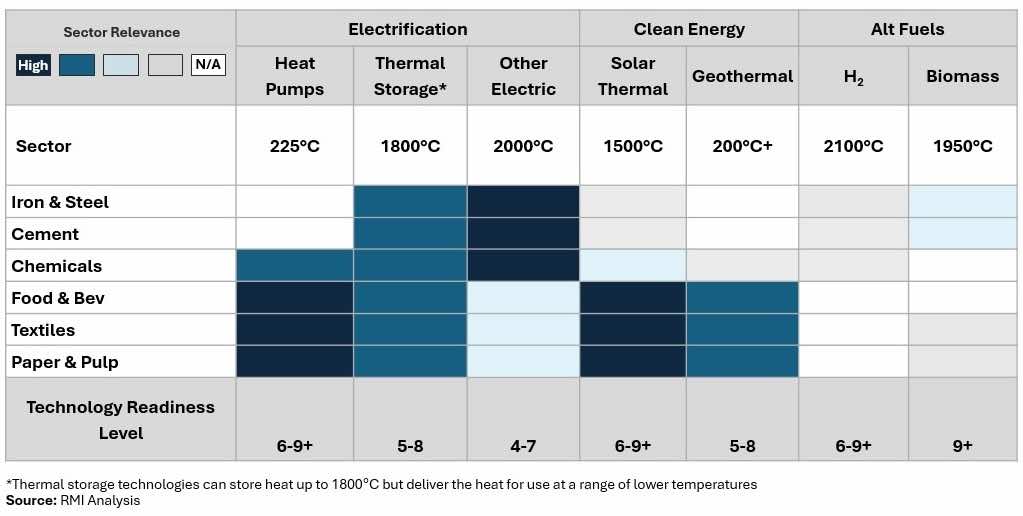
Clean industrial heat (thermal energy from renewable or zero-emission sources) is increasingly cost-competitive and can be tailored to local energy conditions. It can be delivered via electrified systems such as heat pumps and thermal batteries or come directly from solar and geothermal. Exhibit 2 matches these categories of clean industrial heat technologies with the heat grades required by various sectors. These technologies largely reduce operating costs and exhibit better efficiency (95%–500%+) compared to fossil boilers and furnaces (75%–85%). They can also be co-located with cheap renewable energy production, avoid the price volatility of imported energy, and enable faster permitting and siting in cases where traditional combustion fuels would pose pollution concerns.
Exhibit 2 : Applicability of renewable thermal solutions by sector based on maximum heat grade potential and efficiency
Having an expansive renewable thermal toolkit is critical for Africa’s emerging industrial hubs, as there is no one-size-fits-all clean heat solution. The ideal mix of technologies will depend on process demands, access to cheap renewable energy, and reliance on fossil fuel imports, all three of which vary significantly across the continent.[12] Here, we consider Kenya and Nigeria as two example countries with differing pathways for adopting renewable thermal solutions.
In Nigeria, where almost half of industrial emissions are from low temperature industrial heat, primarily in the food and beverage and textile sectors,[13] industrial heat pumps are one mature technology that can reduce reliance on biomass, natural gas, or even diesel as heat sources. However, the grid is especially unreliable, and so companies often plan their own decentralized energy resources and backup systems alongside new facilities. In this scenario, a thermal battery may be especially useful. Factories can store up heat when power is available and use it later — especially useful in locations where a large amount of electricity is available that would otherwise be destined for curtailment.
In Kenya, nearly half of industrial heat comes from burning coal.[14] Paradoxically, the grid is 90% renewable, and special economic zones are encouraging co-development of industry and geothermal energy potential. The food and beverage sector dominates manufacturing output and could make quick strides through electrification via heat humps or by direct use of heat from domestic geothermal resources already under development by the power sector.[15]
Promising innovation areas
Technologies within the renewable thermal toolkit can be utilized alone or in combination with one another to meet rising heat demands. Different processes within a single factory often require heat at different pressures and temperatures. Exhibit 3 maps several solutions to the temperature they can reach, and thus the industries they can serve. This section provides an overview of several technologies we think are the best fits for Africa today: heat pumps, thermal batteries, direct electrification, and solar thermal. Alternative combustion fuels such as hydrogen and biomass could also be part of the solution; however, they are harder to deploy without considering more specifics about the industrial process and surrounding geography.
Exhibit 3:
Innovation Area 1: Heat Pumps
Technology and Application: Industrial heat pumps deliver heat in the form of hot water or steam and can be implemented as air-sourced units or increase efficiency by sourcing heat from water, the ground, or available waste heat streams. Heat pumps capable of producing hot water or steam at <120°C are widely available today, with higher temperature models capable of up to 160°C steam crossing the barrier from demonstration to commercial readiness over the past few years.[16] New designs are currently being piloted that can deliver even hotter steam, at up to 250°C. While this likely represents a near-term limit for existing heat pump designs, it’s possible that future designs could deliver much higher process heat temperatures.[17]
Heat pumps are particularly suited for processes like drying, washing, sterilization, and pasteurization found in the food and beverage and textile industries, although emerging variations can be used for higher temperature processes in the chemicals and the paper and pulp sectors.[18] Heat pumps can be configured for factories already operating today, plugging in to existing centralized steam systems. New plants with lower temperature requirements can plan ahead to reap the efficiency gains of just using cheaper hot water instead of steam.
Performance: Industrial heat pumps can achieve high coefficients of performance (COPs). The COP is the ratio of thermal output to electrical energy input, and can range from 2 (200% efficient) to 5+ (500% efficiency) depending on the overall temperature lift. This can result in significant opex savings compared to electric boilers (95% efficient) and fossil boilers (85% efficient). In regions that are capable of very cheap on-site renewable electricity, including India, heat pumps are theoretically capable of providing heat at delivered costs of approximately $14/MWhth and $22/MWhth at <100°C and 100°C–200°C respectively.[19] Recent estimates for high temperature heat pumps in South Africa powered by photovoltaics (PV) estimate delivered heat costs of $50/MWhth.[20]
Availability: Systems that can deliver heat up to 120°C are widely available with manufacturers and installers heavily concentrated in the EU, China, Japan, and India. Commercial models up to 160°C are available, but from more specialized manufacturers. Multiple startups are working to push the envelope of high temperature heat pumps up to 200°C+ and pilot their technologies.
Kenya/Nigeria Context: The viability of heat pumps is strongly tied to the effective cost of electricity versus fossil fuels (i.e., the “spark spread”). Kenya’s cleaner grid enhances the climate benefits. The ability to pair pumps with solar thermal, geothermal, and solar PV could further reduce operating costs and efficiencies in a region with sufficient domestic resources.[21] Nigeria has a large manufacturing footprint in the food and beverage and textiles industries with thermal energy requirements in the range of heat pumps. Though electrification for industry generally is hampered by Nigeria’s unreliable grid,[22] high efficiencies and potential for tri-generation (heating, electricity generation, and cooling) could make heat pumps an ideal solution when sourced from reliable hybrid or minigrid systems, particularly for consumers who cannot reliably procure large volumes of natural gas, oil, or diesel.
Innovation Area 2: Thermal Batteries
Technology and Application: Thermal batteries store heat generated from electricity or other heat sources (like solar thermal or waste heat) for later use in industrial processes.[23] These batteries use storage materials with high heat capacity and thermal conductivity, such as graphite, crushed rock, bricks, or thermochemical media, covering a wide temperature spectrum up to 1800°C. Some startups are working to push the upper temperature limits even higher. Thermal batteries can enable industries to shift electricity consumption to off-peak hours or absorb surplus electricity generation. If coordinated at scale with utilities via dynamic pricing or demand response programs, this battery mechanism can enable the grid to better utilize existing transmission and distribution infrastructure and reduce renewable curtailment. This would spread the fixed costs borne by all grid customers over a larger total market and reduce the associated charges on customers’ bills.
Performance: By storing energy at up to 1800°C, thermal batteries can satisfy the heat requirements for most industrial processes. This can be done at prices cheaper than conventional fossil sources by charging during the cheapest two to eight hours of the day when wholesale electricity costs can reach low or negative price levels. This is happening today in geographies with high renewable curtailment, such as Chile,[24] Brazil, and Australia. Countries like South Africa are expecting renewable curtailment to grow soon.[25] The value of grid services that thermal batteries can provide is also determined by the tariff structures and demand response incentives available in a given location. Because of variation in energy and capital costs, the delivered cost of heat from thermal batteries can range from $20–$80/MWhth or higher.[26]
Availability: Thermal battery startups are beginning to deploy commercial pilots for low to medium temperature industrial heat (500°C and below; Kraftblock, Antora Energy, Rondo Energy)[27] while others are targeting higher temperature process heat delivery up to 1000°C.[28] Lower temperatures are easier to provide with today’s technologies, as higher temperatures can worsen material degradation and complicate heat delivery. Many thermal battery providers have announced plans to address higher temperature process heat as these issues are solved. For the highest temperature applications (>1000 °C) in the cement and steel sectors, startups would need to streamline integration in highly complex facilities and meet high heat delivery requirements (>100 MWth) that outpace the heat rates of today’s thermal batteries.
Kenya/Nigeria Context: The variable renewable energy share in Kenya is growing[29] and the Nigerian grid experiences intermittent power supply as transmission and market bottlenecks stall generator capacity. The need to only charge two to eight hours per day could turn grid intermittency or dynamic supply into an advantage for thermal batteries, enable the deployment of more renewables, and allow for 24/7 electrification of process heat without the need to connect into the grid at all in a captive power or minigrid scenario.
Innovation Area 3: Direct Electrified Heating
Technology & Application: Several methods have been developed to directly convert electricity to high temperature process heat at temperatures up to 2000°C. These technologies can be classified into two categories: 1) direct substitute for existing combustion equipment such as boilers, crackers, and kilns; and 2) new processes for producing a commodity such as steel (electric arc furnaces) or cement (electric arc calciner) that go beyond simply replacing combustion equipment.
The technologies being developed to produce electrified high temperature process heat include:[30]
- Resistance heating: Heat generated by passing current through a resistive material.
- Arc heating: High energy electrical arc created between two electrodes carrying current.
- Turbine Heating: Reverse gas turbine systems that use electricity to turn turbine blades to create very high temperature process gas.
- Induction heating: Electromagnetic induction is used to heat materials internally.
- Dielectric heating: High-frequency electromagnetic fields used to heat materials.
Performance: Like thermal batteries, direct electrification solutions produce clean heat during the hours when electricity prices are cheap or integrate separate battery energy storage systems to deliver 24/7 heat. While complete electrification today may be challenging due to grid instability and renewables intermittency, there’s often potential for a “mixed fuel” approach to meeting heating demands. It’s possible to co-locate renewables and thermal batteries to electrify a fraction of heat demand while still relying on some amount of traditional combustion fuels for times when electricity prices are high or on-site renewables production is low. This approach has been shown to be cheaper than pure 100%-electricity or 100%-combustion configurations across many geographies because a hybrid approach can hedge against fluctuations in energy price and availability.[31]
Availability: Conventional technologies like electric boilers (using resistance or induction) and electric arc furnaces are widely available. Multiple startups are beginning to pilot solutions for process heat at 800°C and above in the cement and chemicals sectors, in partnership with major producers around the globe (Coolbrook [turbine],[32] SaltX [arc][33]).
Kenya/Nigeria Context: Kenya’s abundant renewable resource potential could help to provide the baseload renewable electricity needed to support direct electrification. Nigeria’s reliance on natural gas, particularly for large manufacturers in the cement, steel, and chemicals sectors, makes widespread high-temperature electrification challenging, however partial electrification could be cost competitive in the near term.
Innovation Area 4: Solar Thermal with Thermal Storage
Technology & Application:
Solar thermal systems capture solar radiation to generate heat directly. Technology selection varies by process temperature requirements:
- Non-concentrating collectors (flat plates, evacuated tubes) are suitable for low temperatures (<100°C), primarily water heating for washing, drying, or pre-heating.
- Concentrating Solar Power (CSP) technologies, like parabolic troughs or linear Fresnel reflectors, achieve medium temperatures (up to approximately 400°C–600°C) suitable for generating industrial steam, which covers the food & beverage, textiles, pulp & paper sectors, as well as some of the chemicals sector.
- High-concentration systems like solar power towers or parabolic dish systems can reach much higher temperatures (up to 1,500°C).[34]
Thermal storage systems can then store the solar thermal heat, enabling 24/7 process heat delivery.[35] Molten salt storage has been the conventional storage media, but this approach has limitations for high temperature heat storage. Many alternatives with lower cost and higher performance are being developed, including:
- Sensible Storage: Energy stored as temperature difference in solid material/particles. Novel molten salts, particles, packed-bed thermocline, and liquid metals.
- Latent Storage: Energy stored using phase change materials (i.e. isothermal phase transition)
- Thermochemical Storage: Energy stored in chemical bonds (reversible chemical reactions)
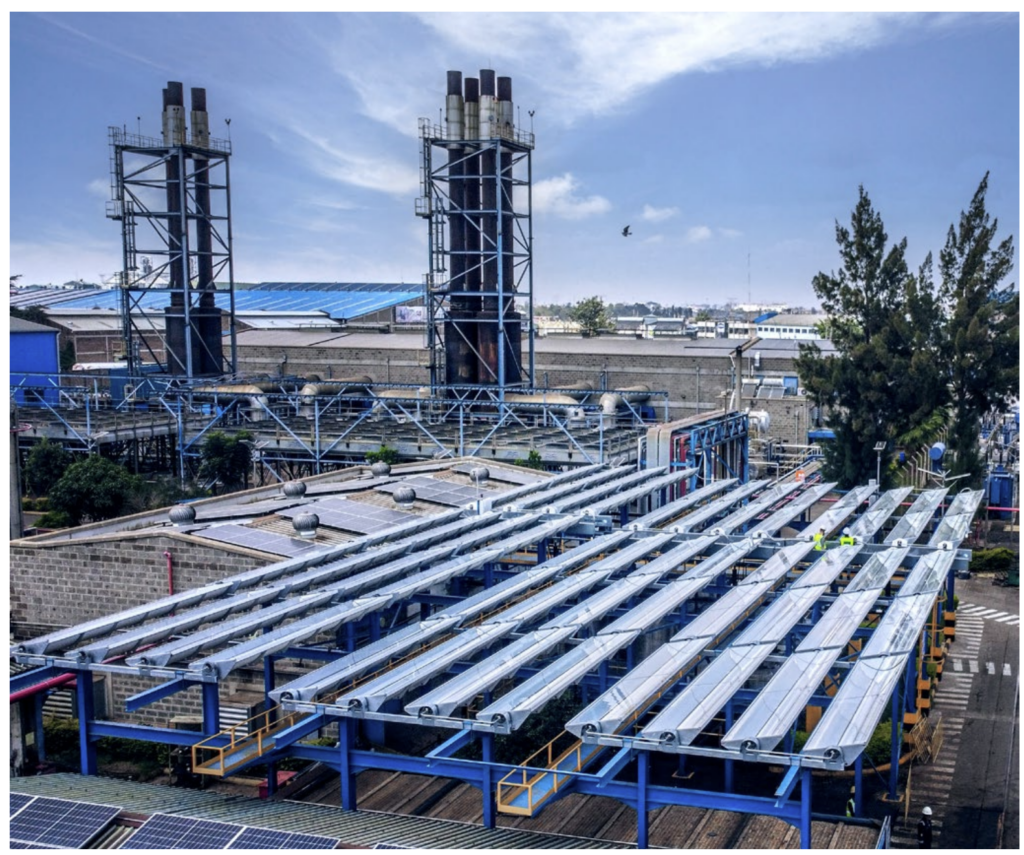
230 kW Absolicon solar thermal installation providing 95°C heat for fluid pre-heating at a peaker power plant in Nairobi, Kenya. Photo: Absolicon.[36]
Performance: CSP costs have fallen by 70% from 2010 to 2022,[37] and producers have made major strides in high temperature concentrating solar and thermal storage. Directly using heat from the sun for thermal loads avoids the energy penalty of converting heat to electricity. The total levelized cost of heat of solar thermal solutions depends on the amount of solar irradiance available in a location, technology choice, scale, and financing costs, though on average solar heat costs range from $20–$50/MWhth globally.[38] Adding in storage adds some cost in the range of approximately $20–$25 per MWhth which could go lower with new storage systems/materials.[39]
A major hurdle for CSP is that capital costs are especially high, and thus the cost benefits of direct solar heat are especially sensitive to financing costs. In many circumstances, combining PV and electricity storage with heat pumps can be a cheaper solution for low temperature process heat. In some cases, combining solar thermal, PV, and heat pumps can often result in a system that is cheaper than one or the other.[40]
Availability: Non-concentrating and medium temperature concentrating solar power solutions are commercially available globally and have been deployed widely for decarbonizing process heat below 400°C.[41] Multiple startups have pilots ongoing to provide higher temperature process heat, and some produce solar fuels.[42]
Kenya/Nigeria Context: Conventionally, CSP requires high solar irradiance , usually in the range of 1400 (3.83) to 2500 (6.84) kWh/m²/year (day) to be competitive. Much of Kenya eclipses the 2000 kWh/m²/year threshold, making it highly viable for solar thermal plus storage. Kenya in particular has begun to integrate solar thermal for industrial process heat with roughly a gigawatt of solar thermal power to provide industrial heat for leather production, agriculture, and mining/quarrying.[43] Recently, Absolicon commissioned a 180 kW / 1 MWh concentrating solar thermal with storage installation for tea drying in Kenya which conventionally relies on the burning of firewood,[44] leading to large swaths of native forests being converted into fuel for heating. In Nigeria, solar potential varies from the cloudier south to the sunnier north, with the latter being the place where solar thermal is viable.[45]
Pathways to Scale
Overcoming the capex premium with innovative financing and heat-as-a-service:
The up-front investment required for renewable heat technologies is higher than conventional combustion alternatives, which tend to be cheaper up front but more expensive to operate in the long run. Heat pumps are roughly 3–4 times as expensive as gas boilers on a dollar per kilowatt basis. Many renewable thermal projects require payback periods of 5 years or more with many pushing beyond a decade.[46]
Retrofits have special challenges of their own, as engineers seek to avoid significant process redesigns and changes to infrastructure, which can significantly raise total project costs compared to the cost of the renewable thermal devices alone. For example, retrofitting a heat pump to better utilize a waste heat stream requires a match between the volume and timing of heat available in the source and required by the destination. Waste heat stream matching (whether for heat exchangers or heat pumps) is a common design practice for chemical engineers but is much more challenging when the pipes have already been run.
To combat the up-front investment requirements, heat-as-a-service (HAAS) has become a popular business model for many renewable thermal technology developers. HAAS allows customers to continue to pay for thermal energy as they always have while preserving their capital for other uses. This enables many industrial heat purchasers to adopt renewable thermal technologies who otherwise would not due to the long payback periods.
In Africa, companies are facing scarce capital and a mis-calibrated “Africa risk premium” that would prevent many from adopting the solutions described here.[47] The HAAS model is one approach to reducing the barrier for heat customers, but the fundamental capex challenge remains (even if it has been relocated to the heat provider’s balance sheet). This challenge will not be solved without intentional action to lower capital costs and raise availability. In our 2025 report The Opportunity for Emergent Climate Tech in Africa,[48] we suggest multiple pathways for addressing this problem, including:
- Creating a low-interest local currency debt facility for climate tech deployments
- Building a shared investor de-risking service to decrease the perception of risk by lenders
- Building a consortium of corporate deployment partners and buyers to reduce offtake risk and identify beachhead customers on the continent
- Providing project development support for especially complex, first-of-a-kind deployments
Lowering the Spark Spread by improving access to cheap electricity
Abundant, low-cost electricity must be available, or built, for electric thermal technologies to outcompete fossil fuel alternatives. Spark spread is a helpful economic indicator for using electricity and fossil fuels directly for thermal energy. The spark spread can be calculated by dividing electricity cost per MWh by the fuel cost per MWhth. Because many renewable thermal technologies have an efficiency of approximately 100%, a spark spread greater than one can favor the fuel, while less than one favors electricity, purely on energy cost terms (ignoring efficiency differences and capital costs). Because they move heat rather than generating it, heat pumps are the exception: a spark spread between two and three can favor the heat pump under a wide range of circumstances.
As an example, in Kenya, coal is the primary fuel for industrial heat but the electricity grid is 90% clean. Kenya’s electricity prices have hovered around $90–115/MWh. The cost of imported coal will vary, but around $100/T (roughly $90/ MWhth) wouldn’t be uncommon. This yields a spark spread of roughly one, easily favoring heat pumps on a cost basis. This shows how the simple spark spread can help stakeholders consider electrification costs against fuel counterfactuals, and weigh technology options or electricity procurement strategies accordingly. It also shows how the balance will tilt increasingly toward electric thermal technologies as cheap power becomes more available.
Industrial policy can help make renewable thermal technologies the default option for new or re-tooling factories
Policymakers help set the context within which developers and manufacturers are making plans for greenfield plants and upgrading existing infrastructure. There is a lot they can do to reduce the barriers to adopting renewable thermal heat sources.
Green industrial zoning is a powerful tool that can help address both the capex premium and electricity availability challenges referenced above. These zones intentionally co-locate energy producers and users in a low-friction industrial environment. Kenya’s Green Energy Park is a lighthouse example,[49] which aims to offer energy-intensive industries access to firm geothermal electricity, as well as heat for direct industrial use. Where geothermal steam or hot brine can be delivered at the right temperature and pressure, factories may be able to use it directly. Where it cannot, renewable thermal technologies such as industrial heat pumps or thermal storage can upgrade or manage that heat for industrial processes.In turn, the factory can serve as an anchor offtaker for the power producer, bolstering the bankability (and potentially lowering the financing cost) for both energy supplier and energy user.
These zones can also make it easier to do business. The Green Energy Park has a clearly defined investor onboarding process. These zones can also concentrate government regulatory and permitting attention on a priority set of projects, helping agencies move these projects along without significant delay, while also keeping a close eye on how novel technologies or industries are developing and complying with the law.
Endnotes
[1] “Africa’s Green Manufacturing Crossroads: Choices for a Low-Carbon Industrial Future,” McKinsey, 2021, https://www.mckinsey.com/capabilities/sustainability/our-insights/africas-green-manufacturing-crossroads-choices-for-a-low-carbon-industrial-future. ↩︎
[2] “The Opportunity for Emergent Climate Tech in Africa,” RMI, 2025, https://rmi.org/insight/emergent-climate-tech-africa/. ↩︎
[3] “The African Leaders Nairobi Declaration on Climate Change and Call to Action,” African Union, 2023, https://www.afdb.org/sites/default/files/2023/09/08/the_african_leaders_nairobi_declaration_on_climate_change-rev-eng.pdf. ↩︎
[4] Meselu Tegenie Mellaku et al., “Decentralized Renewable Energy Technology Alternatives to Bridge Manufacturing Sector Energy Supply-Demand Gap in East Africa: A Systematic Review of Potentials, Challenges, and Opportunities,” Renewable and Sustainable Energy Reviews 216, (2025): 115708, https://doi.org/10.1016/j.rser.2025.115708. ↩︎
[5] “Low-Cost, Reliable Electricity for Nigerian Businesses: Nigeria’s First DisCo-Enabled Hybrid Solar Project,” RMI, accessed 2026, https://rmi.org/low-cost-reliable-electricity-for-nigerian-businesses-nigerias-first-disco-enabled-hybrid-solar-project/. ↩︎
[6] “Fast, Efficient Solutions to Meet Electricity Demand Growth,” RMI, accessed 2026, https://rmi.org/fast-efficient-solutions-to-meet-electricity-demand-growth/. ↩︎
[7] “The Opportunity for Grid Connectivity, Intelligence, and Flexibility in Africa,” RMI, accessed 2026, https://rmi.org/the-opportunity-for-grid-connectivity-intelligence-and-flexibility-in-africa/. ↩︎
[8] “Efficiency and Demand: Africa,” IEA, accessed 2025, https://www.iea.org/regions/africa/efficiency-demand. ↩︎
[9] McKinsey, “Africa’s Green Manufacturing Crossroads,”2021. ↩︎
[10] “Energy Security in an Insecure World,” Ember, 2025, https://ember-energy.org/app/uploads/2025/04/Slidepack-Energy-Security-in-an-Insecure-World.pdf. ↩︎
[11] Jing Cheng et al., “Trade Risks to Energy Security in Net-Zero Emissions Energy Scenarios,” Nature Climate Change 15 (2025): 505–513, https://doi.org/10.1038/s41558-025-02305-1. ↩︎
[12] Yacob Mulugetta et al., “Africa Needs Context-Relevant Evidence to Shape Its Clean Energy Future,” Nature Energy 7 (2022): 1015–1022, https://doi.org/10.1038/s41560-022-01152-0. ↩︎
[13] “NESG Manufacturing Policy Brief,” Nigerian Economic Summit Group, accessed 2025, https://www.nesgroup.org/research/publication/nesg-manufacturing-policy-brief. ↩︎
[14] “Efficiency and Demand: Kenya,” IEA, accessed 2025, https://www.iea.org/countries/kenya/efficiency-demand. ↩︎
[15] “Kenya Country Analytics,” UNIDO Statistics Portal, accessed 2025, https://stat.unido.org/analytical-tools/country-analytics?country=404&codes=OTH_,MI_OTH. ↩︎
[16] “Project 68: Industrial High-Temperature Heat Pumps,” IEA Technology Collaboration Programme on Heat Pumping Technologies (HPT TCP), accessed 2026, https://heatpumpingtechnologies.org/project68/. ↩︎
[17] JunSoo Yoo, Carlos E. Estrada-Perez, and Byung-Hee Choi, “Investigation of Heat Pump Technologies for High-Temperature Applications above 250 °C,” Applied Energy 384 (2025): 125384, https://doi.org/10.1016/j.apenergy.2025.125384. ↩︎
[18] Jeffrey Rissman, “Decarbonizing Low-Temperature Industrial Heat in the U.S.” Energy Innovation, 2022, https://energyinnovation.org/report/decarbonizing-low-temperature-industrial-heat-in-the-u-s/. ↩︎
[19] Sonali Deshpande et al., “Electrifying Industrial Heat in India”, Energy Innovation, 2026, https://energyinnovation.org/report/electrifying-industrial-heat-in-india/. ↩︎
[20] J. Koke, F. Rozon, and C. McGregor, “Analysing the Techno-Economic Viability of Different Solar Heating Systems in South African Beverage Plants,” International Sustainable Energy Conference – Proceedings 1 (2024), https://doi.org/10.52825/isec.v1i.1227. ↩︎
[21] Josué F. Rosales-Pérez et al., “Hybrid System of Photovoltaic and Solar Thermal Technologies for Industrial Process Heat,” Energies 16, no. 5 (2023): 2220, https://doi.org/10.3390/en16052220. ↩︎
[22] María Yetano Roche et al., “Achieving Sustainable Development Goals in Nigeria’s Power Sector: Assessment of Transition Pathways,” Climate Policy 20, no. 7 (2020): 846–865, https://doi.org/10.1080/14693062.2019.1661818. ↩︎
[23] Ankur Dass et al., “Thermal Batteries: Electrifying Heating in Chemical Plants,” RMI, 2024, https://rmi.org/thermal-batteries-electrifying-heating-in-chemical-plants/. ↩︎
[24] “Reducing Curtailment in Chile: Key to Unlock the Full Potential of Renewable Energy,” Ember, 2025, https://ember-energy.org/latest-insights/reducing-curtailment-in-chile-key-to-unlock-the-full-potential-of-renewable-energy/. ↩︎
[25] “GCCA 2025 Update: Integrating Congestion Curtailment Capacity”, National Transmission Company South Africa, 2025, https://www.ntcsa.co.za/wp-content/uploads/2025/11/27.1-GCCA_2025_Update_31102025_publish.pdf. ↩︎
[26] “The Renewable Thermal Vision Report”, Renewable Thermal Collaborative, 2022, https://www.renewablethermal.org/vision/; and Kathleen Spees et al., “Thermal Batteries: Opportunities to Accelerate Decarbonization of Industrial Heating”, Brattle Group, 2023, https://www.renewablethermal.org/tes-assessment-report/. ↩︎
[27] “Kraftblock replaces a 25 MW gas boiler with Net-Zero Heat System”, Kraftblock, accessed 2025, https://www.kraftblock.com/projects/volt; “Antora Energy Turns on First Thermal Battery”, Axios, September 13, 2023, https://www.axios.com/pro/climate-deals/2023/09/13/antora-energy-turns-on-first-thermal-battery; and “Rondo Energy Turns on First Major Thermal Battery — at an Oil Field”, Canary Media, October 2025, https://www.canarymedia.com/articles/clean-industry/rondo-first-big-heat-battery-oil-california. ↩︎
[28] “NOC Energy: How it Works”, NOC Energy, accessed 2026, https://www.nocenergy.com/how-it-works. ↩︎
[29] “Preliminary Roadmap for Industrial Decarbonization – Kenya 2024”, Industrial Energy Accelerator, 2024, https://decarbonization.unido.org/wp-content/uploads/2024/07/preliminary-roadmap-for-industrial-decarbonization–kenya-2024.pdf. ↩︎
[30] “Green Electrification for Indian Industries,” Ember, accessed 2025, https://ember-energy.org/latest-insights/india-green-electrification-for-indian-industries/. ↩︎
[31] “Net-Zero Electrical Heat: A Turning Point in Feasibility”, McKinsey, 2024, https://www.mckinsey.com/capabilities/sustainability/our-insights/africas-green-manufacturing-crossroads-choices-for-a-low-carbon-industrial-future. ↩︎
[32] “UltraTech to leverage Coolbrook’s innovative electric technology for accelerating decarbonization”, UltraTech Cement, 2022, https://www.ultratechcement.com/corporate/media/press-releases/ultratech-to-leverage-coolbrook-s-innovative-electric-technology-for-accelerating-decarbonization. ↩︎
[33] “SaltX and Dalmia Cement have started initial work on a pilot plant for electric cement production in India”, SaltX, 2023, https://www.saltxtechnology.com/cision/saltx-and-dalmia-cement-have-started-initial-work-on-a-pilot-plant-for-electric-cement-production-in-india/. ↩︎
[34] “How can Synhelion’s solar receiver achieve such high temperatures?”, SolarPACES, 2023, https://www.solarpaces.org/how-does-synhelions-solar-receiver-achieve-such-a-high-temperature/. ↩︎
[35] Muhammad Imran Khan, Faisal Asfand, and Sami G. Al-Ghamdi, “Progress in Research and Technological Advancements of Thermal Energy Storage Systems for Concentrated Solar Power,” Journal of Energy Storage 55 (2022): 105860, https://doi.org/10.1016/j.est.2022.105860. ↩︎
[36] “World Wide Projects: Industrial Solar Thermal”, Absolicon, Accessed 2025, https://www.absolicon.com/wp-content/uploads/2025/12/Absolicon_Brochure_REFERENCE_250221_spreads.pdf. ↩︎
[37] “Cost of Concentrated solar power (CSP) projects fell from USD 0.38/kWh to USD 0.118/kWh – a decline of 69%”, HELIOSCSP, 2023, https://helioscsp.com/cost-of-concentrated-solar-power-csp-projects-fell-from-usd-0-38-kwh-to-usd-0-118-kwh-a-decline-of-69/. ↩︎
[38] “Solar Heat Worldwide 2024”, IEA Solar Heating and Cooling Programme (IEA SHC), 2024, https://www.iea-shc.org/Data/Sites/1/publications/Solar-Heat-Worldwide-2024.pdf. ↩︎
[39] Khan, Progress in Research and Technological Advancements of Thermal Energy Storage Systems for Concentrated Solar Power, 2022. ↩︎
[40] Rosales-Pérez, “Hybrid System of Photovoltaic and Solar Thermal Technologies for Industrial Process Heat,” 2023. ↩︎
[41] IEA, “Solar Heat Worldwide 2024,” 2024. ↩︎
[42] “Solar Fuels from Concentrated Sunlight”, SolarPACES, https://www.solarpaces.org/wp-content/uploads/solar_fuels.pdf. ↩︎
[43] “SHIP Database (Solar Heat for Industrial Processes),” AEE INTEC, accessed 2025, https://energieatlas.aee-intec.at/index.php/view/map?repository=ship&project=ship_edit. ↩︎
[44] “Commissioned Solar Heat from Absolicon to Combat Drought and Emissions in Kenya”, Absolicon, 2024, https://www.absolicon.com/commissioned-solar-heat-from-absolicon-to-combat-drought-and-emissions-in-kenya/. ↩︎
[45] “Solar Heat Worldwide 2025 Report,” Solar Heat Europe, accessed 2025, https://solarheateurope.eu/market/market-data/global-data/. ↩︎
[46] Rissman, “Decarbonizing Low-Temperature Industrial Heat in the U.S.,” 2022. ↩︎
[47] “More Money, Fewer Problems: Closing Africa’s Climate Finance Gap”, Boston Consulting Group, 2024, https://www.bcg.com/publications/2024/more-money-fewer-problems-closing-africas-climate-finance-gap. ↩︎
[48] RMI, “The Opportunity for Emergent Climate Tech in Africa,” 2025. ↩︎
[49] “Green Energy Park,” KenGen, accessed 2025, https://greenenergypark.kengen.co.ke/. ↩︎



Related Insights

The Opportunity for Distributed Green Fertilizer in Africa
The Opportunity for Green Cement and Concrete in Africa
Help build the clean energy future. Donate today.
Independent research. Real-world solutions. Supported by donors.
RMI can pursue the highest-impact climate and energy solutions because we’re supported by people who believe change is possible. Every gift helps advance the work needed to make clean energy the default choice worldwide.
For other ways to give to RMI, including checks or gifts of stock, please visit Other Ways to Give.