

Learn how we are working to transform how we use and produce energy.
Paying for Clean Building Materials with C-PACE
A few small updates to Commercial Property Assessed Clean Energy (C-PACE) financing rules could unlock billions of dollars of investment in low-embodied-carbon American-made building materials
Why we share this work for free
RMI is an independent nonprofit working to accelerate the clean energy transition. We publish research like this to inform decision-makers and drive real-world impact.
Our work is supported by philanthropy as well as partnerships, including fee-for-service engagements. This support makes it possible for us to share our independent insights for free.
If you find this work valuable, you can support it anytime.
Get more insights like this
Stay up to date with the latest research, analysis, and tools from RMI by opting in to receive occasional emails below. You’ll get new reports, event invitations, and practical insights to help us all accelerate the clean energy transition.
Loading form...
Your download should start automatically. If it doesn’t, click the download button below.
This work is made possible by philanthropy
RMI is a nonprofit supported by donors and partners. Philanthropy enables us to produce independent research and make resources like this freely available.
If you find this report valuable, please consider supporting our work. You can also explore how we partner with organizations to drive impact.
Jump to Section
Key takeaways:
- Commercial Property Assessed Clean Energy (C-PACE) loan programs have enabled $9 billion of dollars of low-cost financing for clean energy and energy efficiency measures in commercial real estate in 25 US states and cities.
- A few small tweaks to C-PACE financing rules could unlock billions of dollars of investment in clean, low-embodied-carbon materials and construction practices.
Clean building materials: A material public benefit
Construction materials are a major source of pollution. Cement production alone accounts for 8 percent of global CO₂ emissions and is the third-largest source of industrial air pollution such as sulfur dioxide, nitrogen oxides (NOx), and carbon monoxide. Steel is another major emitter. Switching to low-embodied-carbon materials and material-efficient design practices reduces pollution. Low-embodied-carbon concrete, steel, mass timber, insulation, and other materials improve air quality, create jobs, and support domestic manufacturing.
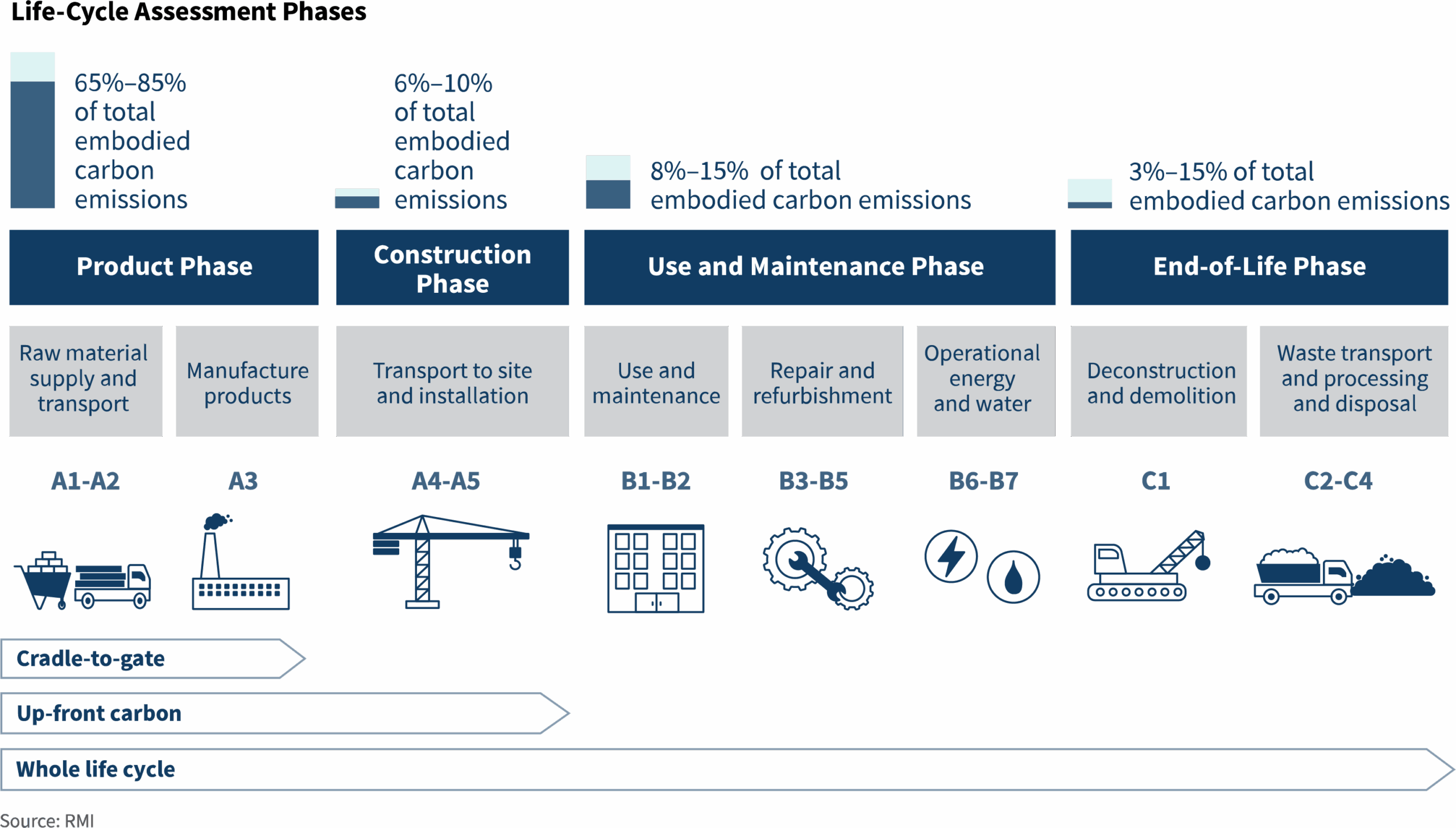
Phases of Whole-Building Life-Cycle Assessments. Embodied carbon assessments typically cover “cradle to gate” stages (modules A1–A3).
Paying for clean materials
State and city governments across the United States are implementing embodied carbon codes, zoning laws, and procurement policies to drive adoption of cleaner materials. However, financial incentives are needed to accelerate this shift. Commercial Property Assessed Clean Energy (C-PACE) loans could speed investments in clean materials.
PACE: Private payments, public benefit
Property Assessed Clean Energy (PACE) loan programs are a modern financial innovation with historical roots dating back to 1736 when Benjamin Franklin established Philadelphia’s first opt-in fire district. Property owners paid a subscription fee to support a local firefighting company, a model that evolved into today’s property tax-funded municipal fire departments.
In 2008, Berkeley, California, pioneered PACE by allowing homeowners to finance solar installations with no up-front costs, paying through an assessment charge on their property tax bill. Since then, C-PACE programs have been enacted in 40 states and the District of Columbia, unlocking over $9 billion in financing for energy efficiency, electrification, and resilience upgrades across 25 states.
C-PACE: A triple win for owners, lenders, and government
C-PACE payments are collected using government property tax systems. In cases of default, these payments are prioritized above private debt, reducing lender risk. This enables lower interest rates, ultimately lowering developers’ cost of capital.
Like Franklin’s fire insurance company, which required property owners to install trap doors for fire access and make other fire safety improvements, modern C-PACE programs mandate that property owners meet energy performance criteria — such as exceeding IECC 2021 energy code standards — to qualify for financing. Energy-efficient buildings powered by clean energy provide communal benefits such as improved occupant health, resilience against extreme temperatures, and reduced energy infrastructure needs.
From clean energy to clean materials
Most C-PACE programs were established before embodied carbon data was widely available. Today, Environmental Product Declarations (EPDs) and standardized Whole Building Life Cycle Assessments provide transparent and reliable ways to track the environmental impact of building materials.
Because embodied carbon is a good proxy for embodied energy, procuring low-embodied-carbon materials and reducing material use should be classified as “energy improvements” in C-PACE programs.
Paving the way for clean materials in C-PACE
C-PACE administrators can straightforwardly update program guidelines to explicitly allow financing for low-embodied-carbon materials and material-efficient design and construction practices. These updates can build on policy language used in federal and state Buy Clean policies, the new CALGreen embodied carbon code rules, and voluntary green building certifications such as LEED. C-PACE program guidelines can reward two key embodied carbon reduction actions:
- Material-Specific: Procuring materials with global warming potentials below regional targets.
- Whole-Building: Demonstrating a reduction in whole-building embodied carbon using a Whole-Building Life Cycle Assessment.
Sizing the Incentive
Many C-PACE programs limit the total amount of financing available for C-PACE eligible measures on a given project. Developers often spend more on energy efficiency and clean energy than this limit. Increasing the financing available to developers for these measures is a strong incentive because it reduces developers’ cost of capital.
C-PACE programs can incentivize clean materials and materially efficient design and construction by increasing financing limits on projects which demonstrate embodied carbon reduction (e.g., from 25 to 30 percent). For programs where guideline or statute limitations prevent direct financing of embodied carbon reduction measures, an increase in the C-PACE financing limit is still a strong incentive because the total costs of eligible conventional energy efficiency and clean energy improvements often exceed lending limits.
Collaboration on clean materials
Since embodied emissions occur before and during construction, shifting to clean building materials is urgent. Through 2025, RMI will facilitate a C-PACE for Embodied Carbon Reduction Working Group to develop best practices for integrating embodied carbon into C-PACE guidelines nationwide.
To participate, contact: Auri Bukauskas at abukauskas@rmi.org.
Top image: Cross-laminated timber is a low-embodied-carbon structural material used on commercial real estate projects. It is increasingly manufactured in the United States using US-sourced timber. Courtesy of Sterling Structural.


Related Insights
The Opportunity for Heat Pumps to Put Downward Pressure on Electricity Rates
Building Smarter, More Efficient Air Conditioners for Real World Conditions

How Heat Pumps Reduce Energy Bills and Air Pollution in the San Francisco Bay Area
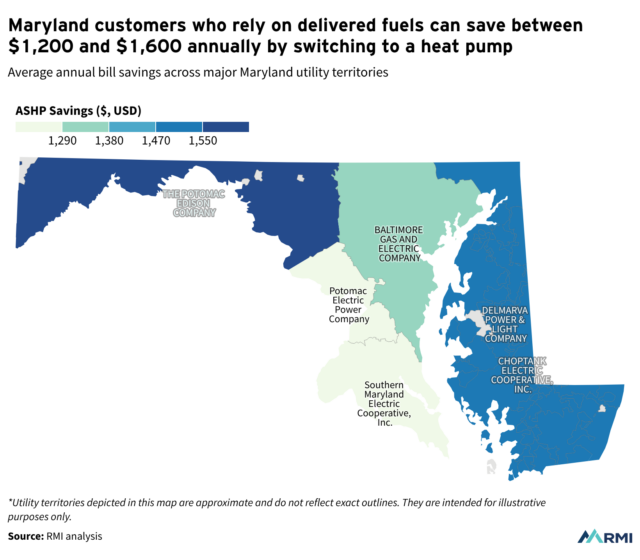
Delivered Fuel Customers in Maryland See Strong Energy Bill Savings in a Switch to Heat Pumps
Help build the clean energy future. Donate today.
Independent research. Real-world solutions. Supported by donors.
RMI can pursue the highest-impact climate and energy solutions because we’re supported by people who believe change is possible. Every gift helps advance the work needed to make clean energy the default choice worldwide.
For other ways to give to RMI, including checks or gifts of stock, please visit Other Ways to Give.
